The Graduate Christian Fellowship together with OHMSI is co-organising for the 1st time in Malaysian history a National Congress on Integrity:
Corruption the Weakest Link. The conference is endorsed by NECF. We expect this 1 day high powered conference to be an opportunity for Christians and concerned citizens in Malaysia to take a stand regarding the issue of corruption in our country and to contribute towards helping shape the national conscience of our land.
We have invited the Prime Minister to give the key note address, failing which Max Ongkili will read the PM's message. We are hopeful that as an outcome all present will sign a pledge on integrity and good governance and that a propose agenda for change be submitted to the PM.
This is an excellent opprtunity for all of us to be involved in something that may be a catalyst to help shape the future of our nation. So do not miss this opportunity!!
How can you help? First pray with us that this conference will be a success.
Second, email this to others whom you think may be interested in this.
Third, come yourself and be part of the experience.
Fourth, sponsor someone whom you think would benefit from attending. The conference is inclusive and people of all faith are welcomed.
Hardcopy brochures and posters will be sent to the churches and christian orgainsations. If you can't access the attached softcopies, the salient information are below:
National Congress on integrity: Corruption the Weakest Link
Venue : Sunway Convention Centre, Sunway
Pyramid
Date : 16 July 1005
time : 9.00 - 6.00pm
Cost : RM100 for GCF/OHMSI members and
early birds
RM125 for regulars
National Congress on Integrity 2005
Corruption the Weakest Link
The National Congress on Integrity 2005 (NCI 2005) is an intense one-day look on t! he effects of corruption on national integrity. It provides a public platform for concerned hearts and minds to engage the issue of corruption in a timely, extensive and inclusive dialogue.
Christian leaders join public, private and third sector leaders to address key issues and explore avenues to effect change. Good case studies on integrity will also be highlighted and public discussions conducted to collate feedback for the Government on related issues.
CONGRESS HIGHLIGHT
9.00am - 9.30am:
Keynote address: Corruption and Its Impact on Nationhood
Speaker: YAB Dato' Seri Abdullah Ahmad Badawi, the Prime Minister of
Malaysia*
PLENARY SESSIONS
9.30am - 9.55am: Moral and Theological Reflections
Speaker: Rt Rev. Dr Paul Tan Chee Ing, Bishop of Malacca-Johore, Catholic
Church
9.55am - 10.20am: Corruption - the Legal Perspective
Speaker: Mr Chooi Mun Sou, Managing Partner, Chooi & Co
10.20 - 10.45am: A Nation in Crisis? Impact and Effect of Corruption on the
Malaysian Society
Speaker: Dr Denison Jayasooria, Executive Director, Yayasan Strategic Sosial
10.45 - 11.15am: Panel discussion and rebuttal
Panel : Dr Chandara Muzzaffar
: Dr Irene Fernandez
: YBhg Dato' Param Cumuraswamy
11.15 - 11.40am Tea Break
11.40 - 12.05pm: Private Sector Experience and Challenges
Speaker: Mr David Wong, Area Vice President, South East Asia and Managing
Director, Malaysia, Tupperware Corporation
12.05 - 12.30pm: Public Sector Experiences and Challenges
Speaker: YBhg Tan Sri Clifford Herbert, former Secretary General of the
Ministry of Finance Malaysia and present Chairman of Percetakan Nasional Bhd
12.30 - 1.00pm: Panel Discussion and rebuttal
Panel : Dr Chandara Muzzaffar
: Dr Irene Fernandez
: Dato' Param Cumuraswamy
1.00 - 2.00pm: Lunch
2.00 - 3.30 pm: Roun! dtable Discussion and Plenary Summing-up of Feedback
- What are the most pressing issues facing the country and what are
the recommendations for action?
3.30 - 3.50 pm: Tea Break
WORKSHOP SESSIONS
3.50 - 5.20 pm: Parallel Workshops on Practical Application and Workable
Alternatives
Workshop A: Citizen Watch by Mr Ernest Balasingam, Citizen Group for Ipoh
Workshop B: A Support System within the Local Church for Mutual
Accountability by Mr Wong Kim Kong, Secretary General, National Evangelical
Christian Fellowship
Workshop C: The Role of an Individual in Promoting Greater Transparency and
Integrity by Dr Denison Jayasooria, Executive Director, Yayasan Strategic
Sosial *
Workshop D: The Role of Corporate Leaders in Enhancing Corporate Governance,
Good Practices in Corporations and Businesses by
YBhg Dato Paul Low, Director of Malaysian Sheet Glass Berhad
Workshop E: The Role of the Ind! ividual Employee in Enhancing Good Behaviour
and Integrity in the Workplace by Mr Cheong Seng Gee, Executive Director,
POD & Exco member, Graduates Christian Fellowship Malaysia
Workshop F: Dealing with Corruption through Proper Channels - Practical Do's
and Don't's *
Workshop G: Transparency for Improved Effectiveness and Governance*
Workshop H: Ensuring Accountability and Efficient Public Spending*
5.20 - 5.45 pm: Pledge Signing Ceremony and Closing of the Congress
* awaiting speakers' confirmation
Tuesday, July 05, 2005


Thursday, June 23, 2005
Packer Gave Me An A-
eCOMMENTARY: Packer Gave Me An A-
GRACE@WORK MAIL 25/05
[June 24th 2005 Edition]
"Take these hands
Teach them what to carry
Take these hands
Don't make a fist
Take this mouth
So quick to criticize
Take this mouth
Give it a kiss
Yahweh, Yahweh
Always pain before a child is born
Yahweh, Yahweh
Still I'm waiting for the dawn"
[Yahweh, by U2]
"Holy, holy, holy, Lord God Almighty!
Early in the morning our song shall rise to thee.
Holy, holy, holy, merciful and mighty!
God in three Persons, blessed Trinity!'
[Holy, Holy, Holy Reginald Heber, John B. Dykes]
Ok. More confession time.
When I was studying in Regent College I had the privilege to do a number of courses under the venerable J. I. Packer. Thing is I received an A- for all my courses with him. I could never break through to get an A. I guess I should be grateful that I never slipped to a B either.
But as most of us discovered, no one in the churches ever bothers to ask what grades you received in bible college. In time you too forget much of the stuff you heard in the classroom lectures. (Hopefully a lot of it gets internalized.)
But there was a phrase that Dr Packer would mention from time to time, a personal theological mantra if you will, that few us will ever forget. Once in awhile Packer would remind us that "the purpose of theology is doxology."
Any true study of God must lead to an encounter that drives us to our knees in wonder and worship.
Trouble is, the study of theology is not very much in vogue these days.
The June 14 2005 issue of the Barna Update had this headline:
"Christians Say They Do Best At Relationships, Worst In Bible Knowledge."
This may merely be a symptom of the age we live in, a lonely time where people hunger for authentic relationships, but also a postmodern time where religion is privatized and experiential rather than historical and truth based.
Are you disturbed by this lack of knowledge of the basic beliefs of our faith? You should.
Christianity is a faith based on revelation.It is a faith that is built on the reality that God has spoken and that what He has spoken to us is contained in the words of the Bible.
However it is critical to bear in mind what theology is for. What happens when we honestly encounter God in the truth that He has revealed to us?
I believe all healthy study of biblical truth must lead to three results. A study of theology must be relational, transformational, and missional.
All true study of theology must be relational. It must draw us closer to God.
Moses had to learn about the true nature of God to be able to approach Him correctly (Exodus 3:1-6). In the end we discover that God is also the Waiting Father (Luke 15:11-32). Doxology indeed!
All true study of theology must be transformational. It must help us become more Christ like. As people of God we are to reflect His character (Matthew 5:43-48).
And it is by imbibing His Word that we grow to be like Him (1 Peter 2:1-3; Romans 12:1-2).
All true study of theology must be missional. It must both inspire and equip one to serve others in the name of Christ. Paul was able to comfort the grieving Christians at Thessalonica with proper theology (1 Thessalonians 4:13-18).
The true servant of God waits to hear a word from God so that he has something to offer to he weary (Isaiah 50:4).
Theology must be relational, transformational, and missional. This is my own mantra about the study of theology albeit a longer and less compact one than Packers', seeing that I don't have his packing skills.
But if the neglect of the study of theology is horrendously dangerous, the relegation of theology to some scholastic exercise that involves only the mind but does not issue forth in worship, Christ likeness and mission, is also dangerously askew.
Many laymen see the study of theology as an exercise of the mastery of certain facts and the jargon that go with it. No wonder they fear that they will be bored to death by theology.
There is the influence of the flesh in us that keeps us from the things of God. This requires repentance and a cry to God to make us hunger after Him. But there is also the need to rescue the study of theology from its academic prison.
Theologian is not a bad word.
Some of us will be called to study the discipline in depth. We will need some mastery of the required languages. We will need to know the history of the development of Christian doctrine. We will need to know the requisite technical terms. We must be aware of the key thinkers in the field. Theologians are specialist thinkers and teachers in service to the church.
But ALL of us need to know God and the things of God. It is sadly ironical that while many shy away from any serious study of the truths of God, many are hungry for a deeper relationship with Him. Many desire to be more like Him. Many are overwhelmed with the needs of the world and hunger for some answers in order to be of help.
We need to let our people know that the proper study of theology, a study with heart as well as mind, will go a long way in addressing their deepest needs. This may explain why Packer's KNOWING GOD continues to be a best seller year after year.
Theology is not some esoteric discipline for the intellectual few. It is God's word of life for all.
I like the way the Lion Handbook of Christian Belief puts it:
"No one lives without beliefs. We all believe something, have some view of what life means. And what we believe affects us deeply; in a real sense we are what we believe. So 'doctrine' and belief are not something to be left to the theorists or the experts. Our understanding of Christianity and our response to it, will be the most crucial thing in our whole lives."
And the true test of the study of theology is not what grades we get.
The true test of theology is what kind of people we become.
Do we become people who are passionately in love with God?
Are we people of holiness and deep compassion?
Do we serve a hurting world with His wisdom?
The people in the pews may be smarter than we think. Perhaps they already know the true test of theological study. They don't care what grades you received in seminary. They want to see what kind of people you are.
It's just that it would have been nice to have gotten an A from Packer just once.
Your brother,
Soo-Inn Tan
Write me!
At:sooinn@graceatwork.org
(If the ecommentaries have been helpful please consider donating to the work. Details below.)
=====================================================================
*Did you find this ecommentary useful?
Forward it to your friends!
*Would you like to join the Grace@Work mailing list to receive future ecommentaries?
Send a blank email to:
graceatwork-subscribe@yahoogroups.com
*Do you need help signing up and/or would you like to write us?
Write us at: sooinn@graceatwork.org
*Would you like to contribute towards the ministry of Grace@Work?
Make cheques/drafts out to:
GRACE AT WORK
and send them to:
Grace@Work,
20M, SS 21/35,
Damansara Utama,
47400 Selangor,
Malaysia
Previous editions of the ecommentaries are archived on the Grace@Work
website at: ( Grace@Work )
Grace@Work: "transforming lives through friendship and scripture"
GRACE@WORK MAIL 25/05
[June 24th 2005 Edition]
"Take these hands
Teach them what to carry
Take these hands
Don't make a fist
Take this mouth
So quick to criticize
Take this mouth
Give it a kiss
Yahweh, Yahweh
Always pain before a child is born
Yahweh, Yahweh
Still I'm waiting for the dawn"
[Yahweh, by U2]
"Holy, holy, holy, Lord God Almighty!
Early in the morning our song shall rise to thee.
Holy, holy, holy, merciful and mighty!
God in three Persons, blessed Trinity!'
[Holy, Holy, Holy Reginald Heber, John B. Dykes]
Ok. More confession time.
When I was studying in Regent College I had the privilege to do a number of courses under the venerable J. I. Packer. Thing is I received an A- for all my courses with him. I could never break through to get an A. I guess I should be grateful that I never slipped to a B either.
But as most of us discovered, no one in the churches ever bothers to ask what grades you received in bible college. In time you too forget much of the stuff you heard in the classroom lectures. (Hopefully a lot of it gets internalized.)
But there was a phrase that Dr Packer would mention from time to time, a personal theological mantra if you will, that few us will ever forget. Once in awhile Packer would remind us that "the purpose of theology is doxology."
Any true study of God must lead to an encounter that drives us to our knees in wonder and worship.
Trouble is, the study of theology is not very much in vogue these days.
The June 14 2005 issue of the Barna Update had this headline:
"Christians Say They Do Best At Relationships, Worst In Bible Knowledge."
This may merely be a symptom of the age we live in, a lonely time where people hunger for authentic relationships, but also a postmodern time where religion is privatized and experiential rather than historical and truth based.
Are you disturbed by this lack of knowledge of the basic beliefs of our faith? You should.
Christianity is a faith based on revelation.It is a faith that is built on the reality that God has spoken and that what He has spoken to us is contained in the words of the Bible.
However it is critical to bear in mind what theology is for. What happens when we honestly encounter God in the truth that He has revealed to us?
I believe all healthy study of biblical truth must lead to three results. A study of theology must be relational, transformational, and missional.
All true study of theology must be relational. It must draw us closer to God.
Moses had to learn about the true nature of God to be able to approach Him correctly (Exodus 3:1-6). In the end we discover that God is also the Waiting Father (Luke 15:11-32). Doxology indeed!
All true study of theology must be transformational. It must help us become more Christ like. As people of God we are to reflect His character (Matthew 5:43-48).
And it is by imbibing His Word that we grow to be like Him (1 Peter 2:1-3; Romans 12:1-2).
All true study of theology must be missional. It must both inspire and equip one to serve others in the name of Christ. Paul was able to comfort the grieving Christians at Thessalonica with proper theology (1 Thessalonians 4:13-18).
The true servant of God waits to hear a word from God so that he has something to offer to he weary (Isaiah 50:4).
Theology must be relational, transformational, and missional. This is my own mantra about the study of theology albeit a longer and less compact one than Packers', seeing that I don't have his packing skills.
But if the neglect of the study of theology is horrendously dangerous, the relegation of theology to some scholastic exercise that involves only the mind but does not issue forth in worship, Christ likeness and mission, is also dangerously askew.
Many laymen see the study of theology as an exercise of the mastery of certain facts and the jargon that go with it. No wonder they fear that they will be bored to death by theology.
There is the influence of the flesh in us that keeps us from the things of God. This requires repentance and a cry to God to make us hunger after Him. But there is also the need to rescue the study of theology from its academic prison.
Theologian is not a bad word.
Some of us will be called to study the discipline in depth. We will need some mastery of the required languages. We will need to know the history of the development of Christian doctrine. We will need to know the requisite technical terms. We must be aware of the key thinkers in the field. Theologians are specialist thinkers and teachers in service to the church.
But ALL of us need to know God and the things of God. It is sadly ironical that while many shy away from any serious study of the truths of God, many are hungry for a deeper relationship with Him. Many desire to be more like Him. Many are overwhelmed with the needs of the world and hunger for some answers in order to be of help.
We need to let our people know that the proper study of theology, a study with heart as well as mind, will go a long way in addressing their deepest needs. This may explain why Packer's KNOWING GOD continues to be a best seller year after year.
Theology is not some esoteric discipline for the intellectual few. It is God's word of life for all.
I like the way the Lion Handbook of Christian Belief puts it:
"No one lives without beliefs. We all believe something, have some view of what life means. And what we believe affects us deeply; in a real sense we are what we believe. So 'doctrine' and belief are not something to be left to the theorists or the experts. Our understanding of Christianity and our response to it, will be the most crucial thing in our whole lives."
And the true test of the study of theology is not what grades we get.
The true test of theology is what kind of people we become.
Do we become people who are passionately in love with God?
Are we people of holiness and deep compassion?
Do we serve a hurting world with His wisdom?
The people in the pews may be smarter than we think. Perhaps they already know the true test of theological study. They don't care what grades you received in seminary. They want to see what kind of people you are.
It's just that it would have been nice to have gotten an A from Packer just once.
Your brother,
Soo-Inn Tan
Write me!
At:sooinn@graceatwork.org
(If the ecommentaries have been helpful please consider donating to the work. Details below.)
=====================================================================
*Did you find this ecommentary useful?
Forward it to your friends!
*Would you like to join the Grace@Work mailing list to receive future ecommentaries?
Send a blank email to:
graceatwork-subscribe@yahoogroups.com
*Do you need help signing up and/or would you like to write us?
Write us at: sooinn@graceatwork.org
*Would you like to contribute towards the ministry of Grace@Work?
Make cheques/drafts out to:
GRACE AT WORK
and send them to:
Grace@Work,
20M, SS 21/35,
Damansara Utama,
47400 Selangor,
Malaysia
Previous editions of the ecommentaries are archived on the Grace@Work
website at: ( Grace@Work )
Grace@Work: "transforming lives through friendship and scripture"
Tuesday, June 14, 2005
Peel off the Skin of Mistrust
Kian Ming co-writes a column in the NST entitled Chisel and Stone.
2:54pm Wed Aug 21st, 2002
I am a ‘banana’. Yellow (Chinese) on the outside but white (Anglophile) on the inside.
This was not the way it was supposed to be. I would have gone to SRJK (C) Kuen Cheng in KL but an unforeseen turn of events saw me being enrolled in La Salle PJ primary school which was much closer to home. I was packed off to ‘angmoh’ (“Anglophile” in Hokkien) Singapore after Form 3 and then left for the UK for my undergraduate studies.
If not for my parents who spoke Mandarin to me at home and my love for Jackie Cheng songs and Stephen Chow movies, I would probably not understand a single word of Cantonese or Mandarin. As it is, my Mandarin and Cantonese are passable enough for me to order food at hawker stalls and Chinese restaurants.
Because of my schooling history the whole issue of the Chinese medium schools and the political controversies surrounding them totally baffled and mystified me.
If preserving the Chinese language and culture was the main reason behind the Chinese school movement, that rationale didn’t seem to make sense. Singapore, where
I studied for four years, taught only one subject in Chinese in six years of primary education and four years of secondary education — and that was Chinese. Yet, the Chinese language and culture are still alive and well there.
Channel 8, the Chinese television channel, was still popular. Many of my Singaporean friends were fluent and conversant in Mandarin. The sale of Chinese books
and kung-fu comics were strong and steady. Qingming performances were as popular as ever. And this despite the country being ruled for much of its post-independence history by a supposedly ‘Anglophile’ prime minister who studied in Cambridge, England.
Thinking that I should find out more about the history of the Chinese education movement in Malaysia before I ignore their views, I decided to read a book entitled
The Protean Saga by Dr Kua Kia Soong, human rights activist, former member of parliament for PJ Utara and now the principal of the New Era College in Kuala
Lumpur. I must thank Dr Kua immensely for writing this book on the history of the Chinese education movement in Malaysia in English for the benefit of bananas like
myself.
I found it a fascinating read. I found out that some of the baggage which Chinese educationist organisations like the Dong Jiao Zong has is because
of their past experiences.
I found out about the struggles of Chinese educationist Lim Lian Geok whose very name would evoke tremendous emotion among the Chinese community, and how he was denied Malaysian citizenship because of his championing for the cause of Chinese education in Malaysia.
I found out about the trials surrounding the attempt to establish a private Chinese university in Malaysia, the Merdeka University, and how that attempt failed.
I found out about the conversion of the Chinese medium secondary schools into national schools and how the promises to the Chinese educationists were not kept.
I found out about how the Chinese educationist movement and its supporters managed to run and fund the small number of independent Chinese secondary schools still in existence in Malaysia which includes famous names like Chung Ling in Penang and Chung Hwa in KL.
That gave a context for many of the current happenings in the field of Chinese education. I began to understand why the SRJK (C) Damansara issue was such a
subject of controversy. I began to understand why the Chinese educationists objected to the establishment of vision schools (Something which I couldn’t, before;
after all, it has the laudable aim of trying to get children from different races to mix together, doesn’t it?).
More recently, I began to see the point of view of the Chinese educationists in terms of their objections to the teaching of Math and Science in English.
That movement has been burnt in the past and the lack of trust prevents them from working and cooperating with the government in the present.
Reconciliatory steps
I believe that both sides should take reconciliatory steps to build up again the level of trust and to improve their relations.
For example, the Chinese educationist movement needs to understand the government’s urgency in trying to improve the standard of English in Malaysian schools.
Even if they do not object to this aim but the methods because of fears that it might decrease the high standards of Math and Science in Chinese medium schools, they must provide concrete alternatives on how the standards of English can be improved in these schools.
They must understand that despite the relatively high passing rate for English in these schools (approximately 70 percent), the fact that many Chinese students from a new village setting have only limited exposure to English in their school life.
The government on its part should give assurances that the vernacular schools in the proposed vision schools would not be converted into national schools. They
must give assurances that it has enough teachers or in the process of training teachers to teach Math and Science in English effectively.
In fact, they could even consider leaving the Chinese (and the Tamil) schools out of the initial exercise to teach Math and Science in English.
If this programme does show an improvement in the standard of English in national schools and succeed in attracting a large number of Chinese (and Indian)
students into them, then the Chinese educationists would have less fear in following suit (and less reason not to as well).
Knowing the history behind the Chinese educationists in Malaysia is important. However, knowing how to overcome the baggage left by history is even more
fundamental to progress into the future.
2:54pm Wed Aug 21st, 2002
I am a ‘banana’. Yellow (Chinese) on the outside but white (Anglophile) on the inside.
This was not the way it was supposed to be. I would have gone to SRJK (C) Kuen Cheng in KL but an unforeseen turn of events saw me being enrolled in La Salle PJ primary school which was much closer to home. I was packed off to ‘angmoh’ (“Anglophile” in Hokkien) Singapore after Form 3 and then left for the UK for my undergraduate studies.
If not for my parents who spoke Mandarin to me at home and my love for Jackie Cheng songs and Stephen Chow movies, I would probably not understand a single word of Cantonese or Mandarin. As it is, my Mandarin and Cantonese are passable enough for me to order food at hawker stalls and Chinese restaurants.
Because of my schooling history the whole issue of the Chinese medium schools and the political controversies surrounding them totally baffled and mystified me.
If preserving the Chinese language and culture was the main reason behind the Chinese school movement, that rationale didn’t seem to make sense. Singapore, where
I studied for four years, taught only one subject in Chinese in six years of primary education and four years of secondary education — and that was Chinese. Yet, the Chinese language and culture are still alive and well there.
Channel 8, the Chinese television channel, was still popular. Many of my Singaporean friends were fluent and conversant in Mandarin. The sale of Chinese books
and kung-fu comics were strong and steady. Qingming performances were as popular as ever. And this despite the country being ruled for much of its post-independence history by a supposedly ‘Anglophile’ prime minister who studied in Cambridge, England.
Thinking that I should find out more about the history of the Chinese education movement in Malaysia before I ignore their views, I decided to read a book entitled
The Protean Saga by Dr Kua Kia Soong, human rights activist, former member of parliament for PJ Utara and now the principal of the New Era College in Kuala
Lumpur. I must thank Dr Kua immensely for writing this book on the history of the Chinese education movement in Malaysia in English for the benefit of bananas like
myself.
I found it a fascinating read. I found out that some of the baggage which Chinese educationist organisations like the Dong Jiao Zong has is because
of their past experiences.
I found out about the struggles of Chinese educationist Lim Lian Geok whose very name would evoke tremendous emotion among the Chinese community, and how he was denied Malaysian citizenship because of his championing for the cause of Chinese education in Malaysia.
I found out about the trials surrounding the attempt to establish a private Chinese university in Malaysia, the Merdeka University, and how that attempt failed.
I found out about the conversion of the Chinese medium secondary schools into national schools and how the promises to the Chinese educationists were not kept.
I found out about how the Chinese educationist movement and its supporters managed to run and fund the small number of independent Chinese secondary schools still in existence in Malaysia which includes famous names like Chung Ling in Penang and Chung Hwa in KL.
That gave a context for many of the current happenings in the field of Chinese education. I began to understand why the SRJK (C) Damansara issue was such a
subject of controversy. I began to understand why the Chinese educationists objected to the establishment of vision schools (Something which I couldn’t, before;
after all, it has the laudable aim of trying to get children from different races to mix together, doesn’t it?).
More recently, I began to see the point of view of the Chinese educationists in terms of their objections to the teaching of Math and Science in English.
That movement has been burnt in the past and the lack of trust prevents them from working and cooperating with the government in the present.
Reconciliatory steps
I believe that both sides should take reconciliatory steps to build up again the level of trust and to improve their relations.
For example, the Chinese educationist movement needs to understand the government’s urgency in trying to improve the standard of English in Malaysian schools.
Even if they do not object to this aim but the methods because of fears that it might decrease the high standards of Math and Science in Chinese medium schools, they must provide concrete alternatives on how the standards of English can be improved in these schools.
They must understand that despite the relatively high passing rate for English in these schools (approximately 70 percent), the fact that many Chinese students from a new village setting have only limited exposure to English in their school life.
The government on its part should give assurances that the vernacular schools in the proposed vision schools would not be converted into national schools. They
must give assurances that it has enough teachers or in the process of training teachers to teach Math and Science in English effectively.
In fact, they could even consider leaving the Chinese (and the Tamil) schools out of the initial exercise to teach Math and Science in English.
If this programme does show an improvement in the standard of English in national schools and succeed in attracting a large number of Chinese (and Indian)
students into them, then the Chinese educationists would have less fear in following suit (and less reason not to as well).
Knowing the history behind the Chinese educationists in Malaysia is important. However, knowing how to overcome the baggage left by history is even more
fundamental to progress into the future.
Standing Up For Jesus
Lai Tak Ming of Graduate Christian Fellowship sums up what the kind of Christianity that is needed in Malaysia in this article
... and the kind of engaging, warm and informed Christians the Agora seeks to raise.
"The church in Malaysia seems to be growing and expanding and thriving with increasing attendance, bigger churches and mega churches mushrooming...
And yet…this growth does not appear to have a proportionate impact on the society at large. The moderating influence as salt and the beacon of hope as light to the world does not seem to have made much of a dent to our Malaysian society. WHY NOT?
Could it be that we, the church, the representative of the Kingdom of God in Malaysia are too preoccupied with our `other world' pursuits that we have neglected our `current world' obligations?
Could it be that we are too parochial in our outlook, too inward looking and too concerned only with personal piety and forms of religiosity? An anecdotal example was shared to me by a friend about how during a Sunday sermon, the pastor talked about the need to spend more time in fellowship with the brothers and sisters and not with our non Christian friends less we become `polluted' by them.
How, I wonder, are we going to be true to our calling to be `salt and light' if we are reluctant to be engaged with the world and to be involved with the lives of those in need of a `physician' as the Lord puts it? Jesus did not ask us to look at him in heaven and be saved. He came into our midst and walked with us and lived our lives to present us the logos of life.
In Amos, God made it very clear what is of greater concern to him. It is not our worship services and beautiful music (and mind you, some of our services have gotten quite sophisticated), or the acts of Christian piety (more bumper stickers and wall posters, tracts and other symbolism of religiosity). It is about justice and righteous living that God wants to see without sacrificing the others. Check out what Jesus said to the Pharisees in Matt 23:23.
So where are we, fellow Christians? Are we making a difference for God in our respective corners of our world? Will Malaysia become a better place because we are here? I commend those of us who have the courage to stand up and be counted, who have decided to walk into the furnace of corruption and wickedness to, with God's help, become beacons of light for the world and the rest of us laggards. I commend the Chun Wais, the Seng Koks, the Ron Tans, the Nehemiahs, the Denisons and many others who dare stand up in the marketplace to make a difference for God.
... and the kind of engaging, warm and informed Christians the Agora seeks to raise.
"The church in Malaysia seems to be growing and expanding and thriving with increasing attendance, bigger churches and mega churches mushrooming...
And yet…this growth does not appear to have a proportionate impact on the society at large. The moderating influence as salt and the beacon of hope as light to the world does not seem to have made much of a dent to our Malaysian society. WHY NOT?
Could it be that we, the church, the representative of the Kingdom of God in Malaysia are too preoccupied with our `other world' pursuits that we have neglected our `current world' obligations?
Could it be that we are too parochial in our outlook, too inward looking and too concerned only with personal piety and forms of religiosity? An anecdotal example was shared to me by a friend about how during a Sunday sermon, the pastor talked about the need to spend more time in fellowship with the brothers and sisters and not with our non Christian friends less we become `polluted' by them.
How, I wonder, are we going to be true to our calling to be `salt and light' if we are reluctant to be engaged with the world and to be involved with the lives of those in need of a `physician' as the Lord puts it? Jesus did not ask us to look at him in heaven and be saved. He came into our midst and walked with us and lived our lives to present us the logos of life.
In Amos, God made it very clear what is of greater concern to him. It is not our worship services and beautiful music (and mind you, some of our services have gotten quite sophisticated), or the acts of Christian piety (more bumper stickers and wall posters, tracts and other symbolism of religiosity). It is about justice and righteous living that God wants to see without sacrificing the others. Check out what Jesus said to the Pharisees in Matt 23:23.
So where are we, fellow Christians? Are we making a difference for God in our respective corners of our world? Will Malaysia become a better place because we are here? I commend those of us who have the courage to stand up and be counted, who have decided to walk into the furnace of corruption and wickedness to, with God's help, become beacons of light for the world and the rest of us laggards. I commend the Chun Wais, the Seng Koks, the Ron Tans, the Nehemiahs, the Denisons and many others who dare stand up in the marketplace to make a difference for God.
Monday, June 13, 2005
Vision Statement

The Agora: Vision Statement
"The Agora Ministry seeks to inspire & train laypeople in the marketplace to live out and proclaim the lordship of Christ over every domain of their life."
Mission
As a grassroots movement, the Agora seeks to encourage Christians in Malaysia to develop a robust and biblical worldview in which we fulfill our different vocations in the public square.
The church in Malaysia faces contemporary challenges to her life and mission in areas such as ethics, modern science, religious pluralism, church-state relations, culture, relativism, economics etc.
It is our conviction that the great challenge for the Church today is the call to engage contemporary culture in a constructive and critical manner through a biblically faithful vision.
Unless we do so, the Church’s witness for Christ suffers.
Vision
We seek to establish these values in our life, family and community
1. Thinking After God’s Thoughts – to think through the issues of life, faith and culture with a mind submitted to the Word of God. To integrate our minds, emotions, wills and strength in holistic worship of God and discerning His purpose for our times.
2. Learning Community – to learn and live in context of community, fellowship and accountability with other believers to benefit from each other in teaching, correction, and training in righteousness, that we may be equipped for every good work.
3. Mission in The Marketplace – To be accurately informed, winsome and wise ambassadors for Christ within our various callings and places in the marketplace as ‘little platoons’ of mercy and truth.
Values And Convictions
We are evangelical in that we believe the Bible is trustworthy and reliable, and Jesus is the only way for sinners to be reconciled with God.
We welcome discerning laypeople to work together in a multidisciplinary sharing to cross-pollinate ideas and contribute towards loving the Lord with all our hearts and minds. We are not scholars so we may not have all the answers. To the best of our abilities, we seek to diligently draw upon scholarly resources.
We have a bias towards using simple, understandable language in our conversations. But we also seek to grow together in our understanding of God’s word and God’s world.
We have a bias towards evangelism and translating theology into practice (praxis).
We do not issue 'fatwas', but we do hope to bring out issues into open dialogue, even debate, in a spirit of love and respect.
Sunday, June 05, 2005
The Police Commission
What has the Police Commission got to do with the Great Commission?
As a Christian citizen of Malaysia, how shall we respond to the findings and recommendations of the recent Police Commission report?
The entire nation awaits the fruits of its labour to push for accountability and transparency. But the interim report of the Police Commission was made public at the cost of RM100
This round, Meng Wai would present his findings on the Police Commission report, and suggest ways in which we can support its efforts (i.e. write to the authorities). He has been an inspiring model to me, having been active in Suaram, counselling, theological studies and calligraphy.
I look forward to learn more from him, and put into action our theology of engagement with the world, not just a privatized faith. :)
Date: 26 June 2005
Time: 1.30 pm
Venue: CDPC
As a Christian citizen of Malaysia, how shall we respond to the findings and recommendations of the recent Police Commission report?
The entire nation awaits the fruits of its labour to push for accountability and transparency. But the interim report of the Police Commission was made public at the cost of RM100
This round, Meng Wai would present his findings on the Police Commission report, and suggest ways in which we can support its efforts (i.e. write to the authorities). He has been an inspiring model to me, having been active in Suaram, counselling, theological studies and calligraphy.
I look forward to learn more from him, and put into action our theology of engagement with the world, not just a privatized faith. :)
Date: 26 June 2005
Time: 1.30 pm
Venue: CDPC
Tuesday, May 31, 2005
Da Vinci Code
The "Da Vinci Code" forum will be held tentatively on
Date: 20 August 2005 (Saturday)
Venue: City Discipleship Presbyterian Church (www.cdpc.org.my)
Date: 20 August 2005 (Saturday)
Venue: City Discipleship Presbyterian Church (www.cdpc.org.my)
Stand To Reason
14 June 2005 - The Agora made a trip to the beautiful historical city of Melaka. Thanks to Julie and gang, who volunteered to be our 'guinea pigs' for our experiments with "Ambassadors For Christ" materials Han Meng bought.
Maybe I'm biased, but in comparison with dakwa' training CDs, these stuffs are head and shoulders more advanced to produce ambassadors who are accurately informed, winsome in character and wise in approach.
Here is a teaser:
"There is a fine line between protecting your children and isolating them. Isolation is not protection. Instead of isolating them from error, we should teach them the error enough to “inoculate” them against it."
(Excellent advice for students going overseas, if u ask me. Rev Wong mentioned how many children of godly leaders lost their faith abroad)
We had fun, prompting questions and discussing the lesson as a group.
Our Malaccan hosts prepared a sumptuous lunch (can't forget the fried chicken, mangoes and satay celup for dinner, yummy!)
I made a mistake by selecting the toughest syllabus "Any Old God Won't Do" after lunch... the subjects were ready to fall asleep cos' it's quite a challenging dose on pluralism. (I thought that it would be something practical they could use right away, but seems like I was too ambitious or need to tweak the materials a bit)
Later in the evening, I had the pleasure to meet a friend whom I've only met online. A bright, scientist-Carl Sagan fan with whom I had some conversation here:
http://groups.yahoo.com/group/God-chat/
Finally, we get to meet face to face and connected right away through... Star Wars! Both of us love movies so we chatted away... It was great to know him on a more personal basis, hopefully develop a friendship. We steered clear from apologetics! :)
Reached home at 1 am, after making a trip to Kajang prison :D but I felt very much alive, and feeling God's pleasure. The Force is strong in some of the Younglings, I have hope for the church yet.
Maybe I'm biased, but in comparison with dakwa' training CDs, these stuffs are head and shoulders more advanced to produce ambassadors who are accurately informed, winsome in character and wise in approach.
Here is a teaser:
"There is a fine line between protecting your children and isolating them. Isolation is not protection. Instead of isolating them from error, we should teach them the error enough to “inoculate” them against it."
(Excellent advice for students going overseas, if u ask me. Rev Wong mentioned how many children of godly leaders lost their faith abroad)
We had fun, prompting questions and discussing the lesson as a group.
Our Malaccan hosts prepared a sumptuous lunch (can't forget the fried chicken, mangoes and satay celup for dinner, yummy!)
I made a mistake by selecting the toughest syllabus "Any Old God Won't Do" after lunch... the subjects were ready to fall asleep cos' it's quite a challenging dose on pluralism. (I thought that it would be something practical they could use right away, but seems like I was too ambitious or need to tweak the materials a bit)
Later in the evening, I had the pleasure to meet a friend whom I've only met online. A bright, scientist-Carl Sagan fan with whom I had some conversation here:
http://groups.yahoo.com/group/God-chat/
Finally, we get to meet face to face and connected right away through... Star Wars! Both of us love movies so we chatted away... It was great to know him on a more personal basis, hopefully develop a friendship. We steered clear from apologetics! :)
Reached home at 1 am, after making a trip to Kajang prison :D but I felt very much alive, and feeling God's pleasure. The Force is strong in some of the Younglings, I have hope for the church yet.
Friday, May 13, 2005
Thursday, May 12, 2005
William Wilberforce and his friends
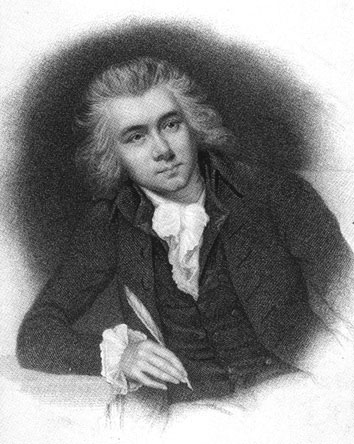
As we talked about William Wilberforce at the last Agora, here is an encouraging story on his circle of friends that I hope inspires us at the Agora to emulate by the grace of God,
"Throughout history groups of men and women have banded together for the purpose of promoting what they believed to be critical causes. With the defeat of his motion for the abolition in 1789, Wilberforce and his closest friend, Henry Thornton, called together such a group around themselves. The common bond that held this 'Clapham Sect' together was the desire to apply their faith in Jesus Christ to personal, social, political, national and international matters. The group made no claim to be theologians, yet they were people who regarded prayer and Bible study as serious matters. The Clapham group believed that they were representatives of God's kingdom on earth and the faithful stewards of all God had given them. Together, this Clapham fellowship sought to make the British Empire an instrument of social and moral welfare to all people. Throughout their time together, they remained remarkably committed to these goals. The labels 'Clapham Sect' and the 'Saints' were given to them by others, the latter by members of Parliament. No indication of any desire to give themselves a name was reflected in the correspondence and literature of members of the group. The term 'Clapham Sect' was not used until later, when the phrase was coined in an 1844 essay by Sir James Stephen. The name originated from the London suburb, Clapham, where many of the group members chose to live."
Read the full story here...
John Piper has his own summary on this issue, and this is a great point that I hope we don't miss. He points out that the burden of Wilberforce’ book “A Practical View of Christianity” was that “true Christianity, which consists in these new, indomitable spiritual affections for Christ, is rooted in the great doctrines of the Bible about Sin and Christ and Faith.”. So Wilberforce’s driving force in his life was those "great doctrines of the gospel" and not merely a social conscience.
Read John Piper’s full article here…
Thursday, May 05, 2005
Politics, Why Bother?
Why and How Christians Should be Involved in Politics
A. Basis for Involvement
What is Politics?
- Broad definition: denotes the life of the city (polis) and the responsibilities of the citizen – concerned with the whole of life in human society.
- Narrow definition: the science of government – gaining power for social change.
- Politics is concerned with the proper ordering of society for the collective good of its members.
- Policy decisions by the governing authorities affect our lives.
Government as a God-ordained Institution
- Government is one of the three God-ordained institutions besides the family and the church. (Rom 13)
- Purpose: to promote order, freedom and justice.
- Question: Must Christians always obey and submit to the government? What if the government abuses its power and acts contrary to the law and infringes religious freedom? (1 Peter 2:13-17; cf. Rev 13, Acts 5: 29)
Socio-Political Involvement Part of the Cultural Mandate
 - The Christian Cultural Mandate (based on Gen 1:26-28) – to exercise dominion over all the earth and redeem every sphere of human endeavour for Christ.
- If we see Christianity as a worldview and believes that it is able to provide real answers and solutions to a wide spectrum of human problems, then we must be involved in life in all its venues: social, scientific, economic, medical, artistic, academic and political.
- Moreover, we have been called to be salt and light, to love our neighbour as ourselves and to seek the common good.
- Jesus’ example: In his public ministry, he went about “teaching and preaching” (Matthew 4:23) and “doing good and healing” (Acts 10:38). There is a socio-political dimension to Jesus’ ministry (Luke 4:18-19) – preach good news to the poor, proclaim freedom for the prisoners and recovery of sight for the blind, release the oppressed.
- In Matthew 25, Jesus speaks of the hungry, the homeless, the stranger, prisoners and the sick and promises He will challenge all His followers on Judgment Day with these words, “As you have done to the least of these, you have done to me.”
- Case study: John Wesley and the Evangelical Revival in Britain in the 17th century. Wesley was both a preacher of the gospel and a prophet of social righteousness. The movement was instrumental in the abolishment of slavery and reforming society – improving working conditions, humanising the prison system, making education available to the poor, etc.
Evangelism and Social Concern Go Hand-in-hand
- Section 5 (Christian Social Responsibility) of The Lausanne Covenant, endorsed by the International Congress on World Evangelisation in Lausanne, Switzerland in 1974, states: “We express penitence for our neglect and for having sometimes regarded evan elism and social concern as mutually exclusive. Although reconciliation with man is not reconciliation with God, nor is social action evangelism, nor is political liberation salvation, nevertheless, we affirm that evangelism and socio-political involvement are both part of our Christian duty. For both are necessary expressions of our doctrines of God and man, our love of neighbour and our obedience to Jesus Christ.”
- Paul B. Henry, in his book Politics for Evangelicals, expressed that: “The Christian community must learn to recognise that civic involvement is in itself a legitimate form of Christian service. To deny this is to suggest a truncated Christianity which arbitrarily separates the sacred from the secular.”
- On another occasion, Paul Henry said: “We are called to seek justice, to let our lights shine, to be the salt of the earth. Involvement in the political process is one of many ways in which the Christian community can be faithful to the redemptive power of the gospel… Our democratic institutions afford us the opportunity to effect change and promote wholeness within our society and between the nations. To forsake this opportunity is to bear responsibility for the consequences of our inaction, as well as to leave the public sector solely in the hands of those who may not be sensitive to Christian values.”
- Prophetic religion always presses the question of the common good.
“The loss of religion’s prophetic vocation is terribly dangerous for any society. Who will uphold the dignity of economic and political outcasts? Who will question the self-righteousness of nations and their leaders? Who will question the recourse to violence and the rush to wars, long before any last resort has been unequivocally proven? Who will not allow God’s name to be used to simply justify ourselves, instead of calling us to accountability? And who will love the people enough to challenge their worst habits, coarser entertainments and selfish neglects?” Jim Wallis in God’s Politics (Wallis is a social activist and editor and founder of Sojourners: Christians for Justice and Peace – www.sojo.net)
- Ronald J. Sider, President of Evangelicals for Social Action, in his book Rich Christians in An Age of Hunger, asks the disturbing question why Christians are not doing enough for the poor despite the fact that they collectively possess the greatest wealth at any time in history.
Social Service and Social Action
-Social concern necessary involves both social service and social action.
Social Service Social Action
Relieving human need
Philanthropic activity
Seeking to minister to individuals and families
Works of mercy Removing the causes of human need
Political and economic activity
Seeking to transform the structures of society
The quest for justice
Why Get Involved when the Ship is Sinking?
- The ship may be sinking, i.e. the world that we live in is decaying, but we do not know how long the ship will take before it finally sinks! While we are still on board this ship, we must keep it in a state of good repair.
- We must not dichotomise the Christian life into the now and later. We are both citizens of heaven as well as citizens of earth (St. Augustine, City of God)
- Being salt of the earth – to slow down the process of decay.
- John Stott: “The world is the arena in which we are to live and love, witness and serve, suffer and die for Christ.”
How Does the Malaysian Church Fare?
-The following table shows the involvement of our churches in the community:
Activity Percentage of Christians Involved in the Activity
Social Care Activities for the Needy:
- Visitations to hospitals or prisons 60%
- Care services for the aged, sick, handicapped, mentally retarded, drug addicts, etc.
36%
- Uplifting welfare of the underprivileged like tuition classes 26%
- Relief assistance like food, clothing and medicine for the needy 25%
- Accommodation for the needy like nursing homes, hostel for orphans etc.
21%
Poverty Alleviation Programmes: 6%
Other Forms of “Good Works” to Society:
- Counselling services for the public such as marriage counselling, parenting programmes etc.
20%
- Community development projects such as gotong-royong 14-17%
- Taking some action on a public issue or contacting a Member of Parliament
2%
- Environment protection activities 2%
- Involvement in justice or political activities 1%
Source: NECF Survey of Churches, Pastors and Christians 2001
- The survey also showed that:
• 80% of pastors agree that the church must demonstrate to society a holistic mission as Jesus did, compared with 52% of Christians who felt the same way.
• 75% of pastors believe that in view of the increase in social ills, the church should be more involved in society, compared with 65% of Christians who felt the same way.
• 57% of pastors believe our churches are too inward looking, compared with 27% of Christians who felt the same way.
• The one most significant activity that pastors would like NECF to focus more on is engagement with the Government and public advocacy for the churches (32%).
B. Ways of Involvement
- The ideal Christian citizen: Karl Barth’s image of a person holding a Bible in one hand and a newspaper in the other.
- Malaysia’s democratic (albeit limited) form of governance allows for participation in the political process.
- Reinhold Neibuhr: “Man’s capacity for justice makes democracy possible, but man’s inclination for injustice makes democracy necessary.”
- Lord Acton: “Power corrupts and absolute power corrupts absolutely.”
- In a fallen world where sin abounds, power must be decentralised from the hands of the few to the hands of the many.
- How can we bring our Christian values to bear on the country’s social and political landscape as citizens in a democratic society?
- Individually, Christians can engage in the political process through the following:
• Vote in the elections
• Be informed about contemporary issues
• Pray for the governing authorities: the King, the Government, the Opposition and NGOs (1 Tim 2:1-2)
• Write to the press or relevant government authority on a public issue of concern
• Lobby your elected rep to champion an important issue of public interest
• Take part in peaceful protests/demonstrations
• Take an active part in your neighbourhood residents association.
• Join a political party or non-governmental organisation
• Run for political office
- Collectively, Christians who share particular and moral social concerns can form groups to study the issue deeper and take appropriate action
- The Church (through its umbrella bodies such as NECF, CCM and CFM) should speak out on issues of public interests from the Christian viewpoint and inculcate greater awareness among its members about the importance of socio-political engagement.
Examples of Christian politicians
- Christians can bring a qualitative difference in our social engagements.
- The following are some famous Christian political leaders:
Abraham Kuyper (theologian and Prime Minister of Holland)
Martin Luther King Jr. (American civil rights leader)
William Wilberforce (British parliamentarian and anti-slavery advocate)
Jimmy Carter (US President, Nobel Peace Prize Laureate and human rights advocate)
Pope John Paul II (used his religious office to effect socio-political changes)
- In the Old Testament, we have figures like King David, Joseph, Daniel, etc. who held political office.
- In Malaysia, some prominent Christian politicians include:
The late Tan Chee Khoon (former Opposition Leader)
Tan Kee Kwong (MP for Segambut, Gerakan)
Dr Maximus Ongkili (Minister in the PM’s Department, PBS)
Teresa Kok (MP for Seputeh, DAP)
Ngeh Koo Ham (ADUN for Setiawan, Perak Opposition Leader, DAP)
Lee Hwa Beng (ADUN for Subang Jaya, MCA)
- There are also Christians actively involved in NGOs:
Irene Fernandez (Executive Director, Tenaganita)
Ivy Josiah (Women Aid Organisation)
Dr Denison Jayasooria (Executive Director, Yayasan Strategik Sosial - MIC’s social arm)
Joseph Roy (Amnesty International)
Malaysian CARE
- Advice for aspiring politicians: “The Christian who enters politics must do so with the aim of achieving public justice…He learns to make the needs of his neighbour his own. In so doing, his search for justice becomes an act of sacrificial love.” – Paul Henry, Politics for Evangelicals
The Malaysian context
- Some issues that Christians can be concerned about/pray for:
• Strengthen our democratic institutions – Parliament, Judiciary, Anti-Corruption Agency, Elections Commission, the Police etc. – to ensure vital checks and balances
• Push for a freer press – freedom of information (RSF’s World Press Freedom Index 2004 ranked Malaysia 122nd out of 167 countries surveyed. In 2003, Malaysia was ranked 104th)
• Combat corruption in the system (structural evil/sins) and protection for whistle-blowers (Malaysia was ranked 37th in Transparency International’s Corruption Perception Index 2004 compared to 35th in 2003)
• Call for the abolishment of unjust laws that restricts freedom and undermines civil liberties
• Legislate a minimum wage for low-income workers
• Ensure that the civil service has a more balanced racial composition
• Arrest the brain drain by abolishing discriminatory policies that do not promote meritocracy and fair competition
• Affirmative policies must extend to all races
• Revolutionise our education system
• Ensure proper tendering of government contracts
• Call for election of local councillors, senators
• Work towards the eradication of rural and urban poverty amongst all races (UNDP reported that Malaysia has the highest income disparity gap between the rich and the poor in South East Asia; About 35% of Malaysian households have a monthly income below RM1,500)
• Forge a united Malaysian race (bumiputra and non-bumiputra divide a barrier?)
- Issues specific to the Christian/religious community:
• Difficulty in getting approval for the construction of churches/places of worship
• “Ban” on the Malay-language Bible and Malay-language Christian literature
• Response to Malaysia as an Islamic State/Islam Hadhari/Islamisation process
• Formation of an Inter-Faith Commission
References
1. Charles Colson & Nancy Pearcey, How Now Shall We Live (Tyndale, 1999)
2. Jim Wallis, God’s Politics (Harper Collins, 2004)
3. John Stott, Issues Facing Christians Today (Marshall, Morgan & Scott, 1984)
4. NECF, Watchmen’s Forum 3 (NECF Research Commission, 2002)
5. Paul B. Henry, Politics for Evangelicals (Valley Forge, 1974)
6. Timothy J. Demy & Gary P. Stewart, Politics and Public Policy: A Christian Response (Kregel, 2000)
Prepared by John Chung for Agora Ministry, CDPC
A. Basis for Involvement
What is Politics?
- Broad definition: denotes the life of the city (polis) and the responsibilities of the citizen – concerned with the whole of life in human society.
- Narrow definition: the science of government – gaining power for social change.
- Politics is concerned with the proper ordering of society for the collective good of its members.
- Policy decisions by the governing authorities affect our lives.
Government as a God-ordained Institution
- Government is one of the three God-ordained institutions besides the family and the church. (Rom 13)
- Purpose: to promote order, freedom and justice.
- Question: Must Christians always obey and submit to the government? What if the government abuses its power and acts contrary to the law and infringes religious freedom? (1 Peter 2:13-17; cf. Rev 13, Acts 5: 29)
Socio-Political Involvement Part of the Cultural Mandate
 - The Christian Cultural Mandate (based on Gen 1:26-28) – to exercise dominion over all the earth and redeem every sphere of human endeavour for Christ.
- If we see Christianity as a worldview and believes that it is able to provide real answers and solutions to a wide spectrum of human problems, then we must be involved in life in all its venues: social, scientific, economic, medical, artistic, academic and political.
- Moreover, we have been called to be salt and light, to love our neighbour as ourselves and to seek the common good.
- Jesus’ example: In his public ministry, he went about “teaching and preaching” (Matthew 4:23) and “doing good and healing” (Acts 10:38). There is a socio-political dimension to Jesus’ ministry (Luke 4:18-19) – preach good news to the poor, proclaim freedom for the prisoners and recovery of sight for the blind, release the oppressed.
- In Matthew 25, Jesus speaks of the hungry, the homeless, the stranger, prisoners and the sick and promises He will challenge all His followers on Judgment Day with these words, “As you have done to the least of these, you have done to me.”
- Case study: John Wesley and the Evangelical Revival in Britain in the 17th century. Wesley was both a preacher of the gospel and a prophet of social righteousness. The movement was instrumental in the abolishment of slavery and reforming society – improving working conditions, humanising the prison system, making education available to the poor, etc.
Evangelism and Social Concern Go Hand-in-hand
- Section 5 (Christian Social Responsibility) of The Lausanne Covenant, endorsed by the International Congress on World Evangelisation in Lausanne, Switzerland in 1974, states: “We express penitence for our neglect and for having sometimes regarded evan elism and social concern as mutually exclusive. Although reconciliation with man is not reconciliation with God, nor is social action evangelism, nor is political liberation salvation, nevertheless, we affirm that evangelism and socio-political involvement are both part of our Christian duty. For both are necessary expressions of our doctrines of God and man, our love of neighbour and our obedience to Jesus Christ.”
- Paul B. Henry, in his book Politics for Evangelicals, expressed that: “The Christian community must learn to recognise that civic involvement is in itself a legitimate form of Christian service. To deny this is to suggest a truncated Christianity which arbitrarily separates the sacred from the secular.”
- On another occasion, Paul Henry said: “We are called to seek justice, to let our lights shine, to be the salt of the earth. Involvement in the political process is one of many ways in which the Christian community can be faithful to the redemptive power of the gospel… Our democratic institutions afford us the opportunity to effect change and promote wholeness within our society and between the nations. To forsake this opportunity is to bear responsibility for the consequences of our inaction, as well as to leave the public sector solely in the hands of those who may not be sensitive to Christian values.”
- Prophetic religion always presses the question of the common good.
“The loss of religion’s prophetic vocation is terribly dangerous for any society. Who will uphold the dignity of economic and political outcasts? Who will question the self-righteousness of nations and their leaders? Who will question the recourse to violence and the rush to wars, long before any last resort has been unequivocally proven? Who will not allow God’s name to be used to simply justify ourselves, instead of calling us to accountability? And who will love the people enough to challenge their worst habits, coarser entertainments and selfish neglects?” Jim Wallis in God’s Politics (Wallis is a social activist and editor and founder of Sojourners: Christians for Justice and Peace – www.sojo.net)
- Ronald J. Sider, President of Evangelicals for Social Action, in his book Rich Christians in An Age of Hunger, asks the disturbing question why Christians are not doing enough for the poor despite the fact that they collectively possess the greatest wealth at any time in history.
Social Service and Social Action
-Social concern necessary involves both social service and social action.
Social Service Social Action
Relieving human need
Philanthropic activity
Seeking to minister to individuals and families
Works of mercy Removing the causes of human need
Political and economic activity
Seeking to transform the structures of society
The quest for justice
Why Get Involved when the Ship is Sinking?
- The ship may be sinking, i.e. the world that we live in is decaying, but we do not know how long the ship will take before it finally sinks! While we are still on board this ship, we must keep it in a state of good repair.
- We must not dichotomise the Christian life into the now and later. We are both citizens of heaven as well as citizens of earth (St. Augustine, City of God)
- Being salt of the earth – to slow down the process of decay.
- John Stott: “The world is the arena in which we are to live and love, witness and serve, suffer and die for Christ.”
How Does the Malaysian Church Fare?
-The following table shows the involvement of our churches in the community:
Activity Percentage of Christians Involved in the Activity
Social Care Activities for the Needy:
- Visitations to hospitals or prisons 60%
- Care services for the aged, sick, handicapped, mentally retarded, drug addicts, etc.
36%
- Uplifting welfare of the underprivileged like tuition classes 26%
- Relief assistance like food, clothing and medicine for the needy 25%
- Accommodation for the needy like nursing homes, hostel for orphans etc.
21%
Poverty Alleviation Programmes: 6%
Other Forms of “Good Works” to Society:
- Counselling services for the public such as marriage counselling, parenting programmes etc.
20%
- Community development projects such as gotong-royong 14-17%
- Taking some action on a public issue or contacting a Member of Parliament
2%
- Environment protection activities 2%
- Involvement in justice or political activities 1%
Source: NECF Survey of Churches, Pastors and Christians 2001
- The survey also showed that:
• 80% of pastors agree that the church must demonstrate to society a holistic mission as Jesus did, compared with 52% of Christians who felt the same way.
• 75% of pastors believe that in view of the increase in social ills, the church should be more involved in society, compared with 65% of Christians who felt the same way.
• 57% of pastors believe our churches are too inward looking, compared with 27% of Christians who felt the same way.
• The one most significant activity that pastors would like NECF to focus more on is engagement with the Government and public advocacy for the churches (32%).
B. Ways of Involvement
- The ideal Christian citizen: Karl Barth’s image of a person holding a Bible in one hand and a newspaper in the other.
- Malaysia’s democratic (albeit limited) form of governance allows for participation in the political process.
- Reinhold Neibuhr: “Man’s capacity for justice makes democracy possible, but man’s inclination for injustice makes democracy necessary.”
- Lord Acton: “Power corrupts and absolute power corrupts absolutely.”
- In a fallen world where sin abounds, power must be decentralised from the hands of the few to the hands of the many.
- How can we bring our Christian values to bear on the country’s social and political landscape as citizens in a democratic society?
- Individually, Christians can engage in the political process through the following:
• Vote in the elections
• Be informed about contemporary issues
• Pray for the governing authorities: the King, the Government, the Opposition and NGOs (1 Tim 2:1-2)
• Write to the press or relevant government authority on a public issue of concern
• Lobby your elected rep to champion an important issue of public interest
• Take part in peaceful protests/demonstrations
• Take an active part in your neighbourhood residents association.
• Join a political party or non-governmental organisation
• Run for political office
- Collectively, Christians who share particular and moral social concerns can form groups to study the issue deeper and take appropriate action
- The Church (through its umbrella bodies such as NECF, CCM and CFM) should speak out on issues of public interests from the Christian viewpoint and inculcate greater awareness among its members about the importance of socio-political engagement.
Examples of Christian politicians
- Christians can bring a qualitative difference in our social engagements.
- The following are some famous Christian political leaders:
Abraham Kuyper (theologian and Prime Minister of Holland)
Martin Luther King Jr. (American civil rights leader)
William Wilberforce (British parliamentarian and anti-slavery advocate)
Jimmy Carter (US President, Nobel Peace Prize Laureate and human rights advocate)
Pope John Paul II (used his religious office to effect socio-political changes)
- In the Old Testament, we have figures like King David, Joseph, Daniel, etc. who held political office.
- In Malaysia, some prominent Christian politicians include:
The late Tan Chee Khoon (former Opposition Leader)
Tan Kee Kwong (MP for Segambut, Gerakan)
Dr Maximus Ongkili (Minister in the PM’s Department, PBS)
Teresa Kok (MP for Seputeh, DAP)
Ngeh Koo Ham (ADUN for Setiawan, Perak Opposition Leader, DAP)
Lee Hwa Beng (ADUN for Subang Jaya, MCA)
- There are also Christians actively involved in NGOs:
Irene Fernandez (Executive Director, Tenaganita)
Ivy Josiah (Women Aid Organisation)
Dr Denison Jayasooria (Executive Director, Yayasan Strategik Sosial - MIC’s social arm)
Joseph Roy (Amnesty International)
Malaysian CARE
- Advice for aspiring politicians: “The Christian who enters politics must do so with the aim of achieving public justice…He learns to make the needs of his neighbour his own. In so doing, his search for justice becomes an act of sacrificial love.” – Paul Henry, Politics for Evangelicals
The Malaysian context
- Some issues that Christians can be concerned about/pray for:
• Strengthen our democratic institutions – Parliament, Judiciary, Anti-Corruption Agency, Elections Commission, the Police etc. – to ensure vital checks and balances
• Push for a freer press – freedom of information (RSF’s World Press Freedom Index 2004 ranked Malaysia 122nd out of 167 countries surveyed. In 2003, Malaysia was ranked 104th)
• Combat corruption in the system (structural evil/sins) and protection for whistle-blowers (Malaysia was ranked 37th in Transparency International’s Corruption Perception Index 2004 compared to 35th in 2003)
• Call for the abolishment of unjust laws that restricts freedom and undermines civil liberties
• Legislate a minimum wage for low-income workers
• Ensure that the civil service has a more balanced racial composition
• Arrest the brain drain by abolishing discriminatory policies that do not promote meritocracy and fair competition
• Affirmative policies must extend to all races
• Revolutionise our education system
• Ensure proper tendering of government contracts
• Call for election of local councillors, senators
• Work towards the eradication of rural and urban poverty amongst all races (UNDP reported that Malaysia has the highest income disparity gap between the rich and the poor in South East Asia; About 35% of Malaysian households have a monthly income below RM1,500)
• Forge a united Malaysian race (bumiputra and non-bumiputra divide a barrier?)
- Issues specific to the Christian/religious community:
• Difficulty in getting approval for the construction of churches/places of worship
• “Ban” on the Malay-language Bible and Malay-language Christian literature
• Response to Malaysia as an Islamic State/Islam Hadhari/Islamisation process
• Formation of an Inter-Faith Commission
References
1. Charles Colson & Nancy Pearcey, How Now Shall We Live (Tyndale, 1999)
2. Jim Wallis, God’s Politics (Harper Collins, 2004)
3. John Stott, Issues Facing Christians Today (Marshall, Morgan & Scott, 1984)
4. NECF, Watchmen’s Forum 3 (NECF Research Commission, 2002)
5. Paul B. Henry, Politics for Evangelicals (Valley Forge, 1974)
6. Timothy J. Demy & Gary P. Stewart, Politics and Public Policy: A Christian Response (Kregel, 2000)
Prepared by John Chung for Agora Ministry, CDPC
Monday, April 25, 2005
Update: Christian & Muslim dialogues - is there a future for it?
ISLAM HADHARI Statement by the Malaysian Government
This is the official presentation we keep hearing again and again, and we are told that this is the season for inter-faith dialogues.
Our prime minister said in his response to forgo the idea of a Malaysia Interfaith Panel
said: "Focus on inter-racial and inter-faith dialogues. This will be better as we need to maintain peace and harmony among people of diverse religions,"
But then we hit a snag last week when we suddenly heard of a ban on the Malay bible as announced by Dato’ Seri Mohamed Nazri bin Abdul Aziz in a parliament session. Christians were shocked, for the Malay Bible does serve a role in some Malay speaking congregations in Malaysia.
This was cleared up promptly by a statement from the Prime Minister. I don’t know if you noticed, but suddenly it became an issue of Malays getting converted by reading the bible (of which this Islamic evangelist has some interesting comments, though I don’t appreciate his derogatory language used with reference to our government).
The question I ask (and Kit Siang has his own take not to be missed) at the tail end of this controversy is, how are we supposed to have genuine interfaith dialogues if a Muslim is not allowed to read the Bible? I have a Quran, and I am not scared of it, why should they be of the Bible? I dream of a Malaysia with Ideological Capitalism, where all the ideas get their air play in the marketplace, and people can choose for themselves the ones they think best correspond to reality.
This is the official presentation we keep hearing again and again, and we are told that this is the season for inter-faith dialogues.
Our prime minister said in his response to forgo the idea of a Malaysia Interfaith Panel
said: "Focus on inter-racial and inter-faith dialogues. This will be better as we need to maintain peace and harmony among people of diverse religions,"
But then we hit a snag last week when we suddenly heard of a ban on the Malay bible as announced by Dato’ Seri Mohamed Nazri bin Abdul Aziz in a parliament session. Christians were shocked, for the Malay Bible does serve a role in some Malay speaking congregations in Malaysia.
This was cleared up promptly by a statement from the Prime Minister. I don’t know if you noticed, but suddenly it became an issue of Malays getting converted by reading the bible (of which this Islamic evangelist has some interesting comments, though I don’t appreciate his derogatory language used with reference to our government).
The question I ask (and Kit Siang has his own take not to be missed) at the tail end of this controversy is, how are we supposed to have genuine interfaith dialogues if a Muslim is not allowed to read the Bible? I have a Quran, and I am not scared of it, why should they be of the Bible? I dream of a Malaysia with Ideological Capitalism, where all the ideas get their air play in the marketplace, and people can choose for themselves the ones they think best correspond to reality.
New Film on the Crusades
The Agora:
 There is a new film on the Crusades coming out next week in New York so i imagine it will be creened very soon in KL. The rpemise of this movie is that Muslims and Christians could have lived in peace if not for the marauding Christian fanatics. Wella nd good, and there were horrible consequences of bad behavior on both sides. But the movie-maker, Sir Ridley Scott 'forgot' to mention what really triggered the start of the Crusades in 1096. It was the act of al-Hakim of the Cairo caliphate who tored down the Chrustian Church in Jerusalem (see my article on Pax islamica in this blog) in 1009. This broke the 200 year old treaty between Emperor Charlemagne and the Abbasid caliph, Harun al-Rashid. This began the slide and year after year, more and more Christians minorities were abused by Muslim majorities, until by 1070, the Muslim Turks who took Jerusalem destroyed the Christian army of Constantinople. It was this concern that led the Christians of the East to ask for help from the Christians of the West. While I do not condone the Christian Crusades (our God does not come with swords to murder), I am peeved that movie after movie take license with history and hit the easy target, Christians (because we also do not practice fatwa). No, do not boycott. See the movie. Just be aware that the truth of real history is difficult enough, let us not let Hollywood teach us history.
All the same, enjoy the CGI and Jeremy irons folks.
RC
 There is a new film on the Crusades coming out next week in New York so i imagine it will be creened very soon in KL. The rpemise of this movie is that Muslims and Christians could have lived in peace if not for the marauding Christian fanatics. Wella nd good, and there were horrible consequences of bad behavior on both sides. But the movie-maker, Sir Ridley Scott 'forgot' to mention what really triggered the start of the Crusades in 1096. It was the act of al-Hakim of the Cairo caliphate who tored down the Chrustian Church in Jerusalem (see my article on Pax islamica in this blog) in 1009. This broke the 200 year old treaty between Emperor Charlemagne and the Abbasid caliph, Harun al-Rashid. This began the slide and year after year, more and more Christians minorities were abused by Muslim majorities, until by 1070, the Muslim Turks who took Jerusalem destroyed the Christian army of Constantinople. It was this concern that led the Christians of the East to ask for help from the Christians of the West. While I do not condone the Christian Crusades (our God does not come with swords to murder), I am peeved that movie after movie take license with history and hit the easy target, Christians (because we also do not practice fatwa). No, do not boycott. See the movie. Just be aware that the truth of real history is difficult enough, let us not let Hollywood teach us history.
 All the same, enjoy the CGI and Jeremy irons folks.
RC
Wednesday, April 20, 2005
Malay-Language Bible Ban?
The karmic cycle of "Bible Ban" reemerged in Parliament recently...
http://www.dapmalaysia.org/english/bul/apr05/bul2665.htm
John Chung: I'm glad the PM has clarified the matter. But for a Minister in the PM's own department to say in Parliament that there is such a ban is really quite shocking! Thankfully, our Christian leaders are quick to respond.
-----------------------------------
No ban on Malay-language Bibles: Abdullah
Apr 19, 05 6:45am
Prime Minister Abdullah Ahmad Badawi today said there was no ban on Bibles
published in the Malay language but they must be stamped with the words "Not for
Muslims".
He was responding to questions after a minister told parliament last week that
the government did not allow editions of the Bible published in Malay to be
distributed as it could be construed as an effort to spread Christianity among
Muslim-Malays.
"There should not be any concern. I met all the leaders of the various church
denominations in my office before when I was deputy prime minister," said
Abdullah, who became prime minister in October 2003.
'Your Bible is your Bible'
"I said your Bible is your Bible, I'm not going to ban your Bible even though
the Bible is written in Malay," he told reporters.
However, Abdullah said the Malay Bible must have the words "Not for Muslims"
printed on the front and can be distributed only in churches and Christian
bookshops.
The government imposed a shortlived and controversial ban on the Bible published
in the language of the indigenous Iban tribe in 2003 but lifted it after a
protest and an appeal by Malaysia's Council of Churches.
Some 60 percent of Malaysia's population are Muslims, while there are large
ethnic-Chinese and Indian minorities who practice other religions including
Christianity, Buddhism and Hinduism.
- AFP
Kian Meng's keen analysis of the situation:
After reading the parliamentary debate, I'm saddened by the lack of quality, especially on the part of Nazri. But then again, I shouldn't be too surprised.
We need to be careful in approaching this issue from a Christian Malaysian's perspective. Nazri and Ayub tended to confuse a few arguments together. We need to
make distinctions.
Firstly, I think we need to make it clear that it is a question of freedom of religion on the part of Malaysian Christians and we can approach it from a
variety of angles. The fact that BM is our national language and has been the sole national language since 1967 means that for many Malaysians and non-Malays,
especially in East Malaysia. If a non-Muslim Malaysian of whatever religious persuasion cannot have access to his or her religious text in the language that he or
she is most comfortable with, BM in this case, then his or her religious freedom will be impinged upon. We should distinguish (initially, at least) this issue –
freedom of religion for non-Muslims – from the issue of possible conversion for Muslims arising from a BM Bible.
We can extend this further. If we take Nazri’s logic – that the BM bible might be used to convert Malay Muslims – then this must mean that we cannot have any
services in BM or even sing Christian songs in BM. Not only does this take away the ability to read Holy Texts in the language a non-Muslim is most comfortable
with, it also must mean that even religious services cannot be conducted in a language which might be ‘used’ to convert Muslims. Christian songs or indeed
Christian books or religious songs and books of any other religion other than Islam, cannot be allowed!
Not only might BM be the language that a particular group or individual be most comfortable with, BM might be the language which is the common denominator for
many different groups or individuals of a particular faith. For an Indian Christian who is fluent in Tamil but not in English and a Chinese Christian who is
fluent in Mandarin but not in English, BM might be the only common denominator in which both these individuals (and groups of individuals like them) can come together to worship their God. These services in BM clearly cannot take place without the use of a BM bible.
There is also a matter of personal religious freedom in choosing more than one language to express our relationship with God. I might be fluent in English or
Chinese but I also want to choose to use the BM language be it in prayer or in song and in the reading of my Holy Text. Speaking from personal experience, my sense of being a Malaysian is increased when I sing a Christian song in BM or read the bible in BM.
So the first point that we should assert is that this is an issue of freedom of religion. And this not only concerns Christians, since it extends of having
religious texts and perhaps public services in BM for other religions in Malaysia – Bhuddism, Hinduism. But practically, the biggest impact of this seems to be on
the Christians since many Christians in East Malaysia use BM as their primary language.
If one can make a convincing case that the use of the BM bible will be kept strictly in the context of Christian services and personal Christian use, then Nazri’s arguments (and that of Ayub, PAS’s Youth Chief) will be much weaker.
But I hesitate to push the last point too much since Nazri’s point on the ‘possible’ use of the BM bible as a conversion tool is weak. One could argue that the English bible could easily be used as a tool for evangelizing Malay Muslims since many Malay Muslims are fluent in English.
Would this be grounds for banning the English bible?
Are there currently any guarantees that Malay Muslims will not buy the English
bible today?
Anyway, the notion that Malay Muslims can be converted just on the basis of reading the Bible in BM is, in a way, an insult to the faith of Malay Muslims.
This is like saying that Christians or Bhuddists or Hindus are more likely to convert to Islam because the Quran is widely available in English, Chinese or
Tamil.
One could of course go further and contest Nazri’s notion that proselytizing to Malay Muslims is not allowed under the Federal Constitution since the
constitution only stipulates that the states (and the federal government in the Federal Territories) can pass laws to ‘control or restrict’ proselytizing
activities to Muslim groups (Article 11 (4)). But I leave this to the more legally minded among us.
Before I end, I think this challenges us as Christians in a specific manner. We should not back away from defending religious freedom for non-Muslims in Malaysia (I’ll leave the religious freedom for Malay to another time) even though we ourselves might not use the BM bible. But this episode highlights to me, at least, of the need to brush up our BM (and even get a copy of the Al-Kitab and read it regularly) so that we can engage and participate in services in BM (if
and where it happens) as a demonstration of our Malaysian identity as well as to show unity among the Christian community in Malaysia. The argument for the
use of a BM bible would be so much more convincing services in BM are regularly conducted in Christian communities throughout Malaysia.
http://www.dapmalaysia.org/english/bul/apr05/bul2665.htm
John Chung: I'm glad the PM has clarified the matter. But for a Minister in the PM's own department to say in Parliament that there is such a ban is really quite shocking! Thankfully, our Christian leaders are quick to respond.
-----------------------------------
No ban on Malay-language Bibles: Abdullah
Apr 19, 05 6:45am
Prime Minister Abdullah Ahmad Badawi today said there was no ban on Bibles
published in the Malay language but they must be stamped with the words "Not for
Muslims".
He was responding to questions after a minister told parliament last week that
the government did not allow editions of the Bible published in Malay to be
distributed as it could be construed as an effort to spread Christianity among
Muslim-Malays.
"There should not be any concern. I met all the leaders of the various church
denominations in my office before when I was deputy prime minister," said
Abdullah, who became prime minister in October 2003.
'Your Bible is your Bible'
"I said your Bible is your Bible, I'm not going to ban your Bible even though
the Bible is written in Malay," he told reporters.
However, Abdullah said the Malay Bible must have the words "Not for Muslims"
printed on the front and can be distributed only in churches and Christian
bookshops.
The government imposed a shortlived and controversial ban on the Bible published
in the language of the indigenous Iban tribe in 2003 but lifted it after a
protest and an appeal by Malaysia's Council of Churches.
Some 60 percent of Malaysia's population are Muslims, while there are large
ethnic-Chinese and Indian minorities who practice other religions including
Christianity, Buddhism and Hinduism.
- AFP
Kian Meng's keen analysis of the situation:
After reading the parliamentary debate, I'm saddened by the lack of quality, especially on the part of Nazri. But then again, I shouldn't be too surprised.
We need to be careful in approaching this issue from a Christian Malaysian's perspective. Nazri and Ayub tended to confuse a few arguments together. We need to
make distinctions.
Firstly, I think we need to make it clear that it is a question of freedom of religion on the part of Malaysian Christians and we can approach it from a
variety of angles. The fact that BM is our national language and has been the sole national language since 1967 means that for many Malaysians and non-Malays,
especially in East Malaysia. If a non-Muslim Malaysian of whatever religious persuasion cannot have access to his or her religious text in the language that he or
she is most comfortable with, BM in this case, then his or her religious freedom will be impinged upon. We should distinguish (initially, at least) this issue –
freedom of religion for non-Muslims – from the issue of possible conversion for Muslims arising from a BM Bible.
We can extend this further. If we take Nazri’s logic – that the BM bible might be used to convert Malay Muslims – then this must mean that we cannot have any
services in BM or even sing Christian songs in BM. Not only does this take away the ability to read Holy Texts in the language a non-Muslim is most comfortable
with, it also must mean that even religious services cannot be conducted in a language which might be ‘used’ to convert Muslims. Christian songs or indeed
Christian books or religious songs and books of any other religion other than Islam, cannot be allowed!
Not only might BM be the language that a particular group or individual be most comfortable with, BM might be the language which is the common denominator for
many different groups or individuals of a particular faith. For an Indian Christian who is fluent in Tamil but not in English and a Chinese Christian who is
fluent in Mandarin but not in English, BM might be the only common denominator in which both these individuals (and groups of individuals like them) can come together to worship their God. These services in BM clearly cannot take place without the use of a BM bible.
There is also a matter of personal religious freedom in choosing more than one language to express our relationship with God. I might be fluent in English or
Chinese but I also want to choose to use the BM language be it in prayer or in song and in the reading of my Holy Text. Speaking from personal experience, my sense of being a Malaysian is increased when I sing a Christian song in BM or read the bible in BM.
So the first point that we should assert is that this is an issue of freedom of religion. And this not only concerns Christians, since it extends of having
religious texts and perhaps public services in BM for other religions in Malaysia – Bhuddism, Hinduism. But practically, the biggest impact of this seems to be on
the Christians since many Christians in East Malaysia use BM as their primary language.
If one can make a convincing case that the use of the BM bible will be kept strictly in the context of Christian services and personal Christian use, then Nazri’s arguments (and that of Ayub, PAS’s Youth Chief) will be much weaker.
But I hesitate to push the last point too much since Nazri’s point on the ‘possible’ use of the BM bible as a conversion tool is weak. One could argue that the English bible could easily be used as a tool for evangelizing Malay Muslims since many Malay Muslims are fluent in English.
Would this be grounds for banning the English bible?
Are there currently any guarantees that Malay Muslims will not buy the English
bible today?
Anyway, the notion that Malay Muslims can be converted just on the basis of reading the Bible in BM is, in a way, an insult to the faith of Malay Muslims.
This is like saying that Christians or Bhuddists or Hindus are more likely to convert to Islam because the Quran is widely available in English, Chinese or
Tamil.
One could of course go further and contest Nazri’s notion that proselytizing to Malay Muslims is not allowed under the Federal Constitution since the
constitution only stipulates that the states (and the federal government in the Federal Territories) can pass laws to ‘control or restrict’ proselytizing
activities to Muslim groups (Article 11 (4)). But I leave this to the more legally minded among us.
Before I end, I think this challenges us as Christians in a specific manner. We should not back away from defending religious freedom for non-Muslims in Malaysia (I’ll leave the religious freedom for Malay to another time) even though we ourselves might not use the BM bible. But this episode highlights to me, at least, of the need to brush up our BM (and even get a copy of the Al-Kitab and read it regularly) so that we can engage and participate in services in BM (if
and where it happens) as a demonstration of our Malaysian identity as well as to show unity among the Christian community in Malaysia. The argument for the
use of a BM bible would be so much more convincing services in BM are regularly conducted in Christian communities throughout Malaysia.
Sunday, April 17, 2005
What Has Bethlehem To Do With Kuala Lumpur?
"The church with its cultural and political diversity, can become a laboratory in which civility, reconciliation and democracy can be nurtured in wider society"
(Peskett & Ramachandra)
Gentle reminder that the next Agora session: "Politics, Why Bother?" will feature one of the youngest Malaysians ever to run for general election.
Date: 1 May 2005 (Sunday)
Time: 2 p.m.
Venue: CDPC (Map is found in www.cdpc.org.my)
Presenter: John Chung
Those who wanna join the chat with Kam Weng may meet at Evangel bookstore, SS2 at 7 pm on Wednesday 17 April (expect late nite as the day after is a holiday)
PS: Good news! At least, 9 people have so far confirmed on the 14 May "Ambassadors For Christ" training... Interested folks can contact me at hedonese@yahoo.com
(Peskett & Ramachandra)
Gentle reminder that the next Agora session: "Politics, Why Bother?" will feature one of the youngest Malaysians ever to run for general election.
Date: 1 May 2005 (Sunday)
Time: 2 p.m.
Venue: CDPC (Map is found in www.cdpc.org.my)
Presenter: John Chung
Those who wanna join the chat with Kam Weng may meet at Evangel bookstore, SS2 at 7 pm on Wednesday 17 April (expect late nite as the day after is a holiday)
PS: Good news! At least, 9 people have so far confirmed on the 14 May "Ambassadors For Christ" training... Interested folks can contact me at hedonese@yahoo.com
Saturday, April 16, 2005
Volcano Eruption News - John Seach
Volcano Eruption News by John Seach
John Search has been monitoring volcanic activity in this region for sometime now, and I am not sure if he is the source of the story below, but it seems likely;
(Note: this is an email that was sent to me)
> > BENCANA LEBIH DAHSYAT MENANTI
> > Pakar: Jangkakan letupan gunung berapi
> >
> > SYDNEY - Seorang pakar Australia semalam memberi amaran tentang prospek
> > berlakunya letupan gunung berapi besar di Indonesia yang bakal
> > meninggalkan kemusnahan lebih buruk berbanding bencana lain yang telah
> > dialami sebelum ini.
> >
> > Profesor Ray Cas daripada Jabatan Geosains Universiti Monash berkata
> > gunung berapi terbesar dunia ialah Danau Toba di Sumatera. Danau itu
> > terletak di garis gelinciran yang merentasi bahagian tengah Sumatera.
> >
> > Profesor Ray Cas dari Fakulti Geosains Universiti Monash berkata gunung
> > berapi super volcano terbesar di dunia itu terletak di Tasik Toba, di
> > Sumatera,Indonesia. Letupan gunung berapi itu kemungkinan berlaku dalam
> > waktu terdekat dan di percayai Malaysia juga bakal menghadapi kesannya
> > apabila di jangka beberapa kawasan bakal bergegar kuat,air laut bakal
> > melimpah,tanah mendap dengan keluasan yang besar dan
> > letusan gunung berapi itu juga di jangka bakal menggegarkan menara 'KLCC'
> > hingga membuatkan ianya bergoyang kuat.
> >
> > Sebelum ini, pakar seismologi meramalkan gempa bumi ketiga berlaku di
> > garis gelinciran itu selepas gempa bumi sekuat 9.0 pada Skala Richter
> > Disember lalu dan gempa 8.7 pada Skala Richter Isnin lalu. Menurut beliau,
> > gempa bumi yang berlaku di garis gelinciran itu akan mempercepatkan satu
> > letupan gunung berapi.
> >
> > Profesor Cas berkata kali terakhir danau itu meletup ialah sekitar
> > 73,000 tahun lalu dan telah mengubah iklim dunia.Beliau menarik perhatian
> > kadar korban ekoran letupan gunung berapi besar 'boleh mencapai beratus
> > ribu sehingga jutaan' orang.'Masalah besarnya ialah banyak gunung berapi
> > berpotensi meletup, tetapi tidak diawasi dengan sepatutnya,' jelas beliau.
> >
> >
> > Sementara itu, Agensi Kaji Cuaca Jepun berkata hanya Singapura dan Sri
> > Lanka memohon untuk menerima amaran awal tsunami daripada Jepun. Selain 11
> > negara yang dilanda tsunami pada 26 Disember lalu, Jepun telah menawarkan
> > amaran awal tsunami di rantau lain termasuk Australia, Britain, Mesir,
> > Perancis dan Afrika Selatan.
> >
> > Para pegawai berkata negara lain mungkin mendapatkan amaran awal daripada
> > Pusat Amaran Tsunami Pasifik yang
> > berpangkalan di Hawaii. - AFP.
Now, I looked up John Search's website , and it was a shocking reality that hit me of the dangerous times in which we live in.
On one hand, we think of the urgency of evangelism that grabs us in these times, but there is another aspect to consider, the fact that we have a human responsibility to stop abusing this planet, and there are consequences for our greed.
Check out this article by Dr. Paul Brand:
A Handful of Mud
Soil is life. Can we preserve it for future generations?
By Paul Brand | posted 07/10/2003
I grew up in the mountains of South India. My parents were missionaries to the tribal people of the hills, and our lives were about as simple as they could be—and as happy.
There were no roads. (We never saw a wheeled vehicle except on our annual visit to the plains.) There were no stores, no electricity, no plumbing. My sister and I ran barefoot, and we made our own games from the trees, sticks, and stones around us. Our playmates were the Indian boys and girls, and our lives were much the same as theirs.
Rice was an important food for all of us. And since there was no level ground for wet cultivation, it was grown all along the streams that ran down the land's gentle slopes. These slopes had been patiently terraced hundreds of years before; and now every one was perfectly level, and bordered at its lower margin by an earthen dam covered by grass. Each narrow dam served as a footpath across the line of terraces, with a level field of mud and water six inches below its upper edge and another level terrace two feet below. There were no steep or high drop-offs, so there was little danger of collapse.
Those rice paddies were a rich soup of life. When there was plenty of water there would be a lot of frogs and little fish. Egrets would stalk through the paddy fields on their long legs and enjoy the feast. Kingfishers would swoop down with a flash of color and carry off a fish from under the beak of a heron.
And it was here I learned my first lesson on conservation.
Read the full article
John Search has been monitoring volcanic activity in this region for sometime now, and I am not sure if he is the source of the story below, but it seems likely;
(Note: this is an email that was sent to me)
> > BENCANA LEBIH DAHSYAT MENANTI
> > Pakar: Jangkakan letupan gunung berapi
> >
> > SYDNEY - Seorang pakar Australia semalam memberi amaran tentang prospek
> > berlakunya letupan gunung berapi besar di Indonesia yang bakal
> > meninggalkan kemusnahan lebih buruk berbanding bencana lain yang telah
> > dialami sebelum ini.
> >
> > Profesor Ray Cas daripada Jabatan Geosains Universiti Monash berkata
> > gunung berapi terbesar dunia ialah Danau Toba di Sumatera. Danau itu
> > terletak di garis gelinciran yang merentasi bahagian tengah Sumatera.
> >
> > Profesor Ray Cas dari Fakulti Geosains Universiti Monash berkata gunung
> > berapi super volcano terbesar di dunia itu terletak di Tasik Toba, di
> > Sumatera,Indonesia. Letupan gunung berapi itu kemungkinan berlaku dalam
> > waktu terdekat dan di percayai Malaysia juga bakal menghadapi kesannya
> > apabila di jangka beberapa kawasan bakal bergegar kuat,air laut bakal
> > melimpah,tanah mendap dengan keluasan yang besar dan
> > letusan gunung berapi itu juga di jangka bakal menggegarkan menara 'KLCC'
> > hingga membuatkan ianya bergoyang kuat.
> >
> > Sebelum ini, pakar seismologi meramalkan gempa bumi ketiga berlaku di
> > garis gelinciran itu selepas gempa bumi sekuat 9.0 pada Skala Richter
> > Disember lalu dan gempa 8.7 pada Skala Richter Isnin lalu. Menurut beliau,
> > gempa bumi yang berlaku di garis gelinciran itu akan mempercepatkan satu
> > letupan gunung berapi.
> >
> > Profesor Cas berkata kali terakhir danau itu meletup ialah sekitar
> > 73,000 tahun lalu dan telah mengubah iklim dunia.Beliau menarik perhatian
> > kadar korban ekoran letupan gunung berapi besar 'boleh mencapai beratus
> > ribu sehingga jutaan' orang.'Masalah besarnya ialah banyak gunung berapi
> > berpotensi meletup, tetapi tidak diawasi dengan sepatutnya,' jelas beliau.
> >
> >
> > Sementara itu, Agensi Kaji Cuaca Jepun berkata hanya Singapura dan Sri
> > Lanka memohon untuk menerima amaran awal tsunami daripada Jepun. Selain 11
> > negara yang dilanda tsunami pada 26 Disember lalu, Jepun telah menawarkan
> > amaran awal tsunami di rantau lain termasuk Australia, Britain, Mesir,
> > Perancis dan Afrika Selatan.
> >
> > Para pegawai berkata negara lain mungkin mendapatkan amaran awal daripada
> > Pusat Amaran Tsunami Pasifik yang
> > berpangkalan di Hawaii. - AFP.
Now, I looked up John Search's website , and it was a shocking reality that hit me of the dangerous times in which we live in.
On one hand, we think of the urgency of evangelism that grabs us in these times, but there is another aspect to consider, the fact that we have a human responsibility to stop abusing this planet, and there are consequences for our greed.
Check out this article by Dr. Paul Brand:
A Handful of Mud
Soil is life. Can we preserve it for future generations?
By Paul Brand | posted 07/10/2003
I grew up in the mountains of South India. My parents were missionaries to the tribal people of the hills, and our lives were about as simple as they could be—and as happy.
There were no roads. (We never saw a wheeled vehicle except on our annual visit to the plains.) There were no stores, no electricity, no plumbing. My sister and I ran barefoot, and we made our own games from the trees, sticks, and stones around us. Our playmates were the Indian boys and girls, and our lives were much the same as theirs.
Rice was an important food for all of us. And since there was no level ground for wet cultivation, it was grown all along the streams that ran down the land's gentle slopes. These slopes had been patiently terraced hundreds of years before; and now every one was perfectly level, and bordered at its lower margin by an earthen dam covered by grass. Each narrow dam served as a footpath across the line of terraces, with a level field of mud and water six inches below its upper edge and another level terrace two feet below. There were no steep or high drop-offs, so there was little danger of collapse.
Those rice paddies were a rich soup of life. When there was plenty of water there would be a lot of frogs and little fish. Egrets would stalk through the paddy fields on their long legs and enjoy the feast. Kingfishers would swoop down with a flash of color and carry off a fish from under the beak of a heron.
And it was here I learned my first lesson on conservation.
Read the full article
Thursday, April 14, 2005
Academy for Christian Thought Seminar: The Natural Sciences & Christian Theology
areopagus2005
The next ACT seminar on April 16th [What Every Christian Ought to Know About Science and Christian Theology] at the Empire State Building will be delivered by Ron Choong. This 3 hour seminar will consider the philosophical commitments intrinsic to the natural sciences and Christian theology. Each field of inquiry assume the significance of metaphysics to shape its ontology. The proposal for a doctrine of science will assess Alister McGrath's appropriation of Roy Bhaskar's critical scientific realism. In what he calls a scientific theology, McGrath argues for an a posteriori critical realist methodology to articulate a possible dialogue between science and theology. In addition, Wentzel van Huyssteen's postfoundationalism and Nicholas Rescher's mathematical notion of transversal rationality will be considered for a democratic platform by which to buttress McGrath's model. Ron Choong's notion of science as discovery of divine disclosure (DDD) and theology as a commitment to a convictional confession (CCC) will be used to describe a creational origination of reality. The case study for this will be an interdisciplinary redescription of the Christian doctrine of creation which can account for a scientific quest for the question of origins (universe, life and reflective consciousness). If it is possible to articulate a biblically faithful doctrine which is both coherent to revelational reflection and corresponds to observational speculation, a major advance may be claimed for progress towards a true theory of everything (TTOE), not one limited to just physics ala Stephen Hawking's TOE.
The next ACT seminar on April 16th [What Every Christian Ought to Know About Science and Christian Theology] at the Empire State Building will be delivered by Ron Choong. This 3 hour seminar will consider the philosophical commitments intrinsic to the natural sciences and Christian theology. Each field of inquiry assume the significance of metaphysics to shape its ontology. The proposal for a doctrine of science will assess Alister McGrath's appropriation of Roy Bhaskar's critical scientific realism. In what he calls a scientific theology, McGrath argues for an a posteriori critical realist methodology to articulate a possible dialogue between science and theology. In addition, Wentzel van Huyssteen's postfoundationalism and Nicholas Rescher's mathematical notion of transversal rationality will be considered for a democratic platform by which to buttress McGrath's model. Ron Choong's notion of science as discovery of divine disclosure (DDD) and theology as a commitment to a convictional confession (CCC) will be used to describe a creational origination of reality. The case study for this will be an interdisciplinary redescription of the Christian doctrine of creation which can account for a scientific quest for the question of origins (universe, life and reflective consciousness). If it is possible to articulate a biblically faithful doctrine which is both coherent to revelational reflection and corresponds to observational speculation, a major advance may be claimed for progress towards a true theory of everything (TTOE), not one limited to just physics ala Stephen Hawking's TOE.
Saturday, April 09, 2005
Ambassadors For Christ
An informal but intensive 'seminar' on being ambassadors for Christ is scheduled in Malacca on Saturday 14th May 2005. A friend may allow us to use his home.
Basically we'd listen to some CD presentations by Greg Koukl followed by plenty of time for discussion, sharing, feedback and questions. Thanks, Julie!
Would appreciate prayers for the organisation, preparation and participants, for a fun-filled, open and learning experience!
Tentative Agenda:
10.00 am: Get to Know You (Ice Breaker)
10.45 am: First Session - An Ambassador’s Essential Skills
12:30 pm: Lunch
1.30 pm: Second Session - Any Old God Won’t Do
3.45 pm: Third Session - Truth is not ice-cream, Faith is not wishing
6.00 pm: Session Complete
Ambassador's Creed:
http://str.org/about/creed.htm
Basically we'd listen to some CD presentations by Greg Koukl followed by plenty of time for discussion, sharing, feedback and questions. Thanks, Julie!
Would appreciate prayers for the organisation, preparation and participants, for a fun-filled, open and learning experience!
Tentative Agenda:
10.00 am: Get to Know You (Ice Breaker)
10.45 am: First Session - An Ambassador’s Essential Skills
12:30 pm: Lunch
1.30 pm: Second Session - Any Old God Won’t Do
3.45 pm: Third Session - Truth is not ice-cream, Faith is not wishing
6.00 pm: Session Complete
Ambassador's Creed:
http://str.org/about/creed.htm
Tuesday, April 05, 2005
Engaging Unbelief


Curtis Chang ministered amongst Harvard, MIT, and Tufts University students via Intervarsity CF for 9 years. One CF got 'banned' for refusing to allow a
gay advocate into leadership...
Reminds me of the 'underground' Anderson CF, where I used to serve... Also how lax CFs could be, in terms of discipline/doctrine. Heard a story that Oneness Pentecostals 'took over' a local college CF not too long ago. Pretty scary.
Anyway I'm fascinated by his book "Engaging Unbelief", a refreshing look at how Augustine and Aquinas adopted similar strategies to engage fragmenting Rome and emerging Islam respectively...
and how we can learn from them in our own 'epochal challenge' - postmodernism.
It's refreshing bcos' it doesnt pretend to 'go alone' where no one has gone before. There is a rich legacy in our tradition, how our past heroes have responded to the world with the gospel.
Not only that, it points the way forward - an Incarnational theology where we "enter" the world of our critics, learn their grand stories even better than they were, thereby able to retell that story Christianly, revealing their 'tragic flaw' and capture every thought to the lordship of Christ.
Download a free Chapter today!
Monday, April 04, 2005
The Agora: Christianity under Pax Islamica
CHRISTIANITY UNDER PAX ISLAMICA
(a) The emergence of Islam
Islam began and continues to thrive as Christianity’s most important, enduring and successful heresy. It began with cultural insensitivity; an anti-Arab reading of the biblical account in the Book of Genesis by both Jews and Christians. Interpreting the departure of Ishmael, Abraham’s first son by his Egyptian slave Hagar, from the camp of Abraham as a rejection of Ishmaelites as a people, the desert-dwelling Arabs responded to the claim that a new revelation has come to call the faithful among the Arabs to the one true God. The Jews and Christians must have adulterated the sacred texts of scripture and falsely disenfranchised them from their true inheritance. Even among the Christians, division between the Byzantine Chalcedonian, Persian Nestorian and Ethiopian Monophysites ran deep. Islam emerged as a counter-point to the Judeo-Christian tradition and is necessarily mutually exclusive to both Judaism and Christianity. In the 300 years of Christianity in pre-Islamic Arabia, no translation of the Bible was made so that when Muhammad sought to name the One, True God, he hesitantly chose ‘Allah’ the name of the pagan Supreme Being of the Arabs 10.
The birthplace of Islam was Mecca, an important market town in western Arabia. Jewish and Christian traders were well known to the pre-Islamic pagans who lived and thrived there. However, an important Christian encounter with pre-Islamic Mecca was one of perceived commercial competition which led to war. This is the story.
In 523, the Christian king of the Axumite kingdom of Ethiopia, Kaleb of Abyssinia invaded the Jewish kingdom of the Himyarites in Yemen to aid of persecuted Christians who appealed for help. King dhu-Nawas (Masruq) was driven from his capital, Zafar . The Himyarites later recaptured Zafar and attacked the Christian kingdom of Najran to the north, killing monks, nuns and even children by the thousands12 . Enraged, the negus of Ethiopia sent an army of 70,000 across the Straits of Bab al-Mandab. They routed the Himyarite army and killed dhu-Nawas and ‘the crucifiers’, as Arabs of the Jewish faith were known. An Arab prince who proclaimed himself a Christian was installed as a puppet king of the Ethiopians. However, the African commander of the the occupying forces in Yemen deposed the Christian Arab prince and declared himself an independent king, independent even of the negus of Ethiopia. His name was Abraha. After several unsuccessful attempts at reigning him in, Ethiopia settled for a reception of tribute from Abraha in exchange for recognition of this new Christian kingdom of Yemen, with its new capital at San’a’. Abraha built a cathedral so magnificent that it threatened the pilgrim trade for which Mecca with its 360 idols of the Ka’aba, one for each lunar day, was famous. Pagan Bedouins, fearing that their business may collapse, burgled the church on the eve of its consecration and defiled the altar and cross with animal dung. In revenge, Abraha marched 400 miles north along the west coast to Mecca to destroy the Ka’aba. This African (Ethiopian) king rode a white elephant across the sands, to the astonishment of the camel-riding Arabs. The year of the invasion, 570, has since been known as the “Year of the Elephant”.
The sheikh of the defenseless Mecca, Abd al-Muttalib, tried to negotiate a ransom to save the city. Abraha wanted no human life, but only the destruction of all the idols at the Ka’aba. This was spiritual and economic suicide for the market town. Sadly, al-Muttalib rode back to Mecca to gather a posse to fight to the death for their holy place. In the battle, it was the Yemeni Christians who lost to the Meccan pagans, further reinforcing their belief in the miracle of the Ka’aba.
Moffett described it well, “It was a minor battle fought in a lost desert world, only imperfectly remembered even by tradition”, but it set in motion the future of Christianity in the desert kingdoms of Arabia. For 55 days after the battle of the Elephant, the champion over the Christians, the old Quraish bedouin Sheikh Abd al-Muttalib’s grandson was born. His name was Muhammad.
After this humiliating defeat, Yemen did not remain in Christian hands for long. The Persian Shah Chosroes II made a truce with Constantinople to secure its northern borders, freeing its troops to expand its southern boundary, the Ethiopian tributary state of African-led Christian Yemen. In 575, the Persians landed at Aden and defeated the garrisons of Yemen. The Jewish prince Sayf ibn-dhi-Yazen, son of dhu-Nawas was installed but was soon murdered and replaced by a Persian satrap .
All the major areas of Christian strength in Arabia were dominated by non-Arab foreigners. In the northwest, the Ghannasid kingdom was a tributary state of Rome for some 400 years. In the northeast, the Lakhmid kingdom was absorbed by Persia. In the southwest, the Himyarite kingdom came under Ethiopia and later Persia. No authentic local Arabic Christian base was establish and the Christian scriptures had not even been translated into Arabic17 . This contributed to its inherent weakness against the rise of Islam.
(b) Muhammad and his successors
Muhammad had a total of 16 wives/concubines, of which his two favorites were Aisha, who was 9 when she married him and Mariya (Mary), a Coptic Christian slave given to him as a gift. The only son of Muhammad, Ibrahim (Abraham), was borne by the Christian Mariyah, but he did not live to see his second birthday. Had he survived to heirship, it would have complicated matters of succession. Two of his other wives were Jews.
After the death of Muhammad in 632, the leadership of Islam fell to four caliphs (successors). As it turned out, all four successors (caliphs) of Muhammad were related to him. Abu Bakr and Umar were both his fathers-in-law and Uthman and Ali were both his sons-in-law. Only the first caliph died a peaceful death, the other three being murdered by fellow Muslims and a Persian slave. The spilt in Islam over the issue of succession was never healed. Uthman, the third caliph, was married to Muhammad’s daughter Ruqayya, but favored his own family, the Ummayads of Mecca. He rejected the notion of blood succession and preferred instead to consider the will of the Prophet’s community. It was he who ordered the editing of a single authorized version of the Qur’an, destroying all other copies, thereby establishing the rule of the community which authenticated the Qur’an itself. This important move at once diminished the personal authority of the caliph and introduced primacy to the Qur’an.
Ali, the other son-in-law, married to Fatima, sensed that his own bloodline was in danger. Uthman was murdered and Ali was made the fourth caliph, despite his implication in the murder. This eventually led to his own murder and began the split in Islam.
In 661, following the murder of Ali, the fourth caliph to Muhammad, the Arab governor of Syria, Mu’Awiyah, set himself up as caliph. It was the foundation of the Ummayad caliphate.
Mu’Awiyah set up his new capital in Damascus and named his son the crown prince, introducing the dynastic principle to Islam. A dissident group, the Shi’a (Shi’ites, or ‘party of Ali’) claimed that the right of interpreting the Qur’an should be confined to Muhammad’s direct descendants (either by blood or marriage). They believed that the murdered caliph Ali was divinely designated the imam whose office can only be transmitted to his descendants and who was immune from sin and error. The Ummayad caliphs or Sunni (Sunnites) believed that doctrinal authority changed hands with the caliphate. Syria had a long Hellenistic past and Arabs were shaped by the heritage of Greece rather than of Rome. Indeed, both the caliph’s wife and physician were Christians.
The Sunnites are led by a caliph while the Shi’ites or party of Ali are led by an imam, who must be a descendent of Fatima. Both groups take as the ultimate authority, the Qur’an and the Traditions or Hadiths. The Hadiths are oral traditions about the life of Muhammad. The standard and most authoritative edition , “The Six Books”, is the work of al-Bukhari (810-970).
At its peak, Islam ruled from southern France to northern India and from the Balkans in the north to the Sudan in the south. Yet from its earliest beginnings, it was not a monolith. There was not a single Islam but an increasing number of sects which broke off from Muhammad’s chosen successors.
(c) Islam and non-Muslims
On the whole, Islam has proven to be the only serious threat to western Christendom and civilization. Its impact was so jarring that it influenced most of arts of learning and shaped they way we understand Greek philosophy. Its fabled wealth was captured by military conquests and its legal system developed a apartheid system by which non-Muslims live as second-class citizens, as dhimmi. Underlying its core values is a sixth pillar, Islamic jihad, developed to its fullest during the Third Crusade by the Kurdish sultan, Saladin of the Ayyubid dynasty in Egypt and Damascus.
(d) The Church under the Patriarchal Caliphs (632-660)
Early Islam dealt with non-Muslims by categorizing their level of departure from the teachings of the prophet. There are two kinds of “People of the Book”, Muslims on the one hand and Jews and Christians on the other. Next come the pagans such as the Zoroastrians. Finally, the idolaters. Muhammad wanted to convert the other People of the Book, but finally gave up any hope of doing so, resorting to militancy as an expression of fulfilling the will of Allah.
Islam is about submission, whether by conversion borne of persuasion or not. Thus the Muslim armies were more interested that their objects of war submitted to Allah above all else. If they do so by dint of spiritual turning to God, all the better. If not, their death is not a failure of jihad. By contrast, Christianity is about proclamation. Even if conversion does not take place, the responsibility of the Christian has been faithfully exercised.
The myth that Muslims permitted Christians to live in peace with them is misleading. At best, Christians had to pay a special discriminatory tax to the Islamic government. Sometimes, they were expelled and had all their possessions confiscated. In many cases, forced conversions saved the Christians. At worst, they were killed outright without recourse to conversion to Islam. The dominance of Islam in Arabia made Arabism almost synonymous with being Muslim. This was no accident. Arabs had to decide between conversion or death.
In Arabia, the Taghlib tribe in the northeast were largely Nestorian Christians who aided Muhammad in his final campaigns against Syria and Mesopotamia. After the success of Muslim conquests, the Taghlibs were forced to choose between Christianity and being considered non-Arab. Resisting the renunciation of their Arabism as well as their faith, a compromise was found. They remained Arabs in Muslim eyes but as Christians, had to pay double the amount of tax an Arab Muslim pays and had to promise not to baptize their children. This dispensation was an exception to the basic rule for Arabs under Islamic rule: Convert or die!
In Jerusalem, Christians were initially treated as dhimmi, non-Muslims living as second-class citizens, paying a special tax. However, with change of leadership, later Muslim leaders began to persecute Christians and this eventually led to the Christian Crusades. The first caliph, Abu Bakr ruled for only 2 years (632-634). The second caliph, Umar ruled for 10 years (634-644). He built the first Muslim mosque in Jerusalem . In 638, he led the conquest of Jerusalem. Later, an edict attributed to him, called the “Covenant of Umar”, set out the treatment of Christians in conquered territory. In fact, the practice of subjugating dhimmis to a lesser citizenship slowly took shape and was at its height only much later, around 820. In any case, this administrative act turned Islam from an army into an empire .
The three major branches of Christianity under Islamic Asia were the Nestorians of Mesopotamia and Persia, the Monophysite Jacobites in Syria and the Chalcedonian Melkites of conquered Byzantine provinces. Among these, the Nestorians were the most favored and their patriarch was permitted to maintain his residence at the old Persian capital of Seleucia-Ctesiphon. Patriarch Yeshuyab II (628-643) claimed to have negotiated directly with Muhammad after their defeat to the Muslim army and obtained favorable status. It was Yeshuyab II who sent the missionary known as Alopen on the first known Christian mission to China.
Under Greek Byzantine (Chalcedonian Melkites) rule, both the Nestorians and Jacobites were outlawed and treated badly. However, under the Muslim Arabs, all three Christian branches were equally heretical and were treated pretty much the same except for ‘favoritism’ with the Nestorians . This gave rise to the impression that the Muslims were kinder to Christians under their rule than vice-versa. In fact, what was meant was that the ‘heretical’ Christians felt that the ‘orthodox’ Christians who persecuted them were now in the same boat as them. The Muslims, being rather a pragmatic sort of people, learned to prefer milking their non-threatening enemies of funds rather than kill them outright.
(e) The Church under the Umayyad Caliphate (661-750)
The first Islamic civil war ended with the murder of Ali (4th caliph) at Karbala (modern day Iraq) and the defeat of his followers, the Shi’ites, and marked the start of the royal Muslim dynasty, the Ummayads. The first Ummayad caliph, Mu’awiya (661-680), moved his capital to Damascus, a Christian territory.
Mu’awiya appointed the Christian Syrian, Mansur ibn-Sarjun (Sergius) to a high non-military position. Mansur was the grandfather of John of Damascus (675-749), among the earliest apologetic missionary monk to the Muslims. He mastered the Qur’an and knew the Hadiths of the time. John was unusual in that while he was in the employ of the Muslim state, he continued to write against theological Islam. Whether the Muslims felt he was not a serious threat or whether they wanted the Byzantines to see John as a Christian traitor, helping to administer Islamic rule in Christian territory, is unknown. By the year 700, non-Arab Muslims, notably Persians and Berbers, outnumber Arab Muslims . This may have contributed to Arab Muslim insecurity so that after John left public service in 726, Muslim treatment of Christians took a nasty turn. It remains a mystery why John wrote strongly against Islam but did not protest the erosion of Christian freedom to worship, which culminated with the execution of bishop Peter of Maimuma near Gaza .
The taxation and humiliation of non-Muslims were mandated by the Qur’an. In sura 9, we read “make war upon such of those ... who profess not the profession of truth, until they pay tribute out of hand, and they be humbled”. Apart from this, another point of discrimination was the land tax. The Covenant of Umar under which Christians were to be treated has been summarized in this way:
“You shall be under Muslim laws and no other, and shall not refuse to do anything we demand of you.... You shall not display the cross in any Muslim town, nor parade your idolatry, nor build a church, nor beat the wooden clappers (used instead of bells by the Nestorians), nor use your idolatrous language about Jesus the Son of Mary to any Muslim”
There were other social humiliations. Marrying or committing adultery with a Muslim woman constituted a major crime. Others are evangelizing a Muslim, turing a Muslim from his religion, and helping the enemies of Islam. Christians were ordered to wear a distinctive girdle around their waists to show they are not Arabs. Later, a large yellow patch on their outer garments marked the wearers as Christian .
(f) The Church under the early Abbasid Caliphate (750-1258)
The Abbasid dynasty was the longest-lived Islamic dynasty which lasted over 500 years, until they were defeated by the Mongols in 1258 . In 762, they moved their capital from Damascus to Baghdad. While the Ummayad empire privileged the Arab race, the Abbasid empire privileged doctrinal orthodoxy. The third Abbasid caliph, Mahdi (775-785) staged a famous debate with the Nestorian patriarch Timothy I (779-823) in 781.
The civil rights of Christians were further eroded so that their testimony against Muslims were inadmissible in courts of law. This was because of the charge in the Qur’an that Christians have corrupted their scriptures, staining their witness and making them inherently untrustworthy .
The years from 850-1000 marked the decline of the church in Asia under Muslim control. The Nestorian patriarch was acknowledged to be the principal leader of all Christians by Baghdad. By the end of the eleventh century, the appointment of Christian bishops under the primacy of the Nestorian patriarch Ebedyeshu II (1074-1090) was in the hands of the Muslim caliph, al-Kaim35 . The Abbasid empire itself began a slow decline from 1000 onwards. Much of the fault lay with the warring factions within Islam. They quarreled over issues of succession, political power, centers of spiritual authority, as well as over Islamic law and theology. Muhammad himself warned that while the Israelites have been divided into 72 sects, “my community shall be divided into 73” . In the tenth century, the Abbasid caliphate split into three warring factions in three continents, the Abbasid of Persia in Asia (Sunnite/Shi’ite), Fatimid of Egypt in Africa (Shi’ite) and Ummayad of Spain (Cordova) in Europe (Sunnite) . At around 999, the rise of the Turks had reached the Muslim borders in the east. The Karluk Turks were followed by the Seljuq Turks, or Turkomans. This Central Asian tribe led by Toghril Beg, grandson of Seljuq himself, carved out an empire for themselves. By 1055, the Seljuqs, whom many historians believe might have been Nestorian Christians, were so impressed by the practice of Islam that they entered baghdad as newly converted Sunnite Muslims. Toghril’s nephew, Alp Arslan (1063-1072) conquered Christian Armenia and later emerged victorious against Byzantine Christians in the Battle of Manzikert in 1071, which led to their cry for help to Rome, resulting in the First Crusade38 .
The Abbasid Empire*
(g) The Crusades
The land claimed by the Jews was achieved by an invasion sanctioned by Yahweh, the God of the Bible sometime in the fourteenth century B.C. Christians in the first century A.D. laid claim to be successors to the ‘chosen’ people, the emphasis being on the God who chose rather than on the ‘choice’ people. By the seventh century, Muslims claim to be reformers of the Judeo-Christian tradition and the true inheritors of the biblical lands.
Thus the notion of ‘recovering’ land or ‘recapturing’ cities are loaded terms. The Israelite ‘settlement’ was a religious claim. However, the displaced Canaanites would have seen it as an illegitimate invasion of sovereign lands. The Jewish dispersal and Christian missionary expansion effectively abandoned Palestine. The Muslims ‘took’ Jerusalem on a religio-political claim to protect the land from which the Prophet Muhammad ascended to heaven. Modern Israel is a political claim based on a religious settlement.
This was how the Crusades began. In 1009, the caliph of Cairo, al-Hakim, tore down the Church of the Holy Sepulchre in Jerusalem, the holiest site in Christendom, and repudiated a 200 year old treaty between Holy Roman Emperor Charlemagne and the Abbasid caliph Harun al-Rashid, which permitted Christian access for pilgrimage to Muslim Jerusalem. In 1070, the Turks took Jerusalem and destroyed the armies of Constantinople at Manzikert a year later. Although the split between Rome and Constantinople took place in 1054, the frightened Eastern Roman Emperor Michael VII appealed to the Roman pope for help. In 1095, Pope Urban II issued a call to arms in Clermont, France. The First (French) Crusade landed and recaptured Jerusalem in 1099, after taking Muslim-controlled Nicaea in 1097 and Antioch in 1098. The great disunity of the Muslims made it look easy for the disorganized Christians39 . The Crusader kingdoms were established but Edessa was captured by the Turks. The Second Crusade launched in response failed to retake the Edessa from the Turks. In 1187, the Kurdish Saladin led an army of Muslims to take Jerusalem and ripped the great gold cross off the crown of the Dome of the Rock. This prompted the Third Crusade led by the French-speaking English king Richard the Lion-Heart. He captured Acre and Jaffa but was too exhausted to retake Jerusalem and ended up signing a truce with Saladin. By 1200, the horrors of the Fourth Crusade began and ended with the decimation of Greek Christian Constantinople in Roman Christian hands from which it never fully recovered. In 1258, Arab Baghdad fell to the fearsome Mongols from the East.
This brief essay seeks to clarify the popular misconception that Christians has a good deal under Islamic Rule while Christendom illtreated non-Christians. While it is certainly true that it was no fun being outside the Church in medieval Europe, various Islamic Empires tolerated non-Muslims only because it was economically convenient to let them live and tax them to death. Islam is a highly pragmatic religion and makes no bones about being commercially viable. Christianity, on the other hand, undergo countless pangs of guilt and hand-wringing as they deal with being in this world while trying to not be of this world. The example fo the start of the Latin Crusades above shows that it is only too easy to think that th Christian Army went on a rampage for nothing. While their campaigns were inexcusable, they were also provoked by the unmitigated acts of the caliph of Cairo. I wish historians would paint a more comprehensive picture of what happened than worry about the sales figures of books written for mass publication.
(a) The emergence of Islam
Islam began and continues to thrive as Christianity’s most important, enduring and successful heresy. It began with cultural insensitivity; an anti-Arab reading of the biblical account in the Book of Genesis by both Jews and Christians. Interpreting the departure of Ishmael, Abraham’s first son by his Egyptian slave Hagar, from the camp of Abraham as a rejection of Ishmaelites as a people, the desert-dwelling Arabs responded to the claim that a new revelation has come to call the faithful among the Arabs to the one true God. The Jews and Christians must have adulterated the sacred texts of scripture and falsely disenfranchised them from their true inheritance. Even among the Christians, division between the Byzantine Chalcedonian, Persian Nestorian and Ethiopian Monophysites ran deep. Islam emerged as a counter-point to the Judeo-Christian tradition and is necessarily mutually exclusive to both Judaism and Christianity. In the 300 years of Christianity in pre-Islamic Arabia, no translation of the Bible was made so that when Muhammad sought to name the One, True God, he hesitantly chose ‘Allah’ the name of the pagan Supreme Being of the Arabs 10.
The birthplace of Islam was Mecca, an important market town in western Arabia. Jewish and Christian traders were well known to the pre-Islamic pagans who lived and thrived there. However, an important Christian encounter with pre-Islamic Mecca was one of perceived commercial competition which led to war. This is the story.
In 523, the Christian king of the Axumite kingdom of Ethiopia, Kaleb of Abyssinia invaded the Jewish kingdom of the Himyarites in Yemen to aid of persecuted Christians who appealed for help. King dhu-Nawas (Masruq) was driven from his capital, Zafar . The Himyarites later recaptured Zafar and attacked the Christian kingdom of Najran to the north, killing monks, nuns and even children by the thousands12 . Enraged, the negus of Ethiopia sent an army of 70,000 across the Straits of Bab al-Mandab. They routed the Himyarite army and killed dhu-Nawas and ‘the crucifiers’, as Arabs of the Jewish faith were known. An Arab prince who proclaimed himself a Christian was installed as a puppet king of the Ethiopians. However, the African commander of the the occupying forces in Yemen deposed the Christian Arab prince and declared himself an independent king, independent even of the negus of Ethiopia. His name was Abraha. After several unsuccessful attempts at reigning him in, Ethiopia settled for a reception of tribute from Abraha in exchange for recognition of this new Christian kingdom of Yemen, with its new capital at San’a’. Abraha built a cathedral so magnificent that it threatened the pilgrim trade for which Mecca with its 360 idols of the Ka’aba, one for each lunar day, was famous. Pagan Bedouins, fearing that their business may collapse, burgled the church on the eve of its consecration and defiled the altar and cross with animal dung. In revenge, Abraha marched 400 miles north along the west coast to Mecca to destroy the Ka’aba. This African (Ethiopian) king rode a white elephant across the sands, to the astonishment of the camel-riding Arabs. The year of the invasion, 570, has since been known as the “Year of the Elephant”.
The sheikh of the defenseless Mecca, Abd al-Muttalib, tried to negotiate a ransom to save the city. Abraha wanted no human life, but only the destruction of all the idols at the Ka’aba. This was spiritual and economic suicide for the market town. Sadly, al-Muttalib rode back to Mecca to gather a posse to fight to the death for their holy place. In the battle, it was the Yemeni Christians who lost to the Meccan pagans, further reinforcing their belief in the miracle of the Ka’aba.
Moffett described it well, “It was a minor battle fought in a lost desert world, only imperfectly remembered even by tradition”, but it set in motion the future of Christianity in the desert kingdoms of Arabia. For 55 days after the battle of the Elephant, the champion over the Christians, the old Quraish bedouin Sheikh Abd al-Muttalib’s grandson was born. His name was Muhammad.
After this humiliating defeat, Yemen did not remain in Christian hands for long. The Persian Shah Chosroes II made a truce with Constantinople to secure its northern borders, freeing its troops to expand its southern boundary, the Ethiopian tributary state of African-led Christian Yemen. In 575, the Persians landed at Aden and defeated the garrisons of Yemen. The Jewish prince Sayf ibn-dhi-Yazen, son of dhu-Nawas was installed but was soon murdered and replaced by a Persian satrap .
All the major areas of Christian strength in Arabia were dominated by non-Arab foreigners. In the northwest, the Ghannasid kingdom was a tributary state of Rome for some 400 years. In the northeast, the Lakhmid kingdom was absorbed by Persia. In the southwest, the Himyarite kingdom came under Ethiopia and later Persia. No authentic local Arabic Christian base was establish and the Christian scriptures had not even been translated into Arabic17 . This contributed to its inherent weakness against the rise of Islam.
(b) Muhammad and his successors
Muhammad had a total of 16 wives/concubines, of which his two favorites were Aisha, who was 9 when she married him and Mariya (Mary), a Coptic Christian slave given to him as a gift. The only son of Muhammad, Ibrahim (Abraham), was borne by the Christian Mariyah, but he did not live to see his second birthday. Had he survived to heirship, it would have complicated matters of succession. Two of his other wives were Jews.
After the death of Muhammad in 632, the leadership of Islam fell to four caliphs (successors). As it turned out, all four successors (caliphs) of Muhammad were related to him. Abu Bakr and Umar were both his fathers-in-law and Uthman and Ali were both his sons-in-law. Only the first caliph died a peaceful death, the other three being murdered by fellow Muslims and a Persian slave. The spilt in Islam over the issue of succession was never healed. Uthman, the third caliph, was married to Muhammad’s daughter Ruqayya, but favored his own family, the Ummayads of Mecca. He rejected the notion of blood succession and preferred instead to consider the will of the Prophet’s community. It was he who ordered the editing of a single authorized version of the Qur’an, destroying all other copies, thereby establishing the rule of the community which authenticated the Qur’an itself. This important move at once diminished the personal authority of the caliph and introduced primacy to the Qur’an.
Ali, the other son-in-law, married to Fatima, sensed that his own bloodline was in danger. Uthman was murdered and Ali was made the fourth caliph, despite his implication in the murder. This eventually led to his own murder and began the split in Islam.
In 661, following the murder of Ali, the fourth caliph to Muhammad, the Arab governor of Syria, Mu’Awiyah, set himself up as caliph. It was the foundation of the Ummayad caliphate.
Mu’Awiyah set up his new capital in Damascus and named his son the crown prince, introducing the dynastic principle to Islam. A dissident group, the Shi’a (Shi’ites, or ‘party of Ali’) claimed that the right of interpreting the Qur’an should be confined to Muhammad’s direct descendants (either by blood or marriage). They believed that the murdered caliph Ali was divinely designated the imam whose office can only be transmitted to his descendants and who was immune from sin and error. The Ummayad caliphs or Sunni (Sunnites) believed that doctrinal authority changed hands with the caliphate. Syria had a long Hellenistic past and Arabs were shaped by the heritage of Greece rather than of Rome. Indeed, both the caliph’s wife and physician were Christians.
The Sunnites are led by a caliph while the Shi’ites or party of Ali are led by an imam, who must be a descendent of Fatima. Both groups take as the ultimate authority, the Qur’an and the Traditions or Hadiths. The Hadiths are oral traditions about the life of Muhammad. The standard and most authoritative edition , “The Six Books”, is the work of al-Bukhari (810-970).
At its peak, Islam ruled from southern France to northern India and from the Balkans in the north to the Sudan in the south. Yet from its earliest beginnings, it was not a monolith. There was not a single Islam but an increasing number of sects which broke off from Muhammad’s chosen successors.
(c) Islam and non-Muslims
On the whole, Islam has proven to be the only serious threat to western Christendom and civilization. Its impact was so jarring that it influenced most of arts of learning and shaped they way we understand Greek philosophy. Its fabled wealth was captured by military conquests and its legal system developed a apartheid system by which non-Muslims live as second-class citizens, as dhimmi. Underlying its core values is a sixth pillar, Islamic jihad, developed to its fullest during the Third Crusade by the Kurdish sultan, Saladin of the Ayyubid dynasty in Egypt and Damascus.
(d) The Church under the Patriarchal Caliphs (632-660)
Early Islam dealt with non-Muslims by categorizing their level of departure from the teachings of the prophet. There are two kinds of “People of the Book”, Muslims on the one hand and Jews and Christians on the other. Next come the pagans such as the Zoroastrians. Finally, the idolaters. Muhammad wanted to convert the other People of the Book, but finally gave up any hope of doing so, resorting to militancy as an expression of fulfilling the will of Allah.
Islam is about submission, whether by conversion borne of persuasion or not. Thus the Muslim armies were more interested that their objects of war submitted to Allah above all else. If they do so by dint of spiritual turning to God, all the better. If not, their death is not a failure of jihad. By contrast, Christianity is about proclamation. Even if conversion does not take place, the responsibility of the Christian has been faithfully exercised.
The myth that Muslims permitted Christians to live in peace with them is misleading. At best, Christians had to pay a special discriminatory tax to the Islamic government. Sometimes, they were expelled and had all their possessions confiscated. In many cases, forced conversions saved the Christians. At worst, they were killed outright without recourse to conversion to Islam. The dominance of Islam in Arabia made Arabism almost synonymous with being Muslim. This was no accident. Arabs had to decide between conversion or death.
In Arabia, the Taghlib tribe in the northeast were largely Nestorian Christians who aided Muhammad in his final campaigns against Syria and Mesopotamia. After the success of Muslim conquests, the Taghlibs were forced to choose between Christianity and being considered non-Arab. Resisting the renunciation of their Arabism as well as their faith, a compromise was found. They remained Arabs in Muslim eyes but as Christians, had to pay double the amount of tax an Arab Muslim pays and had to promise not to baptize their children. This dispensation was an exception to the basic rule for Arabs under Islamic rule: Convert or die!
In Jerusalem, Christians were initially treated as dhimmi, non-Muslims living as second-class citizens, paying a special tax. However, with change of leadership, later Muslim leaders began to persecute Christians and this eventually led to the Christian Crusades. The first caliph, Abu Bakr ruled for only 2 years (632-634). The second caliph, Umar ruled for 10 years (634-644). He built the first Muslim mosque in Jerusalem . In 638, he led the conquest of Jerusalem. Later, an edict attributed to him, called the “Covenant of Umar”, set out the treatment of Christians in conquered territory. In fact, the practice of subjugating dhimmis to a lesser citizenship slowly took shape and was at its height only much later, around 820. In any case, this administrative act turned Islam from an army into an empire .
The three major branches of Christianity under Islamic Asia were the Nestorians of Mesopotamia and Persia, the Monophysite Jacobites in Syria and the Chalcedonian Melkites of conquered Byzantine provinces. Among these, the Nestorians were the most favored and their patriarch was permitted to maintain his residence at the old Persian capital of Seleucia-Ctesiphon. Patriarch Yeshuyab II (628-643) claimed to have negotiated directly with Muhammad after their defeat to the Muslim army and obtained favorable status. It was Yeshuyab II who sent the missionary known as Alopen on the first known Christian mission to China.
Under Greek Byzantine (Chalcedonian Melkites) rule, both the Nestorians and Jacobites were outlawed and treated badly. However, under the Muslim Arabs, all three Christian branches were equally heretical and were treated pretty much the same except for ‘favoritism’ with the Nestorians . This gave rise to the impression that the Muslims were kinder to Christians under their rule than vice-versa. In fact, what was meant was that the ‘heretical’ Christians felt that the ‘orthodox’ Christians who persecuted them were now in the same boat as them. The Muslims, being rather a pragmatic sort of people, learned to prefer milking their non-threatening enemies of funds rather than kill them outright.
(e) The Church under the Umayyad Caliphate (661-750)
The first Islamic civil war ended with the murder of Ali (4th caliph) at Karbala (modern day Iraq) and the defeat of his followers, the Shi’ites, and marked the start of the royal Muslim dynasty, the Ummayads. The first Ummayad caliph, Mu’awiya (661-680), moved his capital to Damascus, a Christian territory.
Mu’awiya appointed the Christian Syrian, Mansur ibn-Sarjun (Sergius) to a high non-military position. Mansur was the grandfather of John of Damascus (675-749), among the earliest apologetic missionary monk to the Muslims. He mastered the Qur’an and knew the Hadiths of the time. John was unusual in that while he was in the employ of the Muslim state, he continued to write against theological Islam. Whether the Muslims felt he was not a serious threat or whether they wanted the Byzantines to see John as a Christian traitor, helping to administer Islamic rule in Christian territory, is unknown. By the year 700, non-Arab Muslims, notably Persians and Berbers, outnumber Arab Muslims . This may have contributed to Arab Muslim insecurity so that after John left public service in 726, Muslim treatment of Christians took a nasty turn. It remains a mystery why John wrote strongly against Islam but did not protest the erosion of Christian freedom to worship, which culminated with the execution of bishop Peter of Maimuma near Gaza .
The taxation and humiliation of non-Muslims were mandated by the Qur’an. In sura 9, we read “make war upon such of those ... who profess not the profession of truth, until they pay tribute out of hand, and they be humbled”. Apart from this, another point of discrimination was the land tax. The Covenant of Umar under which Christians were to be treated has been summarized in this way:
“You shall be under Muslim laws and no other, and shall not refuse to do anything we demand of you.... You shall not display the cross in any Muslim town, nor parade your idolatry, nor build a church, nor beat the wooden clappers (used instead of bells by the Nestorians), nor use your idolatrous language about Jesus the Son of Mary to any Muslim”
There were other social humiliations. Marrying or committing adultery with a Muslim woman constituted a major crime. Others are evangelizing a Muslim, turing a Muslim from his religion, and helping the enemies of Islam. Christians were ordered to wear a distinctive girdle around their waists to show they are not Arabs. Later, a large yellow patch on their outer garments marked the wearers as Christian .
(f) The Church under the early Abbasid Caliphate (750-1258)
The Abbasid dynasty was the longest-lived Islamic dynasty which lasted over 500 years, until they were defeated by the Mongols in 1258 . In 762, they moved their capital from Damascus to Baghdad. While the Ummayad empire privileged the Arab race, the Abbasid empire privileged doctrinal orthodoxy. The third Abbasid caliph, Mahdi (775-785) staged a famous debate with the Nestorian patriarch Timothy I (779-823) in 781.
The civil rights of Christians were further eroded so that their testimony against Muslims were inadmissible in courts of law. This was because of the charge in the Qur’an that Christians have corrupted their scriptures, staining their witness and making them inherently untrustworthy .
The years from 850-1000 marked the decline of the church in Asia under Muslim control. The Nestorian patriarch was acknowledged to be the principal leader of all Christians by Baghdad. By the end of the eleventh century, the appointment of Christian bishops under the primacy of the Nestorian patriarch Ebedyeshu II (1074-1090) was in the hands of the Muslim caliph, al-Kaim35 . The Abbasid empire itself began a slow decline from 1000 onwards. Much of the fault lay with the warring factions within Islam. They quarreled over issues of succession, political power, centers of spiritual authority, as well as over Islamic law and theology. Muhammad himself warned that while the Israelites have been divided into 72 sects, “my community shall be divided into 73” . In the tenth century, the Abbasid caliphate split into three warring factions in three continents, the Abbasid of Persia in Asia (Sunnite/Shi’ite), Fatimid of Egypt in Africa (Shi’ite) and Ummayad of Spain (Cordova) in Europe (Sunnite) . At around 999, the rise of the Turks had reached the Muslim borders in the east. The Karluk Turks were followed by the Seljuq Turks, or Turkomans. This Central Asian tribe led by Toghril Beg, grandson of Seljuq himself, carved out an empire for themselves. By 1055, the Seljuqs, whom many historians believe might have been Nestorian Christians, were so impressed by the practice of Islam that they entered baghdad as newly converted Sunnite Muslims. Toghril’s nephew, Alp Arslan (1063-1072) conquered Christian Armenia and later emerged victorious against Byzantine Christians in the Battle of Manzikert in 1071, which led to their cry for help to Rome, resulting in the First Crusade38 .
The Abbasid Empire*
(g) The Crusades
The land claimed by the Jews was achieved by an invasion sanctioned by Yahweh, the God of the Bible sometime in the fourteenth century B.C. Christians in the first century A.D. laid claim to be successors to the ‘chosen’ people, the emphasis being on the God who chose rather than on the ‘choice’ people. By the seventh century, Muslims claim to be reformers of the Judeo-Christian tradition and the true inheritors of the biblical lands.
Thus the notion of ‘recovering’ land or ‘recapturing’ cities are loaded terms. The Israelite ‘settlement’ was a religious claim. However, the displaced Canaanites would have seen it as an illegitimate invasion of sovereign lands. The Jewish dispersal and Christian missionary expansion effectively abandoned Palestine. The Muslims ‘took’ Jerusalem on a religio-political claim to protect the land from which the Prophet Muhammad ascended to heaven. Modern Israel is a political claim based on a religious settlement.
This was how the Crusades began. In 1009, the caliph of Cairo, al-Hakim, tore down the Church of the Holy Sepulchre in Jerusalem, the holiest site in Christendom, and repudiated a 200 year old treaty between Holy Roman Emperor Charlemagne and the Abbasid caliph Harun al-Rashid, which permitted Christian access for pilgrimage to Muslim Jerusalem. In 1070, the Turks took Jerusalem and destroyed the armies of Constantinople at Manzikert a year later. Although the split between Rome and Constantinople took place in 1054, the frightened Eastern Roman Emperor Michael VII appealed to the Roman pope for help. In 1095, Pope Urban II issued a call to arms in Clermont, France. The First (French) Crusade landed and recaptured Jerusalem in 1099, after taking Muslim-controlled Nicaea in 1097 and Antioch in 1098. The great disunity of the Muslims made it look easy for the disorganized Christians39 . The Crusader kingdoms were established but Edessa was captured by the Turks. The Second Crusade launched in response failed to retake the Edessa from the Turks. In 1187, the Kurdish Saladin led an army of Muslims to take Jerusalem and ripped the great gold cross off the crown of the Dome of the Rock. This prompted the Third Crusade led by the French-speaking English king Richard the Lion-Heart. He captured Acre and Jaffa but was too exhausted to retake Jerusalem and ended up signing a truce with Saladin. By 1200, the horrors of the Fourth Crusade began and ended with the decimation of Greek Christian Constantinople in Roman Christian hands from which it never fully recovered. In 1258, Arab Baghdad fell to the fearsome Mongols from the East.
This brief essay seeks to clarify the popular misconception that Christians has a good deal under Islamic Rule while Christendom illtreated non-Christians. While it is certainly true that it was no fun being outside the Church in medieval Europe, various Islamic Empires tolerated non-Muslims only because it was economically convenient to let them live and tax them to death. Islam is a highly pragmatic religion and makes no bones about being commercially viable. Christianity, on the other hand, undergo countless pangs of guilt and hand-wringing as they deal with being in this world while trying to not be of this world. The example fo the start of the Latin Crusades above shows that it is only too easy to think that th Christian Army went on a rampage for nothing. While their campaigns were inexcusable, they were also provoked by the unmitigated acts of the caliph of Cairo. I wish historians would paint a more comprehensive picture of what happened than worry about the sales figures of books written for mass publication.
Sunday, April 03, 2005
Was Kant really an enemy of Christianity?
What follows is very brief summary of an essay I wrote some years ago at Yale for a seminar rethinking Kant's posture with respect to the Christian doctrine of atonement. John E. Hare had just been appointed to the Noah Porter chair in philosophical theology to replace my other teacher there, Nicholas Wolterstorff (who retired). Hare is both an internationally recognized Kant as well as Kierkegaard scholar. I quickly wrote to ask if we could do a one-on-one tutorial comparing the two masters of philosophy. he agreed and two other doctoral students joined us for a semester (12 weeks) of intense close reading. Both Hare and I studied under the same professor at Princeton, the just retired Diogenes Allen (for whom I served as his last teaching fellow), famed for his absolute intolerance for any lack of precision and rigor in philosophical argumentation. Both Hare and I were taught (many moons apart) by Allen and his generation of Oxford trained scholars, that Kant moved away from orthodox Christiantiy. However, starting some 15 years ago, a fresh generation of thinkers began to change their impression of Kant's famous First Critique. Among them was a young John Hare, son of Oxford's legendary philosophy don R. M. Hare (an atheist). John's view piqued my interest and I decided to read for myself and hear John out in a serious engagement where the stakes really count - in a seminar where as a student, I have everything to lose. I was duly impressed by Hare's principal argument and explored Kierkegaard myself to make a comparison. Here, I argue that Kant has been misunderstood for several generations and a new generation of Kant scholars, including evangelicals, have begun to question the popular view that Kant was anti-Christian.
Due to the length of the essay (almost 60 pages), I am posting a brief of the summary from the conclusion.
THE DOCTRINE OF ATONEMENT IN
KANT AND KIERKEGAARD
“Two things fill the mind with ever new and increasing admiration and awe... the starry heavens above me and the moral law within me.
I see them before me and connect them immediately with the consciousness of my existence” Immanuel Kant - Critique of Practical Reason, 1788
INTRODUCTION
Immanuel Kant (1724-1804) and Soren Kierkegaard (1813-1855) deny that we can acquire a theoretical knowledge of God. For Kant, we know of God by intuition and for Kierkegaard, by experience. By objective and subjective ways of knowing God, both try to show that God cannot be known with objective certainty, i.e., by verification, but can be known through religious belief.
This paper will examine Kierkegaard’s criticism of Kant’s notion of atonement as insufficient and ask if Kierkegaard had correctly interpreted him. For Kant, religious belief is found in pure practical, as opposed to pure theoretical reason. Belief in God is generated by human reflection of the moral gap between what we are and what we ought to be. He has often been thought of as negating the true meaning of Christian theological doctrine of atonement by his rejection of divine grace in favor of auto-salvation.
We begin with a brief survey of Kant’s notion of religion and atonement found in his second critique and his major work on religion. Then we shall summarize Kierkegaard’s three stages of life in his pseudonymous Either/Or. Next, we will discuss Kierkegaard’s critique of Kant’s theory of atonement. We conclude with an appraisal of Kierkegaard’s critique with a commentary on the advantage of literary pseudonymity and the limitation of writing within the limits of reason alone.
cont'd:
The key to understanding Kant is to note his thought experiments in his preface to the second edition of Religion, in which he explains the title of the book. Consider a sphere of pure religion of reason within a larger sphere of historical revelation. All confessional statements describing historical events fall within the part of the larger sphere outside of the smaller sphere, while matters of reason fall within the smaller sphere. He explains that “The philosopher, as a teacher of pure reason, must confine himself within the narrower circle ... and waive consideration of all experiences”41 . While the inner circle rules out parts of the historical revelation as it is interpreted, it does not rule out religion.
This distinction between religion per se and historical events of religious significance is important because it hints at Kant’s determination to control the selection of what is properly within the confines of knowledge by reason alone. He also considers a second thought experiment in which he privileges some alleged divine revelation and leave out the pure religion of reason to examine the revelation as an historical system in the light of moral concepts and see where it leads. If the experiments are successful, he wishes to show that “reason can be found to be ... compatible with Scripture [and] also at one with it, so that he who follows one will not fail to be conformed to the other”. Otherwise, we will have two religions, one of human reason and one of divine revelation42 .
When we read Kant’s notion of atonement in Religion, we must bear in mind the purpose for which he wrote it. Kant’s project of translating religiously significant historical events known to us by divine revelation to the religion of pure reason is not an act of reducing religion to morality. It is an interdisciplinary attempt to speak confessional language in philosophical terms of reference.
Even when he speaks of “Man himself must make or have made himself ... in a moral sense ... whether himself good or evil... an effect of his free choice”, Kant qualifies this statement by limiting it to the moral sense. Likewise he writes that we must understand the phrase Man is created good as Man is created for good, i.e., the original disposition of man is good43, even if his propensity is for evil.
Kant adopts the Lutheran form of the doctrine of total depravity and the human propensity to evil which corrupts us all in the whole along with the original predisposition to good, which helps us survive the Fall.
What of grace then? Is there space for grace in Kant’s view of religion? For Kant, the pure religion of reason can admit the concept of divine grace as something incomprehensible but cannot adopt44, in the doctrine of atonement because grace is beyond the possible scope of sense experience. This does not deny grace if understood from an exposition of religion not limited to the limits of reason alone.
Another feature of Kant’s doctrine of atonement is that it does not permit the transfer of liability because this cannot make sense to pure reason45. But does the transfer occur in Kant’s historical realm? We have to speculate that Kant would say, sure, strictly from the point of view of the historical realm.
Hare argues that Christ takes over our failures when he takes us as members of his own body. The Christ-human relation is qualitatively different from the inter-human relation46 . Will this overcome the Kantian objection against the transmission of liability? From the general perspective of theology, this makes sense, but within the limits of reason alone, I fear not. For reason alone cannot be made to comprehend divine-human relationality short of a confessional conviction that Jesus is God. The framework Kant set up limits his ability to make such a claim, even if he himself believes it, like a faithful Lutheran.
Conclusion:
Kant’s view of atonement is inadequate for Christian orthodoxy if understood to be an historical explanation but within the limits of reason alone, it is an adequate and not unfaithful presentation. The question of whether it will be useful as an apologetic is a different matter.
Was Kierkegaard’s demonstration of Kant’s theory successful in showing the inadequacy of Kantian ethics? Again, as a historical account, Kierkegaard was correct, but within Kant’s own stated terms, he was probably misunderstood by Kierkegaard.
If Kant is read as limiting reason to make room for faith in the sense of partitioning knowledge, he would have done Christianity a disservice. However, if we take him on his word that he sought to see what can be universally understood by all humanity regarding God with the use of pure reason alone, he in fact advanced our understanding of God. Hare argues that Kant wished to translate rather than reduce religion to morality. He attempts to recover a Kantian reading that is more in line with orthodox Christian teachings, especially with regard to the doctrine of atonement. How persuasive is this argument?
The title of Kant’s book, Religion Within The Limits of Reason Alone does not refer to a reduction of religion to morality, but rather to a limitation of pure theoretical reasoning as opposed to pure practical reasoning regarding the nature of religion. Short of practical reasoning, one cannot understand historical events such as the virgin conception and incarnation of Christ. This explanation seems to be in line with Hare’s claim that Kant has been unfairly treated and badly misunderstood. I shall argue that Kierkegaard himself failed to carefully interpret Kant. But why did this happen? Why does it continue to happen? I think it is because of Kant’s ambitious project coupled with an inadequate use of literary style for which Kierkegaard was a master.
We are quite aware of the intended effect of Kierkegaard’s pseudonymous writing style, of which Either/Or is one. It permits Kierkegaard to make statements he would be reticent to make if he wrote it under his own name. While it limits what the book can say, what it permits it to say, it can be said very well. In the same manner, Kant’s writings on religion and atonement in the Critique of Pure Reason and in Religion Within the Limits of Reason Alone reflects a self-imposed writing paradigm which limits what Kant can say, but permits us to understand from the point of view of someone not confessionally committed to the Christian faith, the limits to which reason alone can comprehend the nature of religion and specifically, of the Christian religion. Kierkegaard adopted a pseudonymous writing style to lead the reader into an apologetic for the Christian faith. But he seriously misunderstood Kant’s style of writing, one strictly from the point of view of a pure atheological philosopher. Kant was perhaps also as a nuanced apologist for the Christian faith, to show that the belief in immortality, God and divine grace is not a violation of pure reason in its complete, theoretical and practical senses. The advantage Kierkegaard has over Kant is that the former wrote under several pseudonyms, so that as Victor Eremita in Either/Or, Kierkegaard is free to express rather extravagant statements about life and faith which he himself does not share, while as Anti-Climacus (the only pseudonym who knows Christianity from the inside47 ), in Sickness Unto Death, he was able to present the view that sin is innate to the human condition and yet can be eliminated by the atoning effect of Jesus Christ, who bears infinite responsibility48 .
Kant does not share the privilege of this literary tool and he paid the price of flying too near the sun without protection. His project to demonstrate the philosophical cogency of the Christian belief in God did not manage to persuade a Christian writer of Kierkegaard’s genius.
Due to the length of the essay (almost 60 pages), I am posting a brief of the summary from the conclusion.
THE DOCTRINE OF ATONEMENT IN
KANT AND KIERKEGAARD
“Two things fill the mind with ever new and increasing admiration and awe... the starry heavens above me and the moral law within me.
I see them before me and connect them immediately with the consciousness of my existence” Immanuel Kant - Critique of Practical Reason, 1788
INTRODUCTION
Immanuel Kant (1724-1804) and Soren Kierkegaard (1813-1855) deny that we can acquire a theoretical knowledge of God. For Kant, we know of God by intuition and for Kierkegaard, by experience. By objective and subjective ways of knowing God, both try to show that God cannot be known with objective certainty, i.e., by verification, but can be known through religious belief.
This paper will examine Kierkegaard’s criticism of Kant’s notion of atonement as insufficient and ask if Kierkegaard had correctly interpreted him. For Kant, religious belief is found in pure practical, as opposed to pure theoretical reason. Belief in God is generated by human reflection of the moral gap between what we are and what we ought to be. He has often been thought of as negating the true meaning of Christian theological doctrine of atonement by his rejection of divine grace in favor of auto-salvation.
We begin with a brief survey of Kant’s notion of religion and atonement found in his second critique and his major work on religion. Then we shall summarize Kierkegaard’s three stages of life in his pseudonymous Either/Or. Next, we will discuss Kierkegaard’s critique of Kant’s theory of atonement. We conclude with an appraisal of Kierkegaard’s critique with a commentary on the advantage of literary pseudonymity and the limitation of writing within the limits of reason alone.
cont'd:
The key to understanding Kant is to note his thought experiments in his preface to the second edition of Religion, in which he explains the title of the book. Consider a sphere of pure religion of reason within a larger sphere of historical revelation. All confessional statements describing historical events fall within the part of the larger sphere outside of the smaller sphere, while matters of reason fall within the smaller sphere. He explains that “The philosopher, as a teacher of pure reason, must confine himself within the narrower circle ... and waive consideration of all experiences”41 . While the inner circle rules out parts of the historical revelation as it is interpreted, it does not rule out religion.
This distinction between religion per se and historical events of religious significance is important because it hints at Kant’s determination to control the selection of what is properly within the confines of knowledge by reason alone. He also considers a second thought experiment in which he privileges some alleged divine revelation and leave out the pure religion of reason to examine the revelation as an historical system in the light of moral concepts and see where it leads. If the experiments are successful, he wishes to show that “reason can be found to be ... compatible with Scripture [and] also at one with it, so that he who follows one will not fail to be conformed to the other”. Otherwise, we will have two religions, one of human reason and one of divine revelation42 .
When we read Kant’s notion of atonement in Religion, we must bear in mind the purpose for which he wrote it. Kant’s project of translating religiously significant historical events known to us by divine revelation to the religion of pure reason is not an act of reducing religion to morality. It is an interdisciplinary attempt to speak confessional language in philosophical terms of reference.
Even when he speaks of “Man himself must make or have made himself ... in a moral sense ... whether himself good or evil... an effect of his free choice”, Kant qualifies this statement by limiting it to the moral sense. Likewise he writes that we must understand the phrase Man is created good as Man is created for good, i.e., the original disposition of man is good43, even if his propensity is for evil.
Kant adopts the Lutheran form of the doctrine of total depravity and the human propensity to evil which corrupts us all in the whole along with the original predisposition to good, which helps us survive the Fall.
What of grace then? Is there space for grace in Kant’s view of religion? For Kant, the pure religion of reason can admit the concept of divine grace as something incomprehensible but cannot adopt44, in the doctrine of atonement because grace is beyond the possible scope of sense experience. This does not deny grace if understood from an exposition of religion not limited to the limits of reason alone.
Another feature of Kant’s doctrine of atonement is that it does not permit the transfer of liability because this cannot make sense to pure reason45. But does the transfer occur in Kant’s historical realm? We have to speculate that Kant would say, sure, strictly from the point of view of the historical realm.
Hare argues that Christ takes over our failures when he takes us as members of his own body. The Christ-human relation is qualitatively different from the inter-human relation46 . Will this overcome the Kantian objection against the transmission of liability? From the general perspective of theology, this makes sense, but within the limits of reason alone, I fear not. For reason alone cannot be made to comprehend divine-human relationality short of a confessional conviction that Jesus is God. The framework Kant set up limits his ability to make such a claim, even if he himself believes it, like a faithful Lutheran.
Conclusion:
Kant’s view of atonement is inadequate for Christian orthodoxy if understood to be an historical explanation but within the limits of reason alone, it is an adequate and not unfaithful presentation. The question of whether it will be useful as an apologetic is a different matter.
Was Kierkegaard’s demonstration of Kant’s theory successful in showing the inadequacy of Kantian ethics? Again, as a historical account, Kierkegaard was correct, but within Kant’s own stated terms, he was probably misunderstood by Kierkegaard.
If Kant is read as limiting reason to make room for faith in the sense of partitioning knowledge, he would have done Christianity a disservice. However, if we take him on his word that he sought to see what can be universally understood by all humanity regarding God with the use of pure reason alone, he in fact advanced our understanding of God. Hare argues that Kant wished to translate rather than reduce religion to morality. He attempts to recover a Kantian reading that is more in line with orthodox Christian teachings, especially with regard to the doctrine of atonement. How persuasive is this argument?
The title of Kant’s book, Religion Within The Limits of Reason Alone does not refer to a reduction of religion to morality, but rather to a limitation of pure theoretical reasoning as opposed to pure practical reasoning regarding the nature of religion. Short of practical reasoning, one cannot understand historical events such as the virgin conception and incarnation of Christ. This explanation seems to be in line with Hare’s claim that Kant has been unfairly treated and badly misunderstood. I shall argue that Kierkegaard himself failed to carefully interpret Kant. But why did this happen? Why does it continue to happen? I think it is because of Kant’s ambitious project coupled with an inadequate use of literary style for which Kierkegaard was a master.
We are quite aware of the intended effect of Kierkegaard’s pseudonymous writing style, of which Either/Or is one. It permits Kierkegaard to make statements he would be reticent to make if he wrote it under his own name. While it limits what the book can say, what it permits it to say, it can be said very well. In the same manner, Kant’s writings on religion and atonement in the Critique of Pure Reason and in Religion Within the Limits of Reason Alone reflects a self-imposed writing paradigm which limits what Kant can say, but permits us to understand from the point of view of someone not confessionally committed to the Christian faith, the limits to which reason alone can comprehend the nature of religion and specifically, of the Christian religion. Kierkegaard adopted a pseudonymous writing style to lead the reader into an apologetic for the Christian faith. But he seriously misunderstood Kant’s style of writing, one strictly from the point of view of a pure atheological philosopher. Kant was perhaps also as a nuanced apologist for the Christian faith, to show that the belief in immortality, God and divine grace is not a violation of pure reason in its complete, theoretical and practical senses. The advantage Kierkegaard has over Kant is that the former wrote under several pseudonyms, so that as Victor Eremita in Either/Or, Kierkegaard is free to express rather extravagant statements about life and faith which he himself does not share, while as Anti-Climacus (the only pseudonym who knows Christianity from the inside47 ), in Sickness Unto Death, he was able to present the view that sin is innate to the human condition and yet can be eliminated by the atoning effect of Jesus Christ, who bears infinite responsibility48 .
Kant does not share the privilege of this literary tool and he paid the price of flying too near the sun without protection. His project to demonstrate the philosophical cogency of the Christian belief in God did not manage to persuade a Christian writer of Kierkegaard’s genius.
Saturday, April 02, 2005

Subscribe to:
Posts (Atom)


 Posts
Posts


