Wednesday, January 31, 2007

2007年 潘霍华经典閱讀小組 活动時间表


1月21日 總結《圣徒相通》1-3章 陳俊明主講
1月28日 《圣徒相通》第4章 陳俊明帶領
2月25日 《圣徒相通》第5章 陳俊明帶領
3月11日 《圣徒相通》第6章 陳俊明帶領
3月25日 神學講座(題目未定)
4月22日 《第一亞當与第二亞當》之基督論 張俊明帶領
5月27日 《第一亞當与第二亞當》之創造与墮落 張俊明帶領
6月 講座(暫定:路德行蹤) 陳俊明帶領

时间:8:00 – 9:30pm.
地址:83,Jalan Impiam Kashih8,Saujianan Impian, Kajang 43000, Kajang.
联络人: 张俊明(016-9174073)黄向勤(012-2912086)

Monday, January 29, 2007

The Gospel In Pluralistic Society

Lesslie Newbigin is one of the most influential 20th-century Christian thinkers in the field of missions. He was a missionary to India, but made the greatest impact in the West as a theologian. As a Christian statesman, active in the World Council of Churches, he gained the hearing of liberals, Catholics and a legion of evangelicals deeply impressed with his works.

Newbigin was born in 1909 into a wealthy Presbyterian family. During schooling years he struggled with doubt and lost his faith. Gifted with a clear, critical mind, he majored in economics and geography at Cambridge.

One night, as he lay in bed, he had a visionary experience of the cross which embraced heaven and earth. This conversion experience left such deep impression on his thought and life direction that he decided to study theology. He became involved in the Student Christian Movement (SCM) where he met his future wife, Helen Henderson, the daughter of a mission worker in India. It was his acquaintance with William Temple which led him to a lifelong passion for the ecumenical movement.
When the time came for him to decide on a career, he set forth for south India in 1936 as a missionary. He immediately sought to learn the Tamil language and understand the culture and religion of India by reading the Svetasvara Upanishad in the original language.

When Lesslie Newbigin returned to the West after 35 years, he took up pastorate at a struggling congregation in Birmingham. To his astonishment, he found native England a hostile mission field. It was during this period that his influential books on the gospel and modernity were written.

As a lifetime cross-cultural missionary, he knew the twin dangers of succumbing to either irrelevance or syncretism. In India, Hindus may worship Jesus on Christmas Day but He is perceived as one among a pantheon of deities. Similarly, in the West, the gospel has been co-opted by the modern dichotomy of ‘public facts’ ascertained by science over against ‘personal values’ speculated by religion. Surrendering the public square, the church has retreated into a private, spiritual ghetto. As part of his legacy, Newbigin challenged the Western church to break away from its cultural captivity to a secular, post-Enlightenment worldview.


The cure, however, is neither a remarriage of church and state vis-à-vis Constantine’s model nor a centralized Sharia regulating all of life. He calls for a ‘committed pluralism’ like the scientific community where each member is free to pursue her research within the tradition of what has been established. When disagreements arise, further experiment and argument are conducted, implying truth can be known. In this model, the church could publicly engage the world without being coercive. Even as violent religious fundamentalism is mounting, genuine unity of humankind can never be achieved through a pluralism that abandons the possibility of knowing the truth, by which alone humankind can be one.

Newbigin would insist that “truth is not a doctrine or a worldview or even a religious experience… it is the man Jesus Christ in whom God was reconciling the world. The truth is personal, concrete, historical”.

Leaning on Michael Polanyi’s philosophy, he asserted that there is no knowing without believing or personal commitment. All knowledge, including scientific ones, is based on a measure of faith and tradition. As such, the Enlightenment ideal of pure objectivity and neutrality is an unattainable myth. Ironically, the quest for indubitable certainty rooted in man’s rationality resulted in nihilism and agnosticism which eventually put science itself in jeopardy.

Therefore, we should be bold as the gospel is as much a public truth as the discovery of the scientist. Without embarrassment, the Christian should testify 'with universal intent'. This calls for a ‘declericalizing of theology’, where laypeople in every facet of life – media, politics, business, education and others – are enabled to challenge the prevailing assumptions of society in light of the gospel . Theology should not be reserved for pastors and scholars only!

However, Newbigin does not favor any form of apologetics which seeks to satisfy the standards of rationality within a hostile and alien plausibility structure. For example, one may have watched documentaries defending biblical miracles by insisting how they could be explained nicely by scientific laws. Science has become the ultimate authority.

Favoring an approach that looks similar to Reformed epistemology, he wrote, “The proper form of apologetics is the preaching of the gospel itself and the demonstration—which is not merely or primarily a matter of words—that it does provide the best foundation for a way of grasping and dealing with the mystery of our existence in this universe."

Rather than endorsing culture, the church must demonstrate to the world what it’s like when a community of people lives under God’s reign. The church’s proclamation, kerygma, must be carried out in the context of authentic community (koinonia) and service to the world (diakonia). The life of Christians should be integrated interpreters of the gospel as word, deed and sign. Only then can an alternative plausibility structure can be created by congregations who believe, proclaim, embody and enact the story of God’s mighty acts of creation and redemption. He described justice to the poor and care for creation as urgent areas to be addressed in the new millennium.

Since much has been said about an emerging postmodern culture, it may be worthwhile to explore Newbigin’s view on this issue. Undeniably, truth does not hang in thin air apart from history, language and particular human culture. However, he would insist that this does not entail the false assertion that no culturally-embodied truth claim “makes contact with a reality beyond the human mind”. While he agrees with the postmodern replacement of ahistorical, disembodied truth with a Story, he denies the postmodern skepticism that there is no overarching truth among the many ‘mere’ stories. Again, he wrote, “The church’s affirmation is that the story it tells, embodies and enacts is the true story and that others are to be evaluated by reference to it.”

Reading Newbigin’s works is dangerous business. It puts fire in the intellect, courage in the heart and motivation for action for the universal mission of Christ to a despairing world. A modern-day prophet has walked amongst us. We would do well to rally to his call to leave our privatized ghettos and ride forth to engage our pluralistic culture.

Bibliography

A Walk Through the Bible, SPCK/Westminster Knox, 1999

A Word in Season: Perspectives on Christian World Mission, St Andrew Press/Eerdmans, 1994

Discovering Truth in a Changing World, Alpha International, 2003

Foolishness to the Greeks: The Gospel and Western Culture, SPCK, 1986

Living Hope in a Changing World, Alpha International, 2003

Proper Confidence: Faith, Doubt and Certainty in Christian Discipleship, SPCK, 1995

The Gospel in a Pluralist Society, SPCK/Eerdmans, 1989

The Household of God, 1953, reprinted by Paternoster, 1999

The Open Secret: An Introduction to the Theology of Mission, SPCK/Eerdmans, 1978

The Other Side of 1984: Questions for the Churches, WCC Publications, 1983

Trinitarian Doctrine for Today's Mission, 1963, reprinted by Paternoster, 1999

Truth and Authority in Modernity, Trinity Press International, 1996

Unfinished Agenda: an Updated Autobiography, St Andrew Press, 1993

Friday, January 26, 2007

Muslim-Christian Dialog in Malaysia: Terms of Engagement

by Kam Weng
Challenges for Christians

Some Christians avoid dialogue because of their own misconceptions. It is therefore appropriate for us to analyze how the meaning and goals of true dialogue could realistically be set in Malaysia. In the first place Christians should enter into the national debate about what common society we should work towards. The absence of a Christian voice results in a de facto surrendering of the public sphere to the dominant majority. Surely, this is an irresponsible act and an unconditional surrender to the hegemonic majority. Our failure to respond vigorously has resulted in a continual erosion of our Constitutional rights by many undebated legislations.

But an effective response is possible only if we act out of a clearly defined social philosophy.

Read On For Part 1 And Part 2

Thursday, January 25, 2007

The Best Promise of This Life


At our workplace, as in all of life, we will undoubtedly encounter difficulties from time to time. Sometimes difficulties arise from our own mistakes...on other occasions, it's due to direct opposition from others. At times, there's no one to "blame" - it's just a matter of the confluence of unfavorable circumstances.


Whatever, the source of difficulties, this familiar verse has been a comfort to me amidst them.

"And we know that in all things God works for the good of those who love him, who have been called according to his purpose. For those God foreknew he also predestined to be conformed to the likeness of his Son, that he might be the firstborn among many brothers."
(Romans 8:28-29)

From Beside Still Waters, C.H. Spurgeon elaborates on this passage of scripture better than I ever will...so I'll let his timeless words speak to us.

"Everything that happens to you is for your own good. If the waves roll against you, it only speeds your ship toward the port...You gain by loss, you grow healthy in sickness, you live by dying, and you are made rich in losses."

"Could you ask for a better promise? It is better that all things should work for my good than all things should be as I wish to have them. All things might work for my pleasure and yet might all work my ruin. If all things do not always please me, they will always benefit me. This is the best promise of this life"

I often think that what will make me happy is to have things work out according to my desires . Yet, this isn't what will bring me lasting joy. Spurgeon reminds me that it is actually far better that things work for my good than to have things work as I wish. My wayward heart doesn't always believe this but the promise of Romans 8:28 is indeed "the best promise of this life".

Spurgeon also speaks to God's purpose in the midst of difficult circumstances.

"Sometimes a storm brings people to their senses and arouses their consciences until they cry to the Lord. At other times, serious business losses bring such distress that people are driven to seek riches that are more enduring than gold, a competence that is more reliable than profits, and a comfort that is more genuine and lasting than wealth."

His recommended response? Humble submission to God's purpose accomplished through our trials.

"Submit cheerfully. there is no affliction that comes by chance....Not a drop of bitter ever falls into our cup unless the heavenly Father's wisdom places it there. We dwell where everything is ordered by God. Whenever adversity must come, it is always with a purpose. And, if it is God's purpose, should I wish to escape it?"

Whatever your struggle this week or next, I trust this meditation on "the best promise of this life" will encourage you.

Tuesday, January 23, 2007

Fourth National Congress on Integrity


Federal Accountability, Local Governance

The 4th NCOI or the Fourth National Congress on Integrity will be themed, Federal Accountability, Local Governance. It will be jointly organized by NCOI (National Congress on Integrity), APPAC (All PJ Pro-Action Committee), the SUN and other willing private sector partners.

Date: 3rd February 2007
Venue: UCSI, Main Campus, Cheras, KL
Time: 9 am - 1 pm (with Lunch)

The Core Issue of deliberation is quality of Representative Governance
The recent case of Datuk Zakaria Mat Deros, the disrespectful Local Councilor provides the central framework to review and reexamine the core issues related to Local Governance in Malaysia.

An NST Article by Roger Tan provides as good a framework as any to begin the discussion of issues. The core issue framed by Roger Tan, a lawyer by profession, is, “why do these two councilors have such scant regard for the laws which they are entrusted to enforce?” Roger Tan concluded with the following paragraph, “Perhaps, as a start, Section 10(2) of the Local Government Act can be amended to require the state authority to consult either the minister or the National Council for Local Government in the appointment and reappointment of local councilors.” The organizers of the 4th NCOI agree that the core issue is the “quality of representative local governance” which will help define good governance at the level of Local Authority. Premised on this thesis, we propose the theme of the 4th NCOI as Federal Accountability, Local Governance.

Modus Operandi of the Roundtable Dialogue
Two Keynote Speakers will help set the stage for this Roundtable Dialogue. They are YB Dato Shahrir Abdul Samad, the Chairman of the Parliamentary Public Accounts Committee (PAC) and a leading Constitutional Lawyer, Dato Dr Cyrus Das. They will both be given 20 minutes each to make the formal presentation. After some question and answers, four selected interveners will be given 10 minutes each to make their comments and raise issues not already raised by them.

Following this the plenary session and a short break, Roundtables of 6-8 persons will discuss the core issue from their perspectives. All tables and participants will have the opportunity to partake of the discussion and resolutions. Selected problem statements and resolutions will then be presented for a final commentary by the 7 invited speakers for the final Roundup and the Dialogue will be formally closed.

The Organizing Committee hopes to table the views of the Roundtable will be tabled to the Parliamentary Special Committee on Integrity.


The views of the Roundtable will be tabled as citizen’s views to the Parliamentary Committee on Integrity.

Keynote Speakers

Keynote Speakers: YB Dato Shahrir Abdul Samad, Chairman Public Accounts Committee
YBhg Dato Dr Cyrus Das, Former President of the Malaysian Bar Council
Moderator: YB Dato Dr Tan Kee Kwong, Member of Parliament for Segambut
Commentators: Citizen R Nadeswaran of the SUN Newspaper
Prof Shad Saleem Faruqi, Constitutional Law Professor, UiTM
Mr Edward Lee, Protem Chairman of PJ Action
Andrew Khoo, Legal Advisor of the Anglican Bishop of West Malaysia

Contact
For any other information, please call 03-78773701 or email admin@ohmsi.net

Application
Registration fee: RM30 per person to be paid on admission which includes lunch
Group registrations of ten are at RM 250 per group with pre-registrations.
Walk-in registrations at RM 40 per person.

For those registering as a group of 10, please register and make checks payments to:
"Graduates Christian Fellowship, P.O. Box 8320, 46789, Kelana Jaya, Selangor"
Pre-registration is STRONGLY encouraged to allow the organizers to plan for food and seating.

Friday, January 19, 2007

Renewing Our Minds, Redeeming Our Cultures

"Do not be conformed to this world but be transformed by the renewal of your mind, that by testing you may discern what is the will of God, what is good and acceptable and perfect (Romans 12:2)"


Last week, we considered: “What Would Jesus Think?” He is Lord of our hearts, minds and strength, the supreme model for our thinking, feeling and doing habits. We looked at examples of how Jesus used His mind in the Gospels and see how that is relevant to our own day.

Let us follow His example in thinking properly and integrate our faith in each area of study and research and work to the glory of God in universities, campuses, research institutions, science laboratory, computer labs, hospitals and lecture halls.

What are the areas where our Christian Faith integrate with work/world?

There are different areas of integration: (JP Moreland “Loving God With All Your Mind”)

1) What are the ethical issues involved in my vocation or study? As a businessperson, what is my beliefs of corporate moral responsibility? Or as a law student, what is justice?

2) What does my field say about what is real or not, what is true or false? As a teacher, psychologist or counsellor, should I believe that the mind is really the brain or morality is determined by genes? How should a scientist view evolution?

3) What does my field say about the nature and limits of knowledge? Should I assume that only what can be measured and tested in an experiment is genuine knowledge?

4) Are there specific virtues or qualities especially relevant to your work or study?

How Do We Develop A Christian Mind?

When was the last time you were encouraged to think Christianly as a student of law, business, information technology or education? We need to develop a Christian mindset.

A Christian mind is not simply thinking about topics like prayer, worship, bible study nor just abstract intellectualism. Os Guiness put it this way:

“Thinking Christianly is thinking by Christians about anything and everything in a consistently Christian way – in a manner which is shaped, directed, and restrained by the truth of God's Word and God's Spirit…”and “what we do with what we know is what Christian knowing is all about.”

Consciously or not, all of us have some basic ideas about how to look at life and the world that guide our actions like glasses or contact lenses through which we see everything else. "A worldview is, first of all, an explanation and interpretation of the world and second, an application of this view to life. In simpler terms, our worldview is a view of the world and a view for the world." (Phillips and Brown) A good worldview answers four big questions of life:

· Where do we come from? (Question Of Origin)
· Who are we? (Question Of Identity)
· Why are we here? (Question Of Purpose)
· Where are we going? (Question Of Destiny)

To build bridges across different cultures, Christians need to learn how to be bilingual, translating the perspective of the gospel into a language understood by our culture. We learn to connect God’s Word with God’s world. How do I do it?

The Creation: In Genesis, God created humans and the universe out of nothing. Human lives are sacred and valuable because we bear God’s image. We are not just biological machines.Our first job description: "Be fruitful and multiply (develop the social world: build families, churches, schools, cities, governments, laws) and fill the earth and subdue it (harness the natural world and care for creation: plant crops, build bridges, design computers)". The Cultural Mandate sets out our original purpose to create cultures, build civilizations. “It’s only Eden if you have a gardener. Without one, what you have is Amazon jungle”. Work is meaningful and fulfilling.

The Fall: However humanity has rebelled against God and fallen into sin. A radical corruption happens to the entire creation, shattering our relationships with God, environment, animals, each other and alienation from our own selves. Now we determine the knowledge of good and evil with man at the center, without reference from the Creator. In disobedience, we have made physical and mental idols to rule our own lives. The result is pain, sorrow, alienation, conflict, violence, self-centeredness and death. Even work becomes frustrating and burdensome.

The Redemption: At the cross and resurrection, Christ has redeemed our souls and reconciled all of creation to Himself. The earth we are living in is not abandoned, but renewed at the consummation of history when Christ returns – new heaven, new earth, resurrected bodies. We, citizens of the Kingdom, should be living according to the way of Jesus, caring for the ecosystem in ways that honor the Creator. Although the complete removal of sin is yet to come, we can join Jesus in reversing the effects of sin and letting His kingdom come, His will be done on earth.

Conclusion:

Lesslie Newbigin laid this challenge: Laypeople in every facet of life – media, politics, business, education and others – should be enabled to challenge the prevailing assumptions of society in light of the gospel. A Christian mind should not be reserved for pastors and scholars only! Free online resources are available – take advantage of it! Use what you learn in conversations and interactions with friends.

God called you to a special task in this needy world. Your calling is where your deepest passions and the world’s greatest need meet. So discover your passion, talents and gifts and use them to bless others for the glory of God.

Saturday, January 13, 2007

How Would Jesus Think?

Took leave today to present a message on "How Would Jesus Think"? to the Christian Fellowship in Universiti Malaya... Here's the long version:


What is WWJD? Wikipedia: “A personal motto for thousands of Christians who used the phrase as a reminder of their belief that Jesus is the supreme model for morality, and to act in a manner of which Jesus would approve”.

Today, I’d like us to consider a new question: “What Would Jesus Think?” (WWJT)

He is Lord of our hearts, minds and strength, the supreme model for our thinking habits. Look at examples of how Jesus used His mind in the Gospels and see how that is relevant to our own questions.

Why is it important?

When was the last time you were encouraged to think Christianly as a student of law, business, information technology or education? Demonstrate the Lordship of Christ in all things.

If we don’t think after biblical perspective in our areas of study, two results happen

1) “Faith is believing what you know ain’t true?” (Oscar Wilde) If there are reasons or proofs, where is the room for faith? If got faith, why need reasons?

Biblical faith is beyond reason, but not against reason. It is not blind faith or intellectual suicide. Faith involves knowledge, agreement and personal trust/commitment.

2) No Impact On World Outside: “Christian on Sunday, Functional Atheist on Monday”

”God defines worship as the offering of one's total life to Him, a commitment to obey Him in every sphere of life including formal public worship. Elaborate formal worship without the worship of one's total life was not acceptable.” - Tan Soo Inn

Is the gospel just otherworldly? Or Is it also relevant to every dimension of human existence – spirit, mind, body, economics, politics etc in THIS world?


How Did Jesus Do It?

Look at how Jesus used His mind in conversations with those who ask. Don’t be just an answering machine. Be a good listener. Ask good questions like Jesus to open up assumptions, clarify information, and make people think. Thinking is not our enemy.

Jesus’ purpose of using logic is not to win debates but to open up minds, not force conclusions down hearer’s throats but to let them discover the truth themselves!

Some Examples

1) The Loaded Question in Luke 20: “Should Christians pay taxes or not?” Giving the right answer to the wrong question (loaded with wrong assumptions) is always wrong.

Application: Is abortion wrong? What are the cultural assumptions behind it?

2) The False Dilemma in Matthew 22:37: “Women With 7 Husbands In Heaven?”
What are the possible answers Jesus could have given? (offer a third way) Why didn’t Jesus quote Daniel 12:2 to show the resurrection of the dead?

Application: Do you believe in science or God? Why not both?

3) Take a wrong idea and bring it to its absurd or undesirable conclusion in
Matthew 22:41 “If King David calls the Messiah “Lord”, how can He be just his son?”

Application: There is no absolute right or wrong so you shouldn’t force your views on me? How do we do a 'reductio ad absurdum' on it?

4) Appeal to Evidence in Matthew 11:4-6
John Baptist asks, “Are You the one who was to come or should we expect someone else?”

Did Jesus scold Him for doubting? “You must believe, suppress your unbelief else you’d go to hell?” No! He says, “Look at the evidence!” (Isaiah 61)

Conclusion:

Jesus is Lord of the church. He is also Lord of our universities, campuses, research institutions, science laboratory, computer labs, hospitals and lecture halls.

"There is not a square inch in the whole domain of our human existence over which Christ, who is Sovereign over all, does not cry, ‘Mine!

By seeing how Jesus Himself uses reason, let us follow His example in thinking properly and integrate our faith in each area of study and research and work to the glory of God. God is with us.

Wednesday, January 10, 2007

Wisdom from a Desert Father: Just Do It

A brother said to Abba Poemen: “If I give my brother a little bread or something else, what happens when the demons spoil these gifts by telling me that it was only done in order to please people?” The old man said to him: “Even if it is done to please people, we are still obliged to offer what we can.” He told him the following parable.

“Two farmers lived in the same town. One of them sowed and reaped only a small and poor crop, while the other did not even trouble to sow and reaped absolutely nothing. If a famine comes upon them, which of the two will find something to live on?” The brother replied: “The one who reaped the small poor crop.” The old man said to him: “So it is with us: we sow a little poor grain, so that we will not die of hunger.”


read more

Friday, January 05, 2007

Agora Projects 2007

It doesn't feel like a happy new year yet. Have been hearing too many deaths of godly saints recently. In my sister's church, there had been a faithful member who left us due to cancer/tumor for three consecutive years.

A friend wrote: "God has used all these people to touch various lives. His will and purpose are far more greater than our desires. His ways and thoughts are much
higher than ours. All we can do is submit to His perfect will. Continue to
run the race, and stay faithful."

Only one life that soon will pass,
Only what's done for Christ will last.

We press on and resolved to follow in their well-lived example.

In that spirit, I would like to share some projects we will be doing in collaboration with churches and ministries in the year 2007.

Biblical Preaching Workshop

Soo Inn's Biblical Preaching Workshop will kick off on 20 Jan 2007 (Saturday). We will explore the key facets of preaching from the bible in the 21st century. As a result of taking this seminar, participants will know both the theology of biblical preaching and a methodology for doing it.

For more details
Date: Saturday, January 20th 2007 (Ahwal Muharram)
Time: 10:00 am – 4:00 pm
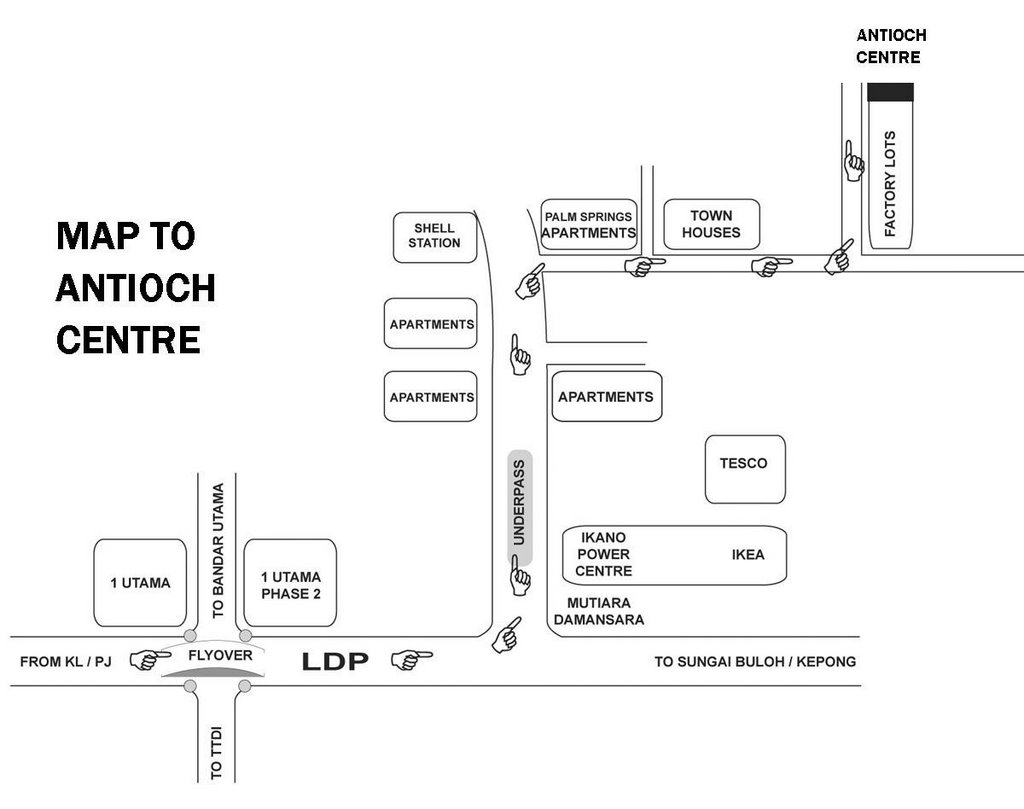
Venue: Antioch Center (Home of Bandar Utama Chapel)

Total Truth Community Learning Initiative

So far, we are extremely encouraged to see the overwhelming response to this initiative in collaboration with OHMSI and churches.

Over the course of 2007, KJ John (First Baptist Church), Kong Beng (Subang Jaya Gospel Center), Fong Yang (City Discipleship Presbyterian) and Phil DeHart (St Andrews Presbyterian) will facilitate a small group each, exploring different dimensions of the Christian faith in relation to politics, science, gender roles, social isssues etc.

The book we will read together and discuss is "Total Truth: Liberating the Church From Cultural Captivity" by Nancey Pearcey, an excellent female evangelical author.

I look forward to see exciting interactions among the groups - a healthy combination of males and females, young and old, participants from different traditions i.e. Mar Thoma, Assembly of God, Methodist, Brethren, Baptists and Presbyterian.

The take-home value, as i see it, is there will be a group of trained Christians who are equipped to integrate their vocations with a Christian worldview and engage the issues of our day in the public square.

For more details
Date: Saturday, January 27th 2007
Time: 9:45 am – 12:00 pm
Venue: City Discipleship Presbyterian Church (Map)

Universiti Malaya PKV: Put On The Mind of Christ

In collaboration with the Christian Fellowship UM, I will also be sharing to a group of students about following Jesus in their areas of studies/research/work next two Fridays. We hope to explore how Jesus himself skillfully and reasonably answered critics, and how He asked questions that open up assumptions and reveal motives.

He is "Lord of universities and research institutes, of the creative disciplines and scholarship". Hopefully seeing Jesus in action, we will have the courage to follow Him in our respective areas of study - be it in law, medical sciences, education etc - integrating faith with life.

Woud covet ur intercessions as I squeeze out some time reading Willard, Moreland, Groothius and Ramsden to prepare these sessions.

Saturday, December 23, 2006

Changing the Mind of Missions

A Book Review: “Changing the Mind of Missions: Where Have We Gone Wrong?”

The Christian church is called to be faithful embodiment of the gospel and its courageous agent of proclamation in a fast-changing world. Her missionary task can be nothing less than the restoration of God’s reign over all of life. Unfortunately, the church may become more influenced by the spirit of the age than living victoriously in the redemptive age of the Spirit.

In their book “Changing the Mind of Missions: Where Have We Gone Wrong?” James F. Engel and William A. Dyrness sound the alarm that the modern missionary movement is in crisis. The signs of crisis can be detected in the church’s captivity in modern worldview, steady decline of financial support and withdrawal into monastic ghettos that disengages from the world. There is also widespread skepticism about whether Christian lifestyles are any different from others, prompting what Ron Sider dubbed as ‘the scandal of the evangelical conscience’. Instead of purveying pessimism, the authors see it as an opportunity for rethinking missions with a Kingdom perspective today.

They identify several weaknesses that beset the mission movement today due to the infections of modernity. In particular, the Church has fallen into two errors of omissions in relation to the Great Commission. Firstly, the rhetoric of fundamentalist-liberal conflict in America has resulted in either a “privately engaging, socially irrelevant” faith or a social transformation project that neglects evangelism . Even closer to home in Malaysia, it is far more common to hear sermons on ‘quiet time’, personal piety or ‘the end of the world’ than sermons on social justice, racial integration and the church’s role in Vision 2020.

The second indictment relates to the church making converts who did not graduate to become disciples. As a result of identifying success in terms of quantifiable conversions, pragmatic techniques to disseminate facts and elicit a ‘decision’ reduced disciple-making to ‘managerial missiology’ . Time-consuming, intangible process of spiritual formation like character and holiness took a backseat. While the Scripture does provide summaries like “Believe in Jesus and you shall be saved!” we need to be aware that such statements occur within the context of a sizeable narrative. Not surprisingly, mission objectives are still spelt out in terms of number of tracts distributed and the completion of world evangelization by certain measurable dateline . Fundraising strategies geared accordingly towards highlighting numerical superiority and ‘marketable concerns’ compete for ministry revenues to the extent that legitimate, less popular causes, such as leadership development, suffer.

Engel and Dyrness also propose to revise the missionary model which has as its starting point centers of power and wealth before moving to the periphery of those who were impoverished spiritually and physically . At the beginning of the modern missionary movement, missionaries from North America and Europe were sent to various parts of the world. Their legacy in education, churches and healthcare institution endures till this day. However, the Christian faith is also seen as inextricably linked to dominance and control of the colonial powers. My leftist uncle in China could easily recite how new frontiers were opened to missionaries by the barrel of the gun. Military defeats and humiliating concessions left an indelible mark on the Chinese psyche that Christianity is a ‘Western religion’. Well-meaning missionaries often find themselves caught in the position of “reluctant imperialists” .

Diagnosis without recommending a cure makes for light work. To their credit, Engel and Dyrness prescribe several directions for decisive transformation. They contend that Scriptures make a parody of the ‘center-periphery’ model. The book of Acts recorded how the gospel made its way from Jerusalem, an insignificant backwater of the Roman Empire to the very household of Caesar. Today, churches in the so-called Two-Thirds World have emerged as significant missionary-sending contributors. They are demanding a Paul-Barnabas type of partnership with Western mission agencies rather than a Paul-Timothy partnership . Expertise, resources and knowledge to develop indigenous leaders should be imparted without using them as leverage for control. Vinoth Ramachandran described a cross-cultural, mutual-listening relationship today as indispensable for faithful witness to Jesus Christ.

Part of the ‘Gracious Revolution’ would also involve the abandonment of modernity’s individualistic autonomy and “creation of communities of common people performing uncommon deeds”. Membership in a faith community is not an optional add-on to conversion. Rather than an institution, the church should be characterized more as a community, which Leslie Newbigin called “the hermeneutic of the gospel, its very message and medium” . The full potential of a local church is not realized when its role is seen only in terms of providing resources and sending missionaries. The authors propose a paradigm in which the church takes proactive ownership of specific tasks in mission in partnership with other agencies. As Emil Brunner put it, the church exists by mission as fire exists by burning.

With regards to the ‘public facts versus private values’ assumption of modernity, Engel and Dyrness call for a recovery of the Puritan’s combination of personal piety and an all-encompassing worldview which subjects all aspects of life to God. They argue that social transformation should not be reduced as a consequence of evangelism or merely a component of evangelistic strategy. Social involvement and evangelism should be ‘inseparable elements in Christ’s kingdom that embraces all of creation’. To echo Abraham Kuyper, there is no sphere of life that is not subject to the sovereignty of Jesus Christ.


I think the authors’ critique of market-driven approaches to mission is timely. Surely, evangelism should go beyond presenting 4-point propositional facts to elicit decisions that secure a ticket to heaven. The gospel must be “modeled, and then proclaimed”. Our message would be more authentic and appealing if it is incarnate in our communities of faith, foreshadowing the eschatological Kingdom. Genuine fellowship involves mutual self-emptying, servant leadership and deep sharing of lives, not just a feel-good huddle. The authors illustrated these issues through a case study of the fictional mission agency called Global Harvest Mission. I feel that the illustrative effects are not especially necessary in contributing any substantial weight to their case.

True motivation for missions is not just “about selling some spectacular product, eternal life or forgiveness of sins, however wonderful these realities are”. The nature of gospel proclamation as heralding the kingship of Christ has solid historical basis in New Testament studies. I greet the authors’ call for a more holistic approach to mission that encompass the entire creation with a hearty amen. At the same time, I wished that they could have interacted with ‘passion for God’s glory’ as the primary motivation that has driven missionaries of earlier generations.

But it seems that Engel and Dyrness failed to discuss the pitfalls of postmodernism while lauding it as a “decided pendulum swing in a more healthy direction” . They are probably on target when discussing the emerging trend of people inundated by absolute, universalistic claims of rationality and a desire for the spiritual in the context of an authentic community. However, is the openness to experiment with various religions symptomatic of a hunger to discover what Schaeffer called ‘true truth’? Or is it simply the desire to choose any ‘truth’ that fits one’s own personal tastes? After all, if there is no objective truth, why not shop for the latest flavor in the supermarket of religions? Perhaps the authors could have recognized the challenge of mission in a postmodern culture includes affirming unique claims of Christ in the face of relativism.

Personally, I’m less sanguine about postmodernism being “one of the greatest opportunities of history for the Christian faith” . Michael Horton has an interesting analysis that what we call postmodern may in fact be ‘most-modern’ or a more radical form of the same old thing . Such modern features like autonomous individualism, specialized consumerism and suspicion of the past are becoming more rampant. Even if a new epoch is emerging, we should be cautious of its challenges as well.


I never cease to be amazed at how God could work out His redemptive plans in the world despite our faltering and sometimes, counter-productive efforts. The modern missionary movement, despite obvious weaknesses, has made significant strides to overcome geographical and linguistic barriers in bringing the good news of salvation to new frontiers. At its best, the emphasis on fundamental doctrines has always accompanied gospel presentation like personal relationship with Jesus, atonement for sins and justification through faith alone.

At the same time, we need to reexamine and align our approach to missions closer to the biblical model. Engel and Dyrness have rightly identified important areas that need to be urgently addressed. The church’s proclamation, kerygma, must be carried out in the context of authentic community (koinonia) and service to the world (diakonia). However, the antithesis should not be framed as “modernism versus postmodernism” because there is no unmixed blessing this side of heaven. The transforming power of the gospel should be allowed to speak to every culture, especially our own.

It is also crucial that we do not fall for false dichotomy in choosing between relationship over against propositions, story over against propositional doctrines, social action over against evangelism or humility over against convictions. The evangelical content of our message needs to be recovered and unleashed to renew the world, modeling a foretaste of the future Eschaton. If we do not put asunder what God has joined together, the missionary enterprise would have enduring relevance and render better service to God and men.

Bibliography

1. Engel, J.F. and Dyrness, W. A. Changing the Mind of Missions: Where Have We Gone Wrong? Downers Grove, Illinois: InterVarsity Press, 2000.
2. Sweet, L. (ed.) The Church In Emerging Culture: Five Perspectives, Grand Rapids: Zondervan, 2003.
3. Wright, T. What Saint Paul really said: Was Paul of Tarsus the real founder of Christianity? Oxford: Lion Publishing, 1997.

Wednesday, December 20, 2006

Living The Christian Faith

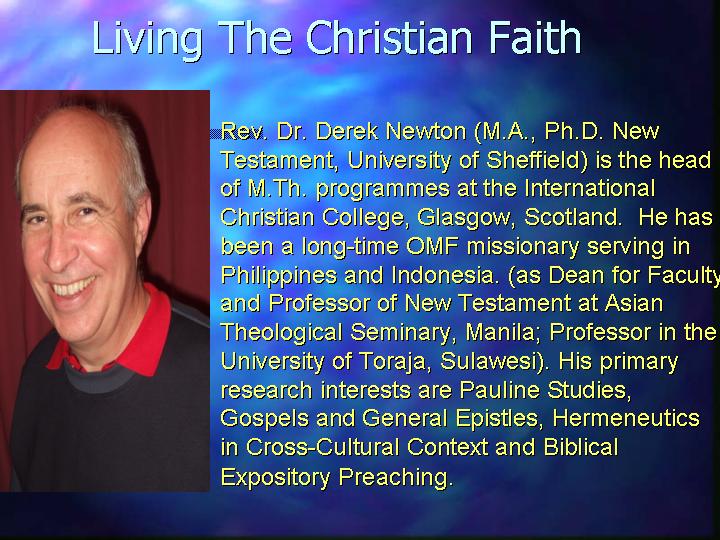
Course sypnosis: A literary and historical analysis of 1 Corinthians. Certain passages will be selected for exegetical purposes to identify the main theological themes of the book, particularly on 1 Corinthians 8-10, because of its relevance in the Asian context. The importance of applying Paul’s teaching to contemporary Christian living will be highlighted throughout the course.

Issues that plaguing the contemporary church such as sexual immorality, divisions, divorce, women leadership, food offered to idols, etc, were dealt by Paul in his epistle to the Corinthians. One could argue that 1 Corinthians is a timeless epistle to the Christian church in all ages. Dr. Newton, in his capacity as a pastor, missionary and Pauline Scholar, will bring us fresh insight into Paul’s teaching and dealing with the various issues confronting the church today. This course is intended for laity and Christian leaders to think through theologically and gain insights to deal with their church problems. For more information please contact Anne Lim (03-33427482)

Dates & Duration: February 12 - 16; 26 – 28; March 1 – 9, 2007.
Monday – Tuesday ; Thursday - Friday: 7pm - 10pm
Saturday: 9am -12pm
Venue: Malaysia Bible Seminari

Commending The Faith

Course Synopsis:
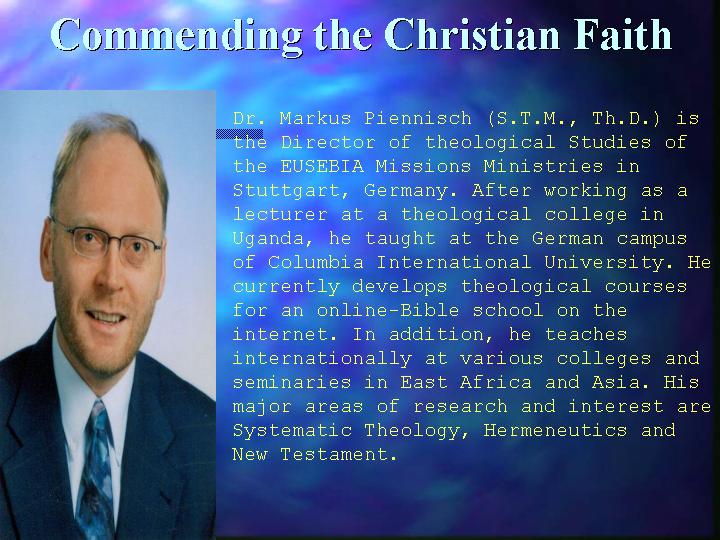
This course presents a theological and missiological introduction to the defense of the Christian faith in the global and multi-religious context of the 21st century. The subject of apologetics will be discussed from the following six aspects which provide complementary perspectives on the defense of the Christian faith. These are logical, biblical and historical aspects as well as aspects of philosophy of religion, systematic theology and theology of religions. The understanding of these dimensions will enable the students to communicate God’s truth in an evangelistic dialogue as part of fulfilling God’s mission.

In this age of moral and religious relativism, this course provides a biblical and theological framework for the defense and preaching of the Christian Faith. It is intended not only for the theological students, but also for the laity and church leaders. For more information please contact Anne Lim (03-33427482)

Dates & Duration: January 11 - 20, 2007
Monday-Friday: 7pm - 10pm
Saturday: 9am -5 pm
Cost: RM 240 – 3 Units (Graduate)

RM 120 – Audit (Graduate)
Venue: MALAYSIA BIBLE SEMINARI
1-11, Jalan Dendang 1, Kaw. 16,
Berkeley Town Centre,
41300 Klang, Selangor

Tel: 03-33427482
E-mail: mbs-ed-registrar@mbs.org.my

Sunday, December 17, 2006

Tidak, Apathy!

Discordant Dude's post "Can You Hear The Gen Y Sing?" is in the running for the People's Choice Award. Read the other 4 contestant articles and VOTE HERE

"This generation of Malaysian youth seems to chorus with John Mayer’s song Waiting On The World To Change. Inaction apparently permeates this generation - labelled by some as Generation Y - whose presence dominates our education system.

To our dismay, our education system is not in sync with Generation Y and way too often finds itself singing in a different key. While I believe much institutional change is needed to revitalise our schools and universities, I will be for the most part looking at actions that can be undertaken on an individual level in this essay.

Thus, my primary concern is on educating the Generation Y of Malaysian youth. How can educators sing in-tune with Generation-Y students and play a more pivotal role in shaping the minds of tomorrow?

Now, John Mayer’s song on the one hand seems to cry apathy, but on the other hand suggests that this apathy is actually very much misunderstood:

“Me and all my friends, we’re all misunderstood,
They say we can stand for nothing and there’s no way we ever could.
Now we see everything that’s going wrong with the world and those who lead it,
We just feel like we don’t have the means to rise above and beat it.”

My contention is that the apparent inaction of Generation Y is very much misconstrued as a form of apathy, when really it is a despairing sense of powerlessness and disillusionment with the clarion call for change of the good old days. To begin our battle against inaction is to first understand that this inaction is enveloped in powerlessness and not apathy.

Therefore, my role as an educator is chiefly one of empowerment – empowering a generation jaded with political process and public participation which seemed to offer nothing but empty promises.

Generation Y is now shaped by the new digital era, which is characterised by a saturation of information. In the Malaysian context and more precisely within our education system, information is too often imported and not contextualised.

Consequently, the first empowerment strategy is to contextualise information for a generation that longs to make sense of things. Malaysian educators must begin writing their own textbooks, localising the different forms of assessment and adapting pedagogical practices to our immediate context. In other words, we must “Malaysianise” our syllabus and classroom to bring relevance to Generation Y.

Generation Y also has the attributes of being an instant generation that wants everything fast and has an affinity for visual rather than text. In some sense, we can say that Generation Y owns a different language and hence requires a different medium of instruction.

So the next empowerment strategy is to contextualise our medium of instruction by speaking a language that Generation Y can relate with. This may mean a more visual and participative learning environment for a generation that is easily dulled. Malaysian youths are not apathetic – they need educators to help them connect to the issues surrounding them and locate their niche in affecting change. The boomer’s mentality of a grander vision of change just doesn’t work anymore.

In order to connect with Generation-Y students, our education system definitely needs more Generation-Y educators, or at least educators that attempt to understand Generation Y.

Of course, the unattractiveness of the academia to young people and the issue of brain-drain both have a lot of institutional implications. Nonetheless, there is much we can do on the ground level to inculcate a more pleasant environment for Generation-Y educators.

Having to work with boomers, Generation-Y educators may easily be misunderstood and discriminated against for their idiosyncrasies and fragmented approach to teaching, due to their disregard for a one-size-fits-all approach.

My personal experience is one which tells of being exhausted by trivialities such as dressing, hairstyle, physical appearance and unnecessary rules and regulations.

What Generation-Y educators need is a meaningful sense of vocation that perhaps can be sustained through peer support. In this regard, I have been able to initiate such informal support groups which provide a platform for the sharing of struggles and ideas for young educators. In a world where so much is misunderstood, a tad bit of understanding can push this new breed of educators a lot further.

Having said all this, do we now stand at a distance and wait for the world to change or do we rise above the system and beat it where we can? As a Generation-Y educator teaching Generation-Y students, my choice is to learn the tune of our Malaysian youth and change the one of our education system.

Do you hear the Gen Y sing? I do. I even hear their cry.

READ ON AND CLICK TO VOTE

Tuesday, December 12, 2006

Doing The Right Thing

Kairos Research Centre is extremely encouraged by the enthusiastic reception of its book Doing the Right Thing: A Practical Guide on Legal Matters for Churches in Malaysia. Sales of the book has been brisk and we are down to the last few copies in our stock.

Perhaps the positive reception of the book is an indication of a growing concern in the mind of the public sparked off by recent trends in legislation that have led to the erosion of religious freedom, and by a series of disputes involving Shariah and Civil law which has generated some tension. These events confirm our conviction that all Malaysians should be well-informed about matters pertaining to law and religion in our society.

Kairos has therefore decided to make available online—with free access—the full text of our legal handbook, Doing the Right Thing. Our hope is that the book will help readers to gain confidence to defend their right to profess, practice and propagate their religion and to remain vigilant in defending their religious rights.

We are aware that laws do go out of date and as such, it may be necessary at some point to undertake a revision of the book to ensure that it remains up-to-date and relevant to our society. We welcome suggestions that will help improve the book. Suggestions may be sent to kairos@streamyx.com. The revision will be supervised by an Editorial and Revision Committee, members of which will be announced later.

Ng Kam Weng
7 Dec 2006

Excerpt taken from Doing the Right Thing (Kairos Research Centre, 2004)

"Churches in Malaysia operate under a set of laws that imposes restrictions on their freedom to practise their faith. The Christian community has often experienced anxieties about matters pertaining to the law, which can appear complex and intimidating.

Christians feel paralysed since they are unsure if they are doing the right thing. Arising from this, there is an obvious need for Christians to be equipped with a basic knowledge of the law so that they can exercise their Constitutional right to profess, practise and propagate the Christian faith with wisdom and courage that comes from knowing that they have done the right thing in the eyes of the law. It is with this in mind that Kairos Research Centre offers this handbook to the wider Christian public.

This handbook was put together with the help of several Christian lawyers. It represents an initial step in a long-term project to help Christians keep up with laws that change over time. Conceivably, other issues will arise in the future that will need to be addressed. Hence, the handbook will need to be updated from time to time. We welcome suggestions from our readers as to how the book may be improved so that it will become an invaluable resource for the Christian community"

iBridge HeadStart

Friends, especially those who just graduated in the past 4 years. Please forward it to your friends as well.

What is Headstart?
It is a small group that meets together to discuss transition from a student life to the working world. Topics includes dealing with work pressure, office politics, work culture and lifestyle changes, relating to parents, adopting back to church life, true Christian community, being salt and light in the marketplace and finding true friends…

Besides this, probably the most important part of headstart ministry lies in the friendship that is built among the group members. Prayer and accountability are integral part of the group.

Who organizes this group?
This Headstart program is organized by iBridge (www.TakeTheLeap.org), a ministry of Graduates Christian Fellowship (GCF), a sister organization of FES and SU. We are a Inter Denominational ministry.

How often does the group meet?
Once a month for 12 times (1 year). Some groups have a spiritual retreat half way through the program. After 1 year, the group ends… but the friendship definitely carries on. Please note that once the group starts, no new members are allowed into the group.

Who should join?
Those who have graduated less than 4 years ago. So if you have graduated this year or last year or up to 4 years ago, then you should join.

Where does the group meet?
The group meets in a house setting. We start groups all over Malaysia depending if there are any request.

Who will lead the group?
Each group will be led by 2 leaders (facilitators) who are matured and capable to handle the group. Usually, the leaders themselves have been through headstart or some senior people who have been very involved with young graduates ministry.

Past Figures
In the past 5 years, we have started more than 28 groups in Klang Valley, Ipoh, Penang and Melaka. More than 200 members have attended this headstart groups and nearly 60% attended the whole program. If you are planning to join Headstart, please make this a priority.

Do I have to pay to join the group?
No, it is free.

How do I join?
Contact James Daniel at vjd@tm.net.my

The Science of Archaeology & the Old Testament

This is a brief explanation of how science helps us understand the Bible. The full ACT seminar in New York will be delivered in 2007. This lecture was delivered at the December 2006 session of Project Timothy at City University of New York’s Hunter College in Manhattan.

Archaeology is the study of antiquity by examining material remains of past human life and activities. It uses modern scientific methods to recover these material remains and infer the meaning of the past, of ancient humans, and his environment. But archaeology is not an exact science – in fact, no science is an exact science. The only exact field of inquiry is mathematics, and that is not strictly speaking, a science.

Biblical archaeology operates at the intersection of theology and history with the tools of science expressed in technology. It shows vividly the importance of science for religion. This interaction is an important element of ‘iron sharpening iron.’ The art and science of biblical archaeology exposes both the science of religion and the religion of science. No religion exists without an appeal to the scientific explanation of reality. By the same token, no science can thrive without faith in even though scientific progress demands the demise of previous achievements.

Old Testament archaeology is the selection of evidence for these regions and periods in which the peoples of the times lived. Why is archaeology important to Old Testament studies? They provide extra-biblical confirmation of many details of biblical history and acts as correctives to many erroneous interpretations. This means that the art and science of biblical exegesis and hermeneutics relies a great deal on inferences we draw from archaeology. Hence, our understanding of the sciences as well as the artistic imagination of the human mind shapes the way we interpret archaeological evidence. This in turn shapes our interpretation of the Bible itself.

Archaeology has rediscovered whole nations, resurrected important peoples, and in a most astonishing manner filled in historical gaps, adding immeasurably to the knowledge of biblical backgrounds.

In Palestine, of the 6000+ archaeological sites that have been surveyed only about 200 have been excavated to some extent, with around 30 sites excavated to any major extent. Of the estimated 1 million documents recovered from OT times, less than 10% have been published. The typical time between recovery and publication is 10 years since almost all archaeologists work only during the summer months, when they are not teaching. The precise locations of many OT places remain in dispute because of uncertainty and changing local names.

3 Points to remember:

1. Archaeology is essential to properly understand the historical context of the Bible. The Bible relates a literary, elitist version of the religion of Israel, whereas archaeology reveals the social context of Israelite religion, including folk religion and counterculture.

2. The Bible, while not a book of history, should be considered a book with elements of history. Despite the ideological slant of the biblical authors, the Bible contains verifiable historical data.

3. Archaeology cannot either prove or disprove the Bible.

Sunday, December 10, 2006

Good News for a Bad Day at Work

I suspect you've experienced some really bad days at work-the kind that made you wonder why you even got out of bed that morning. Perhaps it's the loss of a sales opportunity you've been working on or the demise of a critical project. On other occasions, bad days may arise from conflicts with coworkers, bosses and clients. Needless to say, after nearly 20 years in the technology arena, I've had my share of "bad days".

How do we respond in the face of these adversities at work? Does God have a purpose in the midst of our troubled day? Is there really good news for a bad day at the office?

If you find yourself in such a situation, here are a couple of ways, I believe we can view our circumstances and respond biblically -

The first and best thing we can do is to preach the gospel to ourselves relentlessly. However, there are two temptations that may hinder us in this regard.

The first is to think of the gospel as a message for unbelievers that we "graduate" out of when we come to faith in Christ. This kind of thinking in wholly incorrect. The good news of Jesus Christ is a life giving message for all - for those yet to respond in repentance as well as those who have come to faith but continue to live in this fallen world.

Another temptation is to think of the gospel as impractical to matters of our vocation. Many Christians, myself included, may unwittingly treat our work life in the "marketplace" as a gospel free zone. Sure, the gospel may be applicable on in church or even at home...but at work? Yet, these are the very moments that the gospel is most applicable. We need to be reminded that no matter how pressing the problems may be at work, they cannot compare to our greatest problem - the problem of our sin. For this predicament, God has provided a remedy at great cost to Himself. We need to infuse our hearts with gospel centered scriptures that lead us to meditation. Passages like 1 Peter 3:18, 2nd Cor 5:21 are dripping with gospel truth.

The second way to respond in face of a bad day is to consider our adversities with godly purpose in view. I find that adversity is often a way that God reveals His eternal worth to us. It is not the experience of trials that lead to maturity but how we encounter and engage those trials. Trials are designed to remind us of the temporal nature of this life and the eternal worth of knowing Christ. On a recent bad day, I found myself fraught with anxiety yet I sensed the Holy Spirit reminding me of 2 Cor 4:17-18

"For our light and momentary troubles are achieving for us an eternal glory that far outweighs them all. So we fix our eyes not on what is seen, but on what is unseen. For what is seen is temporary, but what is unseen is eternal."

I was also encouraged to desire God and hope in Him from Psalm 73:25 where David writes

"Whom have I in heaven but you. There is nothing on earth that I desire beside you. My heart and my flesh may fail but God is the strength of my heart and my portion forever."

This is good news indeed!

If you want more good news for a bad day, check this out.

Friday, December 08, 2006

Interview with Raj Singh

Raj and Margaret Singh

On the 22-25th of November, I had the privilege of joining a group of great young people making an impact in the Klang Valley, worshipping Jesus through serving the underprivileged and homeless. At the end of it all, I managed to interview the man, Ps. Raj Singh, the big guy behind Soul Survivor Malaysia who also happen to be the Senior Pastor of Christian Life Gospel Centre. Here I include the transcript of our conversation (Note : It is a recollection of the interview. The accuracy of the words and information may be disputed, but the content is almost similar to our conversation).

Read on

"If we truly want to be an authentic church, we need to show to the society that although we are very different in our cultures with Malays, Chinese, Indians and other races, with different social classes, and languages, because of Christ and the power of the Gospel, we are able to pull things together as a caring vibrant community of believers. That is a great testimony to the world. Although we are not able to do this effectively now, we are learning to make the church more welcoming to the poor be it the way we run our services, the language we speak etc. If we are not able to integrate, then how different are we from the society which is so fragmented out there?"

Biblical Preaching

Biblical Preaching : An Introduction

The goal of this one day seminar is to introduce participants to all the key facets of preaching from the bible in the 21st century.
As a result of taking this seminar, participants will know both the theology of biblical preaching and a methodology for doing it. A practical worksheet will also be introduced that will give a suggested template for sermon preparation.

Topics:
1. A Theology of Preaching.
2. Preaching in a “media” age.
3. The Need for Sermon Organization.
4. The Structure of the Sermon.
5. Interpreting the Bible.
6. Preparing the Sermon
7. Delivering the Sermon

Instructor
Tan Soo Inn (BDS Singapore, ThM Regent, DMIn Fuller), Founder and Director of Grace@Work (www.graceatwork.org), a ministry committed to seeing lives transformed through friendship and Scripture.

Details
Date: Saturday, January 20th 2007 (Ahwal Muharram)
Time: 10:00 am – 4:00 pm
Venue: Antioch Center (Home of Bandar Utama Chapel)

28, Jln PJU 3/41,
Sunway Damansara,
47810 Petaling Jaya
Selangor, Malaysia.

Registration
We need to know if you are coming so that we can prepare enough materials. (A freewill collection may be taken to help defray costs.)

Bandar Utama Chapel members and friends please inform Lai Nai Kyn, Email: nklai@industronics.com.my, if you plan to come. Agora folks and everybody else please inform Dave Chong, Email: hedonese@yahoo.com if you plan to come.

We thank God for those among us whom God has gifted to do expository preaching. But the responsibility for speaking God’s truth lies with all of God’s people. Our goal should be the same as Paul in Romans 15:14 which is addressed to the whole church:

“I myself am convinced, my brothers and sisters, that you yourselves are full of goodness, filled with knowledge and competent to instruct one another.”

This seminar is a serious attempt to help us grow in the competence needed for us to instruct one another.

As we enter the 21st century we need many saints to be able to teach God’s Word. Therefore we encourage as many as possible to take advantage of this learning opportunity.

Thursday, December 07, 2006

Our Reason For Being

Dear Friend,

Welcome to Our Reason For Being. It hosts a series of reflections that addresses the question of the meaning of life.

It is undeniable that we all have a deep-seated desire to make sense of life. Existential psychotherapies seek to help us find a meaning in life, a purpose to live for. But we do not seem to be satisfied with having just any reason for living. What is the whole point of being born only to die some time later? Human beings seem to have an innate need for the (not just a) meaning of life. Our heart seems to cry out for the purpose of our transitory existence in this world.

This series of reflections is written in response to this cry for meaning. It is an exposition of the biblical book of Ecclesiastes. You would be amazed how relevant this ancient piece of wisdom literature is to contemporary thinking and living. Ecclesiastes addresses our need for the meaning of life in a rather comprehensive, coherent and compelling manner. I invite you to take the journey to explore with me what this book has to say to us.

I hold a doctorate in Near Eastern Languages and Cultures from the University of California, Los Angeles. I have been teaching a course on Ecclesiastes for more than ten years. I offer this exposition to you as a fellow pilgrim in search of our reason for being.

At the moment the reflections are offered in installments. The expected date for the upcoming installment is indicated.

The beginning of the journey is just this CLICK away.


Sincerely,
Leong Tien Fock
tf.leong@gmail.com

Rethinking Peter Singer

Peter Singer is one of the most popular thinkers/ethicists of our time. I found out that he taught some fantastic stuffs about humane treatment of animals, environmentalism and the poor; also some controversial and disturbing views on infanticide, euthanasia etc. So it was good to chat a bit with Gordon Preece and got his autograph on the book on "Rethinking Peter Singer" frm Canaanland.

Here is a nice review of the book:
“Since neither a newborn human infant nor a fish is a person, the wrongness of killing such beings is not as great as the wrongness of killing a person.”

“…regarding a newborn infant as not having the same right to life as a person, the cultures that practiced infanticide were on solid ground.”

These are two of four quotes from philosopher Peter Singer that were featured in a quarter-page ad in the Australian newspaper during the 1996 federal election. The Australian Family Association took out the ad because Peter Singer was running as a Green Senate candidate. Fortunately for the unborn, the newborn, the elderly and many other “non-persons”, Singer received only a tiny fraction of the vote.

He now teaches at Princeton University, after a long career at Melbourne’s Monash University. He has written over twenty books, and is regarded as a leading contemporary philosopher and bioethicist. He is famous for his advocacy of animal liberation, as well as for his callous view of human life.

This new book, edited by an ethicist at Melbourne’s Ridley College, contains five important articles offering a critical assessment of Singer’s philosophy and writings.

After an incisive introduction, Preece offers a close look at the man and his work in chapter one. While recognising the relative consistency throughout his writings, he points out the well-known inconsistency of his regard for his mother has she wrestled with Alzheimer’s disease. He rightly notes that on the basis of Singer’s utilitarian and consequentialist outlook, he should have bumped off his own mother. But fortunately for his mother, “Singer is a better son and person than ethicist”.
Read on for the rest of the review

Tuesday, December 05, 2006

Steely Zest For Life

It was a humbling experience the first time we met Carol and got to know about her trust in the Lord and courage to take on the challenges of life. She is a heaven-sent miracle right in front of our eyes. Here is an excerpt from New Straits Times

KUALA LUMPUR: She was born with brittle bone disease, and doctors warned her parents she would not live long. But even as a baby, Carol Rasiah was a fighter.

Now 35 years old and confined to a wheelchair, she radiates joy for living and gutsy determination.

A part-time writer and small businesswoman, she says the most painful experience in her life was missing out on a formal education. There were not many schools for the disabled in her youth.

"Even when I had the opportunity to go to school, the teachers were afraid to deal with my physical condition," says Rasiah.

She has the rare bone disease osteogenesis imperfecta, a genetic disorder which causes weakened bones that fracture and break easily. In its more severe form it can prevent growth and lead to malformed bones and breathing difficulties.

Rasiah earns a living running a small sweets shop, and she contributes articles on her perspective on life to international magazines. She’s a part-time volunteer with the Beautiful Gate Foundation for the Disabled in SS2, a training centre and residence. She dreams of taking computer and journalism classes.

Despite the many challenges she faces on a daily basis, pity is not a word in her lexicon.

"I don’t believe in sympathy. I believe the disabled and the able should live together as one community. I understand that sometimes able-bodied people feel uncomfortable, and also that not all disabled people can communicate well, but that can be changed," she said.

She was attending Petaling Jaya City Hall’s International Disabled Persons’ Day celebrations.

Thursday, November 30, 2006

Postmodernism defined as self-referential absurdity

Do check out this episode of Ockham's Razor in which Author Larry Buttrose takes a critical look at postmodern theory which has enjoyed great popularity in Universities for a long time but is now in decline;

Larry tells us;

"The rococo tabernacle of intellectual chic, Theory enjoyed vogue in universities worldwide, but now finds itself closely interrogated. So great has postmodernism's own crisis become that at the start of semester in a compulsory Theory-based writing unit at one Sydney university, students had their tutor commiserate for the pain they would have to endure, and hand around chocolates ... In some ways comparable to John Howard's like-minded scientists who have for the past decade reassured us that all is well and that the earth does indeed remain flat.

Chocolate-coated or not, Theory leaves a bitter aftertaste. Following a recent newspaper publication of my critique of it, the emails I received, overwhelmingly in favour, came mostly from graduates lamenting their precious educational time wasted on Theory as undergraduates. Despite ructions murmured within, the academy kept mum, but the Empire might well still write back, at a time of its own choosing."

Read the full transcript here or download the MP3 Audio narrated by the Author here.

------------------------------------------------------

Larry Buttrose is doing a PhD on creative writing at the Southern Cross University in Lismore. And his latest book is called 'Powerful and influential - people who have changed the way we think.'

Monday, November 27, 2006

Policy of Basic Respect

TRICIA YEOH, a Senior Research Analyst with a public policy institute, wrote:

OUR prime minister, in closing the Umno General Assembly last week, said that leaders of a race who respect and honour the Federal Constitution must also be responsible enough to defend the rights of the non-Malays. He reminded his members that Barisan Nasional, the country’s coalition government, should make decisions based on what is best for the country and its people. Indeed, one accedes to our country’s premier a merit of consistency in calling for tolerance and respect for all ethnic groups alike.

Recent statements by his fellow party members have therefore been more than a little confusing to the public at large, leaving the following examples ringing in our ears.

Bangsa Malaysia, a fundamental concept in espousing national unity in our multi-ethnic country, has been rejected in favour of limiting the definition of Malaysians to Malays being the main, or pivotal, race in the country. Leaders of Barisan Nasional component parties have been chided for expressing their fears that the communities they represent are being sidelined. Strong and offensively racial statements have been reportedly made in the duration of the past week. An Umno leader was asked when he would use the keris (the traditional Malay dagger) some time after brandishing it at the general assembly.

Now, such assertions are reflective of either a serious contradiction in terms upon which our national leaders seem to operate, or a gross misunderstanding of the prime minister’s rhetoric of justice and respect for all.

In either case, the public is greatly puzzled as a result. It is becoming increasingly difficult to correspond Pak Lah’s noble calls for tolerance and harmony with those that are in blatant disregard of the most basic respect for humanity, perhaps even falling short of being classified as seditious.

Indeed and rightfully so, the Umno Youth Chief has cautioned that stern action be taken against those who play the racial card for political interests. To the keen observer, however, it does strangely seem as if many may already be culpable of this very warning.

A cost to national interest

This unfortunate inconsistency brings about several consequences. Firstly, it brings the level of national discourse several steps down the intellectual ladder. Quality debates founded upon informed facts, and not biased opinion, should be the order of the day. A great deal more time and energy should be spent on discussion which encourages new long-term strategies feasible for the country. Instead, recent babble demonstrates that Malaysians are contentedly myopic in its obsession with race and religion.

Secondly, it shows the lack of commitment to seriously tackling issues of national development. In such an age of globalization, economic competitiveness and ideas to improve trade and investment ought to be high up in the list of discussion content. Our neighbouring countries continue to improve by leaps and bounds in foreign direct investment, whilst Malaysia slides sluggishly to 62nd place, according to the 2005 UNCTAD FDI rankings.

The quality of tertiary education, both in teaching methods and content, needs to be brought to an international level. That none of these was the key focus of the recent Umno assembly, the country’s largest political party, is especially worrying.

Finally, if this perceived discrepancy continues, it inevitably comes at a cost to national unity – ironically enough, the primary goal that Vision 2020 sets out to achieve. The fear is that such sentiment of racial undertones, intentionally or not, would then seep to the masses. Nobody wishes for such a situation to come to pass.

Platforms of understanding

There are, however, solutions that can be sought. Basic ground rules should be set up and strictly adhered to. Statements that hint at compromising national unity in any way should be reprimanded. This should apply to all leaders in all public discussion, including parliamentary debates. Condemnatory insults of any race or religion should not be tolerated under any circumstance. In short, there should be conscious effort to move away from clamour and steadily towards rational dialogue.

Forming such common platforms of understanding is the first step forward. It should be collectively agreed that a basic level of respect for humanity, in line with Islam, is to be maintained, both in speech and in action. This agreement should not come as a result of coercion, but of willing and intentional decision by all parties. While it is true that many national policy issues will not be as quickly or easily resolved, at least one should stand tall as the benchmark against which all others are evaluated: national unity.

There is an urgent need to demonstrate that the political leadership is ready and willing to be consistent in its various policies and public statements. Failure to do so leaves the public in the dark as to which is the most accurate or sincere in nature. National interest must be seriously considered, a wake-up call that insular thinking will bring us nowhere.

If the government is serious about its philosophy of respecting and defending the rights of all races in Malaysia, then let’s have less talk about theoretical notions and more action.

I quote from Pak Lah, that “one of the nine thrusts of Vision 2020 is to create a mature democratic society. We have stated our desire to work towards establishing a mature, liberal and tolerant society. If we are serious about this goal, we must pursue the process of transformation with diligence.” I concur.

Read on for a good example of being a witness in the marketplace

Wednesday, November 22, 2006

Preaching Workshop

Wanna learn more about preaching or homiletics?
Soo Inn has promised to conduct a course on preaching for friends in Bandar Utama Chapel and for Agora. He suggested to do the theory component in one intensive Saturday seminar.

Date: Jan 20 2007
Time:10am - 4pm
Venue: Bandar Utama Chapel (Antioch)

Interested ones can contact us at hedonese@yahoo.com or sooinn@graceatwork.org "This will be a big help. I am looking forward to this seminar because I truly believe preaching God's word is not just for a few
pulpit superstars (and we know what can happen to them) but for all of God's people. I want to empower as many as possible. Thanks for your partnership. Soo Inn"

Freedom From Cultural Captivity

Agora, OHMSI and CDPC are co-hosting the above Study of Nancy Pearcey's book called "Total Truth: Liberating Christianity from its Cultural Captivity" for anyone interested. Our target group is all those between 25-40 years of age; although technically there are no age limits.

The Objective of the Study is "to review existing and mainstream worldview
assumptions and to reform our own thinking to evolve a biblical and Christian worldview which will guide us to think and act accordingly."

The Guidelines for the book study are:

1. It is a one year commitment, and the participant is responsible to get your own copy of the book. (contact Hedonese or Canaanland) Prior reading of the Chapter to be discussed is required and there must be a willingness to speak and participate at small group levels. Those who have not read the chapter cannot participate in the discussion. We cannot miss more than one session consecutively to remain in the study. Punctuality is critical, and all are advised to arrive 15 minutes before start time to fellowship.

2. We agree to "wait upon the Lord and pray for the leading of the Holy Spirit" in how the Lord wants to "use us in the public affairs of life" as a direct result and encouragement from the study. As the Lord leads, we will follow through these "actions" as a commitment to the Study Group.

3. Study Group members agree to become part and parcel of the Action Movement portion of the National Congress on Integrity (NCOI) currently jointly organized by OHMSI and GCF.

4. Format for each session:

-10 minute overview by a Speaker and some questions/issues to consider
-60 minutes discussion of the chapter in small groups; and to raise issues which cannot be resolved
-45 minutes of plenary discussion to resolve any unresolved issues from the discussion and wrap up

5. We will all endeavor to start our own similar study group elsewhere upon completion of this study. Also, at about the final sessions (Oct/Nov 07
or Dec/Jan 08), the meet days may be collapsed into a retreat away from KL and
over the weekend to finish well and to focus on any really BIG ISSUES THAT
REMAIN UNRESOLVED. We could even invite other Elders to join us for differing views.

6. Start date is 27th January 2007 and every last Saturday of the month after that for the rest of the year, except if festival holidays coincide.
Start time is 10.00am to finish by 12.00noon. Place is fixed at CDPC
(See Map available at http://cdpc.org.my). All are encouraged to arrive by 9.45am to fellowship before start time. A "willing and able hunger lunch fellowship" will follow for those interested and can spare the time.

7. Please pray that all those interested and ordained by God will be able,
available and make the commitment to come. God Bless.


Yours because His,
KJ John,
OHMSI.Net

PLEASE FORWARD TO ANY OTHERS WHO MIGHT BE INTERESTED