Tuesday, November 21, 2006

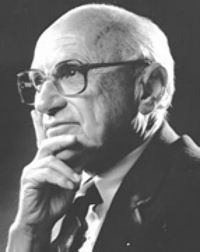
Tribute to Milton Friedman (1912-2006)


The last 50 years of the worlds economy has been a struggle between the forces of the ideas of John Maynard Keynes and Milton Friedman. Keynes comes from the more European styled more government intervention liberal perspective and Friedman form the American styled conservative deregulated free markets. These two forces worked well correcting each other, so much so that I have heard a prominent economics professor say that the Capitalism practiced today in America would have been called Socialism 100 years ago.

My conclusion, learning from the great economist and lectures of our time is that the markets must be free enough to be a messenger to us – and then the government steps in after that to repair and restores the causalities left behind by the market, only when there are no other options left.


I guess I would side more with the Friedman school of thought, not because I would like to see Laissez-faire economics oppress people again, but as Friedman said in his famous essay, “Is Capitalism Humane?”;

“Capitalism per se is not humane or inhumane; socialism is not humane or inhumane. But capitalism tends to give much freer rein to the more humane values of human beings. It tends to develop an atmosphere which is more favorable to the development on the one hand of a higher moral climate of responsibility and on the other greater achievements in every realm of human activity.”

Freer markets tend to develop the economy better, and a developed economy can produce more resources to help others. Now granted that the money may be hoarded by the elite, this is why the governance and policies of a nation are also so crucial, and in my Christian interest, I want to see the poor and marginalized helped with both their dignity in their self effort intact and when they cant put in any effort – then I want to see them helped without killing the goose that lays our golden eggs.

I post this mainly as a tribute to Milton Friedman, who passed away last Thursday, 16 November 2006. A great economist in the tradition of Adam Smith, he was known as the great champion of economic freedom in the 20th Century.

The short summary of Friedman’s life and work can be found on AdamSmith.org;

Friedman is best known for his monetarist policies – insisting that inflation is highly destructive and that only monetary policy can control it – but that monetary policy is a heavyweight instrument and cannot be used for short-term economic management. But he is also distinguished for pioneering work on other subjects such as the unintended effects of professional licensing and prise regulation, tax policy, and the theory of the consumption function.

To find out more, get his book Capitalism and Freedom: Fortieth Anniversary Edition

or to learn about Friedman and some other important economist in history check out this resource:

Legacies of Great Economists (Course No. 528)
(10 lectures in MP3, 45 minutes/lecture for USD 15.95)

Taught by Professor Timothy Taylor for The Teaching Company
Macalester College, M.Econ., Stanford University

Thursday, November 16, 2006

Umno Presidential Address

The following press statement was issued today to the major newspapers. Kindly read through and continue to pray for our country

Press Statement Nov 16, 2006

Malaysian Evangelical Christians Hails

Umno President Presidential Address


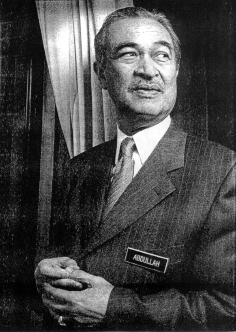
NECF Malaysia lauds Umno President Datuk Seri Abdullah Ahmad Badawi for his firm and assuring statements made while delivering his presidential address at the opening of the 57th Umno General Assembly on Nov. 14.

His statements reflected his sincerity and commitment to his responsibility as the Prime Minister of all Malaysians.

NECF particularly notes and welcomes his specific commitment to:

Firmly act against any group, whether Muslim or non-Muslim, who incites the public with "bogus allegations and fictitious threats";
Reject any demonstration of the "new intolerance";
Strengthen national unity, to promote cooperation and dialogue;
Uphold meritocracy and to promote excellence as the way forward for Malaysia, and "no race should be left behind in terms of educational attainment";
Eradicate poverty regardless of racial background;
Enforce the rule of law in battling against corruption in particular;
Advocate good governance: political leadership should provide "best possible example by displaying honesty, diligence, dedication and commitment"; and
Affirm freedom of expression in rational manner: "a nation should provide channels that enable its people to voice their concerns."
Although his speech was read in his position as the Umno president, NECF deems his message beneficial to all Malaysians as it aims at raising a generation of united and progressive Malaysians who are able to tackle the challenges of a globalising world.

However, NECF regrets the statements made by several Umno leaders, which appear to go against Datuk Seri commitment towards national integration and unity.

Their statements further demonstrate an unhealthy superior attitude by blaming on and unnecessarily issuing warning statements against the people of other races.

NECF notes with deep disappointment their statements that the rights of Malays were being threatened by the other races. Such statements made so publicly are likely to breed resentment in the hearts of our Malay brethren, and is definitely injurious to peaceful race relations in the country.

NECF is also disappointed by some Umno leaders for rejecting the setting up of an Interfaith Commission and discouraging discussion on constitutional provisions.

--------------------------------------------------------------------------------

Prepared and released by NECF Malaysia Secretary-General Rev. Wong Kim Kong, J.M.N. For assistance, please contact Rev. Wong at 016-229 2017.

Wednesday, November 15, 2006

Puritan Lessons on Faith and Work - Part 2


The Puritan view of vocation not only legitimized all manner of work as service to God but also had practical implications in the way work was conducted. One such implication was exemplified in the Puritan’s motivation for his life’s work. Imagine a young man seeking to make choices regarding his career choice. What might he receive as career counseling advice from his Puritan elders?

Here’s a possible sampling of their sage advice which I’ve “distilled” into a few key takeaways –


Key advice: Have a high view of why you work

“Some man will say perchance: …must we not labor in our callings to maintain our families? I answer: this must be done but this is not the scope and the end of our lives. The true end of our lives is to do service to God in serving of man”
William Perkins

Key advice: Don’t be motivated by fame or fortune but rather by a desire to serve.

“Choose that employment or calling in which you may be most serviceable to God. Choose not that in which you may be most rich or honorable in the world; but that in which you may do most good...”
Richard Baxter

Key advice: Carefully assess your gifts when choosing your life’s work - they are a possible indicator of God's leading

“Another thing to make the calling warrantable is when God gives a man gifts for it…When God hath called me to a place, he has given me some gifts fit for that place, especially if the place be suitable and fitted to me and my best gifts…”
John Cotton

Key advice: Be on your guard against selfish, worldly ambition as you pursue your life’s work.

“Take heed lest, under the pretense of diligence in your calling, you be drawn to earthly-mindedness, and excessive cares or covetous designs for rising in the world”
Richard Baxter

None of this is the kind of advice we're accustomed to hearing or the kind of thinking we carry to work daily. We're not often exhorted to pursue work for the purposes of service nor are we advised to be cautious of selfish ambition. Instead we are often ambitious without caution and pursue work for wealth-building rather than service. This unusual thinking is at the heart of the Puritan work ethic. I suspect it sounds strangely out of place in the corporate world today not because it's antiquated but because it's counter-culture.


For more reading on integrating faith and work:

Puritan Lessons on Faith and Work - Part 1
Ambition and the Christian

Theistic Evolutionist you should know


Here is a short tribute to some of my heroes of the faith who laboured to synthesize their convictions that the truth of biology and zoology and the truth of the bible must meet at the top. Men like Asa Gray;

The leading American botanist of the nineteenth century, Asa Gray helped organize the main generalizations of the science of plant geography. The manual of botany that carries his name is still in use today. Friend and confidant of Charles Darwin, Gray became the most persistent and effective American protagonist of Darwin's views. Yet at the same time, he believed that religion and Darwin's theory of natural selection could coexist.

See the list.

Saturday, November 11, 2006

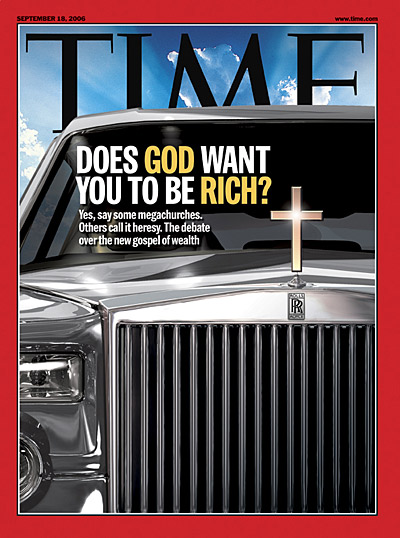
Examining the Theology of the Word-Faith Movement


Health and wealth are two major concerns of many people. Therefore anyone who offers a guaranteed package of health and wealth will attract many people.

Three of the four megachurches in the United States belong to the Word-Faith movement. These churches are Osteen’s Lakewood in Houston, Creflo’s Dollar World Changers near Atlanta and T.D.Jakes’ Potter House in south Dallas.

The Word-Faith movement is also called the Positive Confession movement because of the importance it placed on the spoken Word of God and God Faith. It is also described as the “Name It and Claim It” movement, Health and Wealth theology or just Prosperity Gospel.

This article will examine the theology of the Word-Faith movement from the perspective of Reformed Theology

read more at www.kairos2.com/word-faith.htm


The Apprentice

Consistent with the CPDC vision to leadership development, college and university students have undergone the Habitude leadership course by Tim Elmore. One of the young graduates who chose to remain anonymous shared an encouraging testimony of how the Lord taught her a lesson while she went for a McKinsey interview. (Just to give an idea how tough it is to get a job here, let's just say the process is similar to TV reality show The Apprentice)

Cause here you have to compete with a bunch of the brightest graduates around, going through a long series of workshops and get risk 'elimination' after each round.

The first assignment was to write an essay on "Which leader inspired you the most? Why?" My friend thought she would write something true to herself. So naturally, she wrote about Jesus and passed it up.

But when the Director asked the group of young guns, "Who's the inspirational leader you wrote about?" answers came up like "Clinton!", "Gandhi", "Mother Theresa", "Bill Gates" and so on.

At that point, my friend was quite embarassed. Imagine how politically incorrect in that corporate setting to say, "Jesus!" She remained silent.

But just then, the Director produced a selected essay and read it out:
"This is the best essay I've seen. It's original and I want you all to be like this".

Guess what? It's her essay about Jesus. And she felt the Lord is teaching a lesson here, "You don't need to be embarassed of me. Stand tall for Me in the marketplace".

Wanna know what she wrote? Here is the essay:

QUALITIES OF A LEADER

A leader whom I admire greatly once told me, that to be a great leader, one must be the servant of all. As paradoxical as it sounds, it holds great depth of meaning in addressing the qualities of a leader.

I believe for a leader to be a servant of all he must first possess humility, a heart that is teachable. He must be willing to learn not only from the mighty and the strong but also from the weak, plain and simple. A humble leader is also one who is willing to serve and to work side-by-side with his followers, seeing them as his equals.

Integrity is also another essence of a leader. There must be a consistency between what he preaches and what he practises – ‘walking the talk’ in his lifestyle and leading by it. Integrity in a leader also means a steadfast grip to values and beliefs in all circumstances and to remain wholesome through it.

Finally, I believe a leader should not only have dreams and visions but to be able to inspire others to achieve them. He must be able to bring out the strengths of each follower and also be ready to accept their weaknesses with respect, while achieving the goal. As Peter Drucker mentioned, “The only definition of a leader is someone who has followers”, it is imperative then for leaders to have not only the above mentioned qualities but definitely more and beyond in order to have followers.

Friday, November 10, 2006

从基督 看 同性恋

从基督徒伦理的角度来看, 同性恋是一门相当复杂的课题. 它牵涉到法律,社会心理学及医学, 甚至神学思考和圣经的基础原则. 虽然圣经有关<性>与<犯罪>的教导对基督徒伦理有关键性的影响, 但同性恋的课题并不能够只用几个圣经里的例子来作结论.

我经常被一些肤浅的解说困扰了我的思想; 尤其是针对同性恋这种触摸到人内心深处复杂情感的课题. 然而, 身为基督徒, 我们不应廻避神学及圣经对这课题的释义;因为,我们是本着圣经为我们安身立命的终身原则.

在现今时代,作为耶稣基督忠诚的跟从者,我们更要深入思考圣经及神学论在同性恋这课题的教导. 有所谓一群同性恋基督徒, 更是自创及推广了他们自己一套的哲理,导致同性恋这风气也越来越盛旺. 他们甚至曲解了圣经, 并且坚持圣经的教导和同性恋的立场是没有冲突的, 尤其是对于一生只有一位(同性恋)伴侣的主张, 他们认为这是符合圣经教导的.

(当今, 同性恋的风气已经侵入大马,近期更有一位知名的基督徒作家当众宣告他是一位同性恋者. 这位同性恋基督徒也向公众表明了他的展望 - 也就是在他完成他现今在美国的社会与神学博士学位后,将会回来大马组织及开办同性恋者的教会.)

那么, 到底圣经在同性恋这课题是有着怎样的教导及解说呢? 我认为教会在这方面, 则应该以更谦卑的心态来了解圣经所提供的资料。别忘了不久以前,就有一些教会以主观的解圣来支持种族主义和奴隶的观念。

当我们查考圣经时,就知道其实圣经中讲述到关于同性恋的课题是很少的。

Richard B. Hays说过:

“圣经很少深入地讨论到关于同性恋的课题.反观贫富不均这课题, 圣经倒是有很多的解说及教导.”

但是,无论如何,圣经里对于同性恋这回事, 仍是有着明确的立场表明。特别是通过罗马书1:26–27的经文表达,是再清楚不过的。

“因此,神就任凭他们放纵可耻的情欲:他们的女人把原来的性的功能,变成违反自然的功能;同样地,男人也舍弃了女人原来的性功能,彼此欲火攻心,男人与男人作出可耻的事。他们这样妄为,就在自己身上受到应该受的报应。”


首先,圣徒保罗在这段经文中, 是指着同性的性<行为>; 而不是指着那些有着同性恋倾向的人,被保罗责备的是男同性恋及女同性恋的性<行为>. 反观歌林多前书,圣徒保罗则是在指责那些身带一些罪恶的罪<人>。在罗马书1:26–27的经文里, 保罗是指着所有的罪人而说的 - 所有的罪人都陷入了背叛他们创造主的罪恶当中。

保罗的立场是很明确. 他说世人都犯了罪,亏欠了上帝的荣耀. 更甚者, 在这段经文中, 保罗把<同性性交行为>举例为人类堕落最典型的罪恶。

再者, HAYS先生也说:

“在这里保罗把同性性交行为作为最典型的范例 - 人类的堕落已把上帝创造的定律大大的给破坏了。上帝创造男人、女人是为了让他们生养众多。当人类以自己的意思来‘更换’ 上帝所指定的角色,而进行同性性交的行为,他们已经以自己的行为,潜意识自主地代替了上帝。”

保罗在这里使用同性恋行为作为典范的例子来形容堕落的人类,是因为我们很清楚的知道, 我们人类是被上帝创造为男和女各别异性的. 使徒保罗在这段经文中描述的很清楚,同性恋不是上帝所意识及认同的.

“于是,神照着自己的形象创造人;就是照着他的形象创造了人;他所创造的有男有女。”(创 1:27)

所有背弃男与女性行为的定律,都是一种对上帝- 我们的创造主的污辱。

我们现今活在一个堕落的世界当中,有些人生来就有着强烈的同性恋倾向,
当然,异性恋者是不会完全的了解同性恋者的孤单和欲望不被满足心情.我建议你们要多多去倾听他们的心声而少给予训悔。

我最喜欢的一位属灵作者 - HenriNouwen,在他后期的作品中讲述了他许多的孤单和创伤。


当他离世以后我才知道他原也是一位同性恋倾向者。但是,他宁愿选择孤守终身,胜过于陷入同性恋性行为的罪当中。他这所作所为,就是耶稣基督忠诚追随者的好榜样,一生背着十字架。

我们众人因罪本也不完美. 当活在这堕落的世上,是极为痛苦的。所以身为耶稣基督跟从者的我们, 有着一个盼望, 就是那即将来临完美的天地和那完全的医治。

使徒保罗在罗马书8:18-25叙述到关于苍天下所有的被造物都在呻吟和诉苦,正在等候那即将来临的新天地。

若我们心里相信,口里承认耶稣基督是我们的救主,作为耶稣的忠诚跟随者,我们必须马首是瞻地仰望那完全的上帝,好让我们现在每一刻的生活都是跟随那完整的;而不是妥协在这个已经败坏且堕落世界的生活模式里。

这个等待及跟随当然对我们来说是很艰难的事情,尤其是对于某些人来说是更为困难的。更因如此, 我们是很须要神的恩典!

(当今有些同性恋信徒极力要开办及创立一个可以包容他们的教会,这是否乃是传统教会无法给予那些挣扎要信靠及跟随耶稣的同性恋倾向者爱和包容? 若真是如此,相信神必向我们责问.)

我们应自我反省, 如果我们是真诚的想为上帝的传扬福音工作而奋斗,那么我们应该服侍所有等候上帝的灵魂, 更不可忽略同性恋者!

我猜想有很多的人, 对同性恋这课题比其他课题有着更大的兴趣.但HAYS先生提醒我们,上帝对经济不平衡的课题还有加多的教导及指示.

我们不能做的, 是加添圣经里面所没有提及的事情。罗马书1:24-27经常提醒我,圣经极其反对同性恋的性行为。

你的主内弟兄,
一位异性恋者,因主恩典而被得救.
Soo-Inn Tan

Saturday, November 04, 2006

Ambition and the Christian


A recent conversation with a friend convinced me that many christians in the marketplace are confused about what to do with personal ambition. As we spoke, I realized that he was struggling to discover how to pursue his dreams and ambitions without compromising his first love. I recognized the struggle in him because I've been there and am still there to some degree.

Ambition for the Christian is a curious thing. We are conflicted because we've heard the cautionary tales of Christians gone awry with selfish ambition. Yet, we feel the pull of a God given desire to be productive. It led me to explore the topic in a three part series on my Every Square Inch blog.

For those not inclined or don't have time to check out my posts, the key takeaways from the posts include:
  • Dreams and ambitions are gifts from God that we should steward in a responsible manner. Rather than retreating from ambition, we should embrace it as God's gift to us.
  • Stewarding ambition with responsibility entails being rightly motivated.
  • Pursuing ambition as a Christian must involve a trust in God.
  • While we explore our ambition, we must do so in faithfulness.

Otherwise, if you're interested to check it out, here are the links

Part 1 - Stewarding Our Ambition

Part 2 - Trusting God with Our Ambition

Part 3 - Stewarding Ambition with Faithfulness

Join the conversation on this topic at Every Square Inch and tell me what you think.

If God Knows The Future, Why Pray?

Not too long ago, C.S. Lewis could confidently assert, “Everyone who believes in God at all believes that He knows what you and I are going to do tomorrow.” Even my non-Christian colleagues are fond of saying, “I have no idea about what will happen. Only God knows!

However, a group of prominent scholars identified with the "open theism" movement has recently rejected the classical understanding of God’s foreknowledge in favor of a more 'relational, risk-taking' model of God.

Let us explore the practical and pastoral implications of open theism on three crucial facets of prayer - namely, our requests for God to act in our lives, seeking His will for decision-making and responses in the midst of pain and suffering.

For more details, check out the series on Moving The Hand of God:
Moving The Hand Of God (Intro)
What Is Open Theism?
If God Knows The Future, Why Pray?
Could We Trust God's Guidance With Major, Long-Term Decisions?
Praying In The Dark Night Of The Soul
Moving The Hand Of God (Conclusion)
Footnotes and Bibliography

Pentingkah Apa Yang KuPercaya?

Some interesting blog posts I've come across recently that definitely deserve to be forwarded to friends and families :)

Cahaya Nusantara a young blog that seeks to translate quality Christian resources for the Bahasa-speaking community in East/West Malaysia posed a tricky question: Pentingkah Apa Yang Ku Percaya? (Way to go, guys!!)

"Dalam bidang keagamaan kita sering mementingkan keikhlasan iman kita (contohnya, adakah anda betul-betul mencintai Tuhan?) lebih daripada kebenaran iman kita (contohnya, adakah kepercayaan ini benar?). Saya merasakan ini sangat pelik.

Sebenarnya, apakah maksud kepercayaan?"


(I like the poem "Andai ada pelita di tangan, "Masakan disimpan di dalam peti?
Andai ada genggaman garam, Masakan dibuang ke dalam laut?" Reminds me of how rich and dispersed spiritual gifts are in the body of christ, if you could help and willing in this project? Join in the party)

Alex wrote on The Renovation of our souls :

"Some of us may have been Christians for so many years that we have become too comfortable in church. We may not be aware of an inner shift in the soil of our inner spiritual life away from God. Maybe we have been praying less and do not attend prayer meetings anymore. We find less and less time to read the Bible. Where once there was an urgency to share about Jesus with our non-Christian friends, there is none now. We find ourselves putting less and less into the offering bags.

It may even have been years since we regularly examine our lives to see whether we are living a life glorifying to God. We share less and less with each other about what God is doing in our lives. Our emotions are more often full of anger than of gratitude. Anger is a sign that we are not content with what we have. If that is so, we may need to do some renovation in the garden of our souls."


David Tan wrote God In The Dock on the atheistic 'backlash':

"The famous Darwinist Richard Dawkins is especially virulent in his views and it is no secret that he thinks religious adherents are bigots and nutcases, and are the cause of the world’s woes. I’ve not read his latest book ‘The God Delusion’ but it’s already a bestseller. I picked up this quote from the book that says; "Stalin was an atheist and Hitler probably wasn't, but even if he was ... the bottom line is very simple. Individual atheists may do evil things but they don't do evil things in the name of atheism."

Well, I’m tempted to say that Stalin and Hitler and their ilk may not have killed millions in the name of atheism, but they definitely did so in the name of natural selection. Why Dawkins should point the finger at religion and exonerate atheism, needs no rationale. But why not invoke what is obviously a demonstrable evidence of survival of the fittest when people kill each other (whatever the motivation)? So what’s wrong with indulging in a little gene pool cleansing?"


Sherman wrote about the Games Ministers Play:

"I was having a long chat last night with a younger brother of mine who’s in training for the full-time ministry. The basic essence of the discussion rested upon the reality that few people today understand the most fundamental functions of a minister, which are to conduct the sacraments (together with living the incarnational / sacramental life) and to preach the authentic gospel of Christ. Even senior pastors; they’re most often taken in by church growth models and programmes focused on acquisition and retention.

The model of ministry has evolved uncritically. A pastor is now gauged by how effective he is in managing a church which propels around programmes and systems. The pastor is consciously seen as coordinator, manager, and organiser; everything but the sacramental presence of Christ among his people".

Friday, November 03, 2006

Christianity and Intellectual Freedom

Does Christianity allow its members intellectual freedom? Does being a disciple of Christ allow us the freedom to think? Jesus commanded his disciples to make other disciples, instructing them about all that he has taught them (Matt 28:18,19).

Did Jesus teach his disciples to think? “Who do you say I am?” Jesus asked Simon Peter (Matt 16:15). That is a thinking question. Jesus started by asking who the others thought he was, and then he asked Simon Peter that question. In the gospel narratives, Jesus always taught the disciples to think, guided them to come to the correct conclusions and to make decisions. That is intellectual freedom.

Does our intellectual freedom allow us to explore areas of knowledge that are not considered “Christian”? How we answer this question is important. One answer will lead to a wider concept of intellectual freedom. The other answer will lead to books banning and burning.


The concept of intellectual freedom will imply that everyone will have the freedom to express unorthodox or unpopular views, and the importance of allowing to be made available these unorthodox or unpopular views. This will mean that we allow our church members to be exposed to all types of knowledge, praying that our church teaching is enough to help them discern what is acceptable and what is not. I know this statement will make many of you uneasy.

What happens if these unorthodox or unpopular views unduly influence our congregations? What if they contain some ideas that conflict with our church’s teaching? Will it corrupt the younger Christians and our youth? Surely some of these unorthodox or unpopular views should be so deeply buried that they will not see the light of day. The church leadership should appoint themselves to be censors on what their congregations should read or watch. In other words, there is no intellectual freedom as we appoint ourselves as censors for the people of God.

Now what if other people think the same way as we do and appoint themselves as the censor or the guardians of our intellectual freedom? And these people have a different worldview than us? Does the pot then call the kettle black? The Home Ministry of Malaysia (KDN) has been banning books for years. Recently 109 books from one distributor were banned. see list. Why then do we get upset when the government restrict intellectual freedom while we applaud when we Christians restrict intellectual freedom on our own members?

I believe we should follow the example of our Lord. Jesus allowed his disciples the intellectual freedom to learn and make the correct choices. Someone once said, “All truth is God’s truth.” Moses was schooled as a prince by the Egyptians. Daniel was trained by the Babylonian court. Jeremiah sent a message to the exiles and told them to settle down and learn from their neighbours, the Babylonians. As a result of this openness, the learning and wisdom of the Jewish community in Babylon at that time was regarded as their golden age of learning. We need to trust in the sovereignty of the Lord and of the work of the Holy Spirit. As Gamaliel II said of the new Way movement, if it is of God, it will endure. If not, it will fade away.

Christianity should allow its adherents intellectual freedom to explore. Of course there is no such thing as absolute intellectual freedom. Even in the United States, the Supreme Court acknowledges that there are certain exceptions to the First Amendment (freedom of speech). These are obscenity, child pornography, slander and defamation, state secrets, and ‘inflammatory speeches’ that will cause riots. Aside from that there are the freedom to think and express one’s views.

Now why would the Home Ministry (KND) ban Read –Aloud Children’s classics, “Vogue”-Make-up, A History of God (Karen Armstrong), SpongeBob Square Pants, Dora, The Malayan Trilogy (Antony Burgess) and People Watching: Desmond Morris’ Guide to Body Language? How will these books corrupt Malaysian society? It need a lot of thinking to make sense of this.


And there are much more for Christians to think about nowadays: open theism, emergent churches, ancient evangelical future, emigration, to name but a few such thoughts.


Soli Deo Gloria


“If all mankind minus one were of one opinion, and only one person were of the contrary opinion, mankind would be no more justified in silencing that one person, than he, if he had the power, would be justified in silencing mankind.”— John Stuart Mill, On Liberty

“He that would make his own liberty secure, must guard even his enemy from opposition: for if he violates this duty he establishes a precedent that will reach to himself. ”— Thomas Paine, Dissertation On First Principles Of Government


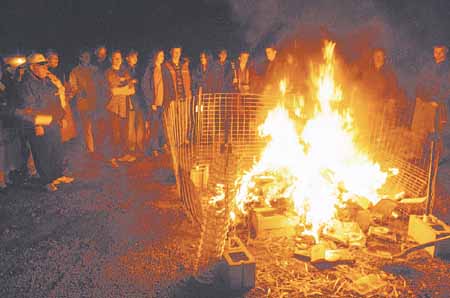
"On Sunday evening, members of the Harvest Assembly of God Church in Penn Township sing songs as they burn books, video and CDs that they have judged offensive to their God."

Bulter Eagle, March 26, 2001

Tuesday, October 31, 2006

So What's Wrong With Homosexuality?

In the tradition of STR, I wrote a brief response to an pro-gay article in Malaysiakini called So What? Its Their Sexual Preference.

Dear Francis

First, let me say that I hold no grudges against homosexuals. Not only that, I fully support your timely call to treat our fellow Malaysians who are homosexuals with respect, understanding and compassion.

The authorities must be vigilant to bring swift justice upon those immoral individuals who verbally or physically abused them.

Now, I accept my homosexual friends as valuable, dignified human beings. And they understand that I do so without condoning their behavior. In my humble view, homosexuality is immoral just as heterosexual adultery is immoral.

However, if you say that publicly nowadays, you are immediately called derogatory names like homophobic,
heterosexist, bigot or hate-monger.

I don’t use emotive labels to publicly stigmatize people who I disagree with. But name-calling is often used to condemn people who disagree with the 'morality' of homosexual behavior.

This is a convenient but unhelpful way of muddying the waters. Of course, I may be wrong but at least my views are based on principles, not prejudice.

So what’s the big deal about homosexual behavior?

You seem to argue that homosexuality is ‘normal’ or morally benign because “being gay is their choice, they have the right to choose their preferences”. That’s a “freedom of choice” argument.

But let’s think about this: Can people choose whatever sexual preferences they fancy?

Apparently not. We are not morally entitled to choose preferences like pedophilia, necrophilia or extramarital affairs, for that matter.

Why not? Because it’s wrong, even if it’s done in private.

Now, it may be objected that unlike pedophilia, homosexual behavior may be consensual among adults. What’s wrong with gay lifestyle as long as “the couple truly love and accept each other”?

But again, this argument does not hold water after a moment’s reflection.

Are people allowed to commit adultery or incest “as long as they love and accept each other”?

Even a heterosexual man who falls in love with his own sister or daughter (yucks!) can’t simply marry anyone he wants. So mutual consent simply does not justify immoral behaviors.

Now, I do agree with your description of homosexual practice becoming more “normal” or publicly visible as seen in examples of gay clerics, Ang Lee movies and celebrity tabloids.

But what is “normal” (as- is) may not be “normative” (ought-to-be).

Yes, homosexuals are among us. But it doesn't follow that their behavior is a moral norm just as having Mat Rempits all around us does not mean that we ought to encourage illegal races.

There is also another sense of the word “normal”, meaning “things are functioning in the way it was meant to be”. When things work “normally”, they are fulfilling what they are designed to do.

In this sense, homosexual practice is simply “abnormal”. Sexual organs were obviously not meant to fit in bodies the way homosexuals use them, resulting in a host of adverse medical consequences.

So we should not confuse the call to accept the existence of homosexuals in a spirit of tolerance with advocacy for homosexual behavior as morally acceptable.

Now don’t get me wrong. There is a lot of confusion when it comes to making such distinctions.

Our moral objection against homosexuality per se no more fosters violence against homosexuals than our disagreement against adultery fosters violence against people who are unfaithful to their spouses.

I am not asking people to be bigoted gay-bashers, spread hate or boycott Elton John’s music just because there are moral objections against their lifestyles. This kind of thinking would make PEMADAM responsible every time a drug addict gets beat up behind Chow Kit Road.

Lastly, I share your hope for a period of social reform in our nation that makes for a more equitable, just and caring society for all citizens regardless of creed, skin color or economic status.

Ethnicity has nothing to do with morality. With homosexuality we're talking about something different – it is a particular behavior that most Malaysians find odd, unnatural, harmful and deeply unethical.

As yet, there is no confirmed biological cause for homosexuality. Even if a biological factor may contribute to homosexual tendency, it does not determine our choices. Human beings are not programmed robots whose destiny is fixed by nature.

Surely, we don’t approve of hot-blooded heterosexuals who ‘naturally’ feel biological urges to grope female pedestrians to carry out their hormone-induced inclinations just because they are supposedly ‘born that way”. Even they are not entitled with such ‘equal rights’ in society.

Why not? Perhaps not because of blind prejudice, prudery or lack of scientific understanding.

But simply because it’s unethical.

They should still have the freedom to vote, find security and equal employment opportunity as any other citizen in our country.

But no one – heterosexual or homosexual – is entitled to unethical behavior.

Chang Wei Hao, a heterosexual sinner in the process of being rescued by Grace, is also an avid blogger at The Agora.

Saturday, October 28, 2006

Mind The Gap

A few Sundays ago, I fetched a young gradruate to a Logos Presbyterian Chinese church mission conference... He is a multimedia grad and now working for a M'sian film production - doing some special effects.

He has been to another church for years but out of action for many months. But he decided to come back, after awhile he shared why he considered to leave his home church....

Apparently he was told by well-meaning bros and sis that there are three jobs christians should not do...

1) Politicians - bcos its dirty
2) Lawyers - bcos of the temptation of money
3) Artists - bcos it's worldly and spiritually dangerous to be in that business and it doesn't help that my friend's company is now producing another Malaysian horror flick! :D

And He shared something very telling which described many christian grads...

"I felt like two persons when in church and when at work (something I love and enjoy but I dun consider it ministry)... I put on a mask when in church which frowns at
my work, and when I go to work, happily cracking away at my craft, I feel unspiritual or dishonoring God..."

A split personality or schizophrenic Christianity is often wat the laity struggles with if we do not integrate faith and work.

This is also something I struggle with in my own life as well... Considering how most of our life is in the marketplace, imagine how crucial it is that we have a theology of vocation for laity in the marketplace.

I highly recommend the Lausanne Marketplace ministry 'suggestion for action' here as written by Gordon Preece, Tony and Siew Li (Kairos).

Who knows? Maybe there's a Van Gogh in ur church whose life and sanity depends on it. Oh ya, here is a FUN video clip of the recent GCF/iBridge Camp at Bkt Tinggi. To join the iBridge movement, click here

Something creative (Malaysian Idol Daniel's MTV) done with some MMU/CDPC students Way to go, fellas!

Thursday, October 26, 2006

Cahaya Nusantara

Cahaya Nusantara - Projek blog perbincangan tentang kehidupan dan pemikiran Kristiani, falsafah dan teoloji, budaya popular dan glokal, perbandingan agama, kerjaya dan iman, pembentukan rohani, misi dan gereja dalam Bahasa Malaysia. Dalam permulaan yang kecil ini, kami berdoa agar Tuhan dapat memberkati pelayanan ini dan mencurahkan berkat-Nya kepada para jemaah di seluruh pelosok Nusantara untuk memahami dan menghidupkan Firman Allah dalam dunia ini.

Misi

Cahaya Nusantara berhasrat untuk menggalakkan para pengikut Yesus untuk menghidupkan dan memuliakan Tuhan dalam segala aspek kehidupan mereka. Sebagai pergerakan dalam peringkat akar umbi, Cahaya Nusantara berhasrat untuk meningkatkan penulisan dan kerja pemikiran Kristiani dalam bahasa Malaysia di kalangan orang awam, sebagai bahasa kebangsaan dan perpaduan. Melalui bahan-bahan penulisan ini diharapkan umum dapat membentuk pandangan dunia dan pemikiran yang berasaskan Alkitab yang teguh untuk berdialog dalam masyarakat sekular dan umum.

Ini kerana gereja di Malaysia menghadapi beberapa cabaran semasa dalam kehidupan dan misinya seperti etika moral, sains moden, pluralisme agama, hubungan gereja-negara, budaya, relativisme, ekonomi, hubungan etnik, sekularisma, globalisasi dan sebagainya.

Adalah menjadi pegangan kuat kami bahawa cabaran terbesar bagi Gereja pada hari ini adalah untuk berhadapan dengan budaya semasa secara konstruktif dan kritikal melalui pemahaman Alkitabiah yang sejati.

Sehinggalah kita berbuat demikian, kesaksian Gereja untuk Kristus akan terjejas. Cahaya Kristus dalam Nusantara tidak akan terang.

Visi

Kami berhasrat untuk memantapkan nilai-nilai berikut dalam kehidupan peribadi, keluarga dan komuniti kami.

1. Memikirkan pemikiran Tuhan – untuk berfikir tentang isu-isu kehidupan, kepercayaan dan budaya dengan minda yang berserah kepada Firman Tuhan. Untuk mengintegrasikan minda, emosi, keinginan, dan kekuatan secara holistik untuk menyembah Tuhan dan mengetahui pelan Tuhan untuk masa kini.

2. Komuniti elektronik - Kami ingin berdialog dan berbincang dalam konteks komuniti antara satu sama lain untuk memanfaatkan pengajaran, teguran dan latihan daripada orang lain, supaya kita dapat dilengkapi untuk segala kerja yang baik. Kekangan lokasi menyebabkan kami memerlukan pendekatan yang lebih kreatif untuk berkomunikasi.

3. Misi dalam Panggilan – Untuk menjadi duta Kristus yang dilengkapi ilmu ketuhanan, menawan hati, dan bijaksana dalam memenuhi panggilan kita di mana sahaja kita berada, untuk menjadi soldadu kasih dan kebenaran. Kami percaya bahawa iman tidak bercanggah dengan logik. Kami juga percaya bahawa tidak terdapat sebarang pembahagian antara kerjaya dan iman, bidang sekular dan spiritual, ilmu dunia dan ilmu rohani. Semua aspek kehidupan wajib diterangi berdasarkan Alkitab.

Nilai dan Pegangan

Kami percaya bahawa Alkitab adalah teks yang boleh dipercayai dan benar, dan Yesus adalah satu-satunya jalan di mana orang berdosa dapat berdamai dengan Allah.

Kami mengalu-alukan umum untuk bekerja bersama-sama secara transdisiplin untuk meyumbang idea dan pemikiran, untuk menggalakkan semua untuk mencintai Tuhan dengan hati dan minda kita. Kami bukanlah orang terpelajar mahupun ahli akademik yang mengetahui segala-galanya, tetapi kami akan cuba sedaya-upaya untuk menggunakan sumber-sumber ilmu yang ada sebaiknya.

Kami mempunyai kecenderungan untuk menggunakan bahasa yang ringkas dan mudah difahami. Tetapi kami juga ingin bertumbuh dalam pemahaman kami terhadap Firman dan dunia Tuhan. Kami mempunyai komitmen terhadap Berita Baik dan mengaplikasikan teoloji kepada praktis (praksis).

Kami mempunyai komitmen dalam mengkontekstualisasikan ajaran Kristus dalam konteks Nusantara dan masyarakatnya supaya Firman Tuhan dapat difahami dalam konteks yang boleh dihayati masyarakat tempatan. Melalui penghayatan yang berakar pada jati diri masyarakat tempatan, kami percaya bahawa budaya tempatan dapat diperkayakan lagi.

Kami tidak mengeluarkan ‘fatwa’ tetapi kami berharap dapat mengeluarkan isu-isu untuk dialog terbuka dalam semangat kasih dan hormat-menghormati.

Monday, October 23, 2006

Puritan Lessons on Faith and Work - Part 1


One of the distinguishing marks of the Puritans was their fully orbed views on work. Their passion and commitment to the supremacy of God's authority in all of life extended into their work life. I thought it might be interesting examine what they believed and how they applied their rich theology in this area. What would the Puritans say to us who live and work in a digital age? They might begin with their conviction that all work is ordained by God. They would be eager to dispose of any false distinctions between secular and sacred work.

"This is a wonderful thing, that the Savior of the world, and the King above all kings, was not ashamed to labor; yea, and to use so simple an occupation. Here he did sanctify all manner of occupations." Hugh Latimer

This was in great part reinforced because they held to a view that God calls each person to a specific work or occupation.

"God doth call every man and woman...to serve him in some peculiar employment in this world, both for their own and the common good..." Richard Steele

Cotton Mather provides the following comment on how one should steward that calling.

"A Christian should be able to give a good account, not only what is his occupation but also what he is in his occupation"

Regardless of whether you share the Puritans views on work, their passion to see God honored in and through their work is commendable and inspiring. How might their conviction in the sanctity of all legitimate work inform us today? I offer a couple suggestions -

It should bring us purpose in our work. If the Puritans are right, all manner of legitimate work offers an opportunity for us to obey and honor God. In short, it provides an opportunity for worship.

It should inspire faithfulness. If you believe as the Puritans did that it is God who calls each man to a particular vocation, then faithful discharge of that work is vital if we are to fulfill that calling. Attention to faithfulness in other areas of life but not in this area would be deficient.

Even though I do not consciously subscribe to a sacred-secular dichotomy of work, I nonetheless often forget these truths in practice. By obscuring them, I may be missing opportunities for faithful worship in my daily life.

Monday, October 16, 2006

Bridging The Gap

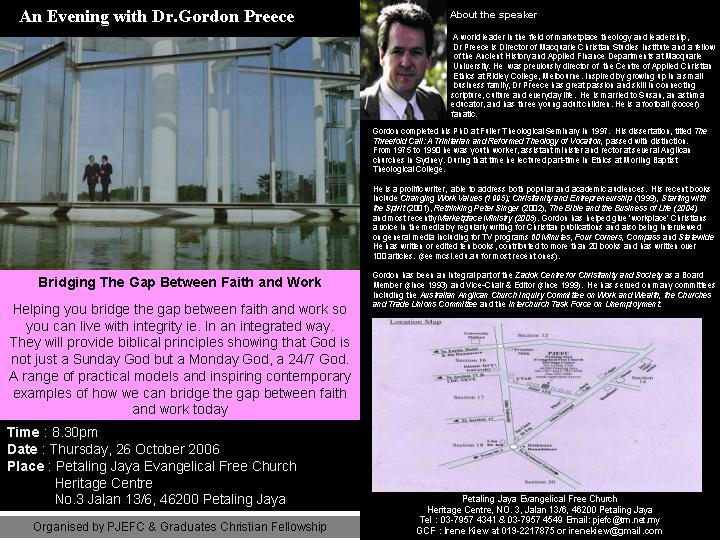
Dr Gordon Preece from Australia, who is speaking at the Graduates
Christian Fellowship Malaysia annual conference, will be holding an evening talk in PJ EFC. The title of the talk is "Bridging the Gap Between Faith and Work".

He aims to help us bridge the gap between faith and work so that we can live with integrity -- ie. in an integrated way. He will provide biblical principles showing that God is not just a Sunday God but a Monday God, a 24/7 God, and give a range of practical models and inspiring contemporary examples of how we can bridge the gap between faith and work today.

Date: 26 Oct 2006 (Thursday)
Time: 8:30pm
Venue: Petaling Jaya Evangelical Free Church
Heritage Centre
No.3 Jalan 13/6, 46200 Petaling Jaya
Topic: Bridging the Gap Between Faith and Work

More articles from Gordon can be found here

Tuesday, October 10, 2006

The Servant King

Lyrics By Graham Kendrick

From Heaven You came, helpless Babe,
entered our world, Your glory veil'd,
not to be served but to serve,
and give Your life that we might live.

(Chorus)
This is our God, the Servant King,
He call us now to follow Him
to bring our lives as a daily
offering of worship to the Servant King.


There in the graden of tears,
My heavy load He chose to bear.
His heart with sorrow was torn,
'Yet not my will but Yours' He said.

Come see His hands and His feet,
the scars that speak of sacrifice,
hands that flung stars into space,
to curel nails surrendered.

So let us learn how to serve,
and in our lives enthrone Him.
Each other's needs to prefer,
for it is Christ we're serving.

Monday, October 09, 2006

The Top 50 Books That Have Shaped Evangelicals

The Top 50 Books That Have Shaped Evangelicals
A list by Christianity Today

Landmark titles that changed the way we think, talk, witness, worship, and live.
posted 10/06/2006 12:13PM

People and movements can be defined by the books they read and remember.
The time it takes to read and digest a book requires us to engage someone else's ideas with more seriousness than almost any other activity. So it is with some trepidation that we present this list.

See the full list here

Sunday, October 08, 2006

Homosexuality, are Christians wrong again?

Homosexuality, are Christians wrong again?

NTV7 Edisi Siasat featured a story on “Gay Coming Out” where they interviewed Ouyang whom I have been told claimed;

“people misinterpret the bible in the past. He brought out the examples of how people justify slavery using the Bible”

The argument that the current Christian position on homosexuality could be a misinterpretation like the misinterpretation of those who used biblical text to justify slavery is a fallacy we call the law of undistributed equals. Ravi Zacharias describes it like this;

Elephants have ears
People have ears
_________________

So people and elephants are the same thing

Do you see the problem? Just because 2 things may have one or more similarities, its still does not make them one in the same thing.

Read the full article here

How Much Does God Weigh?

In his book God in the Wasteland, David Wells describes the notion of how God is "weightless" in our postmodern society.

"...God is now weightless. I do not mean that he is ethereal but rather that he has become unimportant. He rests upon the world so inconsequentially as not to be noticeable... Those who assure pollsters of their belief in God's existence may nonetheless consider him less interesting than television, his commands less authoritative than their appetites for affluence and influence, his judgment less awe-inspiring than the evening news, and his truth less compelling than the advertisers' sweet fog of flattery and lies. That is weightlessness."

One way to respond to this is to consider how secularized our society has become, but I was more impressed to consider my daily life, especially in the marketplace. If there's any place where "God rests so inconsequentially so as not to be noticeable", it is in the arena of business.

In the typical corporate workplace, the serious mention of God is so rare that it seems unusually out of place to do so. Even when spoken of, there is no gravity to the idea that God exists or that he has a claim on us. In stature, he ranks only a notch higher than a myth.

I wonder how I'm contributing this current state. I believe that this "weightlessness" of God at the workplace exists in large part because as Christians, we speak and act so as to undermine the reality of the immortal, invisible God. Much of this is inadvertant, unwitting and by omission.

Yet, when we speak of God in general, philosophical terms but never in personal terms, we contribute to the weightlessness of God. When we consistenly express enthusiasm about the football game on Sunday but no enthusiasm about the Sunday meeting at church, we contribute to the current dilemma. In times of difficulty, if we express our need for assistance from other co-workers but never openly acknowledge our need for God, we functionally ignore his providence.

I'm pausing to consider what I'm communicating about God everyday. Do I speak of God as though he truly exists? I wonder how we can better speak, work and live in such a manner that the gravity of who God is cannot be ignored. What would that look like?

Saturday, October 07, 2006

Graduate Christian Fellowship

Greetings……Great news, the i-bridge camp/conference registration will be extending till next week FRIDAY(13th) due to massive response and the availability of few more places. So to all my bro & sis in Christ do encourage your Christian friend/churchmate come to the camp as it focus on the issue of your marketplace and definitely a great time to slow down things to hear what God is saying to each one of us at this particular time and season.

So who Is GCF and I-BRIDGE?
The Graduates Christian Fellowship (GCF) is a non-profit non-exclusive organisation for Christian graduates, professionals and anyone who wishes to play a meaningful role in the marketplace and in society in general. Since its inception in the 1970's, GCF has evolved from an informal gathering for fellowship and encouragement
into a movement of people committed to making a moral impact.

GCF VISION
To build a community of servant-leaders committed to transforming society for Christ.

GCF MISSION
We are committed to the challenge equipping Christians to be servant leaders.

GCF CONTEXT
While recognizing the central place of the local church, our primary concern is for Christians in the marketplace where faith and life intersect.

INTER-BRIDGE
iBridge is a ministry of Graduate Christian Fellowship (Malaysia). It was founded in 2001 with the aim of catering to the needs of young graduates in Malaysia, and to encourage and challenge one another to follow Jesus in the real world. iBridge holds on to its core values of ministering to young graduates in their transition from a student to a working adult.

iBridge aims to encourage networking, spiritual friendship and mentoring among young Christian graduates in Malaysia. Its main objective is to create Networking (connecting lives in transition), Spiritual Friendship (cultivating praying partners) and Mentoring (creating lifelong disciples).

iBridge is a growing community of Christians who are fresh graduates and young professionals in Malaysia desiring to transition from campus to the marketplace, follow God in the "real world", find meaning in their work and to keep their faith alive. iBridge is an initiative of the Graduates Christian Fellowship of Malaysia.

If you are a young Christian graduate desiring to transition from campus to the marketplace, follow God in the "real world", find meaning in your work, keep your faith alive... the iBridge community will help you find spiritual friends who are fellow pilgrims on the journey. The iBridge Camp is an annual camp which particularly
caters to this group of young graduates.

However, we recognise that there is also a growing community of Christians who have effectively transitioned from campus life into the working world; graduates who desire to be 'salt and light of the world', who seek to enlarge their worldview and to engage the world by constantly applying Scripture and their faith.

These graduates face different challenges and issues that a fresh graduate face during the transitional period. They face the challenge of going from 'survival' in their jobs to finding their life vocation. They face the increasing demands of career seniority, marriage, parenting that leads to being isolated. They struggle to
overcome their apathy and indifference and aspire to have a passion for people in the marketplace. In short, they are in a transformation phase of their lives.

With these unique individuals in mind, the GCF Annual Conference, which will be held together with the iBridge Camp this year 2006, will especially cater to complement the other group of graduates who have more than 3 years working experience and to assist them in deeper and another level of personal development, building communities and blessing the world.

For the registration forms just download it at www.taketheleap.org or you can email us at ibgcfcamp2006@gmail.com for more enquiries...

Thursday, October 05, 2006

The Bible & Homosexuality

This eCommentary is taken from The Bible and Homosexuality by Soo-Inn Tan, 25 Sep 2006

For the bahasa Malaysia version, check out Keropok Lekor's post "Alkitab Dan Homoseksualiti".

In their commentary on Romans, M Eugene Boring and Fred B. Craddock have this to say about homosexuality:

"The Christian ethical perspective on homosexuality is a complex subject involving legal, social, psychological, and medical points of view as well as theological and biblical statements. Although the biblical teaching on sexuality and sin is an indispensable factor in Christian ethical decision making, this issue cannot be settled by quoting a few biblical texts."

They are right of course. And I am always disturbed by the over-simplifiers in any debate, especially on a subject as emotional and as complex as homosexuality.
However Christians cannot avoid struggling with the theological and biblical statements especially if we believe that the bible properly interpreted is the authority for our life, beliefs and practice.
Struggling with theological and biblical statements is also
what we have to do since there is also a growing Lesbian and Gay Christian movement who maintain that the church has misread the Scriptures and that there is no biblical prohibition on homosexual practice, especially for faithful
monogamous homosexual partnerships.

(This matter has surfaced with a vengeance in Malaysia when recently a high profile Christian writer and thinker went public with his homosexual orientation and the fact that he was in a committed relationship with a same sex partner. He
is at present finishing doctoral studies in Sociology and Theology in the U.S. and hopes to return to Malaysia after his studies to start a church sympathetic to homosexual unions.)

What does the bible teach about homosexuality and homosexual practice? I think the church should always be humble enough to relook at the biblical material. After all it wasn't that long ago that some in the church justified racism and slavery from their reading of the bible.

And looking at the bible we have to admit that the passages that discuss homosexual behaviour are few. Richard B. Hays is right when he reminds us:

"The bible hardly ever discusses homosexual behavior. There are perhaps half a dozen brief references to it in all of Scripture. In terms of emphasis, it is a minor concern --- in contrast, for example, to economic justice."
(The Moral Vision of the New Testament, p.381)

Nevertheless, the few places where homosexuality is mentioned, the teaching is clear. Romans 1: 24-27 is particularly critical.

"Therefore God gave them over in the desires of their hearts to impurity, to dishonor their bodies among themselves. They exchanged the truth of God for a lie and worshiped and served the creation rather than the Creator, who is blessed
forever! Amen.

For this reason God gave them over to dishonorable passions. For their women exchanged the natural sexual relations for unnatural ones, and likewise the men also abandoned natural relations with women and were inflamed in their passions for
one another. Men committed shameless acts with men and received in themselves the due penalty for their error." (NET)

A full exegesis of this passage is beyond the scope of this essay. Readers are encouraged to read up commentaries on the book of Romans of which there are many.
We do note a few things. First Paul is addressing homosexual acts and not homosexual orientation. Both male and female homosexual behaviour are addressed. And, unlike places like 1Corinthians, Paul is not addressing specific people caught in specific sins.

Here Paul is talking about humankind as a whole, laying the case for the fact that all of humankind is in sinful rebellion against their Maker.

His point is that all have sinned and fallen short of God's glory (Romans 3:23), but interestingly he chooses homosexual intercourse as the sin that best illustrates the falleness of humankind.

Again Hays is helpful:

"Paul singles out homosexual intercourse for special attention because he regards it as providing a particularly graphic image of the way in which human fallenness distorts God's created order. God the Creator made man and woman for each other, to cleave together, to be fruitful and multiply. When humans beings 'exchange' these created roles for homosexual intercourse, they embody the spiritual condition
of those who have 'exchanged the truth about God for a lie.'"
(p.388)

Paul chooses homosexual practice as the example of a fallen humanity because a key expression of God's image in humankind is the fact that we were made male and female.

"God created humankind in his own image, in the image of God he created them,
male and female he created them."(Genesis 1:27 NET)

Any turning away from male-female sexuality is finally an assault on the very nature of God.

Of course we now live in a fallen universe.
Some people are born with strong homosexual desires.
Heterosexuals who do not know the loneliness and unfulfilled desires of homosexuals could do with more listening and less lecturing.

One of my favourite writers on spirituality is the late Henri Nouwen. Many of his books speak of his deep loneliness and pain.

It was only after his death that I discovered he was homosexual.
But he was also celibate.
He had chosen to remain celibate rather than indulge in homosexual sexual intercourse.
He sounds like a follower of Jesus who took up his cross.

It is painful to be broken human beings living in a broken world.
We long for that perfect world to come when final healing will come.
Paul talks about a creation groaning and suffering while waiting for the ultimate rebirth and the coming of the new reation in full. (Romans 8:18-25)

If we claim to be followers of Jesus Christ then we are to strive to live in a way that aligns our present lives with the perfect life to come and not to give in to the broken patterns of a fallen world.

This will be tough for all of us, and tougher for some than others.
Much grace is called for.

(Is there pressure to start churches orientated to homosexuals because our churches have failed to show love and acceptance to our brothers and sisters struggling to
follow Christ in the midst of their homosexual struggles? God will hold us accountable.)

There is much soul searching to be done by all.
If we are really sincere about fighting for God's ways then we should fight for all of God's concerns and not single out homosexuality.

I suspect there are more of us excited about the issue of homosexuality than about economic injustice. And as Hays reminds us God has so much more to say about economic injustice.

But what we cannot do is to make the bible say something that it doesn't.
For me Romans 1:24-27 is clear.
The bible does not permit homosexual practice.

Your brother,
a heterosexual sinner saved by grace,
Soo-Inn Tan
Wednesday, October 04, 2006

Learning Community

Addressing the need for intellectual witness in the wider society, Kam Weng proposed an action item on leadership development that resonates deeply -

"many Christian leaders in the third world do not have enough time to acquire the pre-requisite skills and knowledge adequate to confront the best scholars from the other religions. Hence, it is vital that we begin early to equip younger Christians for such a demanding task... It is urgent that we identify promising young leaders and nurture them with supplementary education while they are still in colleges."


Not only that, Soo Inn proposed that developing leaders is also about 'spiritual friendship', living and walking with these young leaders - sharing our lives, otherwise it could be too abstract.

With that in view, I highly recommend the following community learning initiatives in the Klang Valley which would put needed resources in your hands to be an ambassador for Christ in the marketplace and guided by facilitators who are willing to share their lives.

1) ACT Ministry will be having a fortnightly (Mondays) group study on Philosophy for Understanding Theology by Diogenes Allen and ACT Ministry notes on "Greek Philosophy in Christian Doctrine". Time: 8.30pm - 10.00pm

Length: 12 sessions beginning on the 25/09/2006 and ending 12/03/2007 with Christmas and Chinese new Year breaks in between.

2) Basic Doctrine Course (tapes/workbooks from John Stott) at CDPC starting on 29 Oct 2006. Facilitators: Michael & Yvette Koh, excellent couple-teachers.

3) KJ John is a regular contributor at Malaysiakini with an emphasis on integrity and transparent governance in our country. He and Kong Beng will team up to lead the OHMSI group study on the book "Total Truth" by Nancey Pearcey which is an excellent resource for being informed about cultural issues in our day - from sociopolitical engagement, ethics, intelligent design,
homosexuality, gender issues, secularism, islam etc etc...

(btw the term 'total truth' was coined by Francis Schaeffer to mean that Christianity is not only true for religious issues like 'personal encounter w God' but also true in the public issues like how we do science, economics, social-politics, arts racial, sexual issues etc ...)

Since KJ John is also an experienced and well-connected writer for the public square, I believe we can really benefit from his insights in the Malaysian context. Also, Kong Beng would contribute from a theological perspective.

The next best thing (imho, a much better thing) to getting a formal education is to get experienced mentors like them to give us some coaching and hands-on guide.

The take-home value, as i see it, is we could have a group of young people who are prepared to engage the issues in malaysiakini or other public forums in some specialised issues when the need arises...

So far, I'm encouraged to see some promising future leaders have expressed interest.

We are desperately in need of people who will stand up and be counted. Round up your frens who may be interested and suitably gifted, and let's get connected.

How to sign up? Just email me at hedonese at yahoo.com

KJ John's Proposed Ground Rules are:

1. Meeting once a month either Saturday or Sunday for about 2 hours at a location of our choice. Attendance is compulsory for those all who sign up.

We cannot miss more than one in a row to a maximum of two meetings. The book has only 13 chapters and we intend to only READ and REVIEW only one chapter a month.

2. Those who have not read relevant chapter CANNOT PARTICIPATE in the discussion and dialogue. Both Navs 2:7 program and BSG follow these rules. Good for personal discipline and good discipleship.

3. Once committed, it is from start till finish.

4. We all agree to undertake to endeavour to start a new group of our own as our passing on the baton of the new way of thinking about life and living; after the session is over after about one year.

Tuesday, October 03, 2006

Poliomyelitis- a disease that just will not go away

There had been high hopes that poliomyelitis or polio can be eradicated by the year 2000. The WHO has organized massive immunization programs and almost all countries use the WHO immunization schedule which includes vaccination against diphtheria, tetanus, and poliomyelitis. The Rotary Foundation has spent billions of dollars to ensure that children in the most remote areas receive the vaccine. With the combined might of the WHO and the NGO, the Rotary Foundation, there had been high hopes that poliomyelitis will go the way of smallpox.

Poliomyelitis cause paralysis of major muscles. In the old days, children with poliomyelitis have difficulty breathing as their respiratory muscles were paralyzed. They were placed in “iron lungs” which help them to breathe. The “iron lungs’ worked by alternately creating and releasing a vacuum.

In March 2005, a 20 months old boy was founded to be infected with a wild strain of polio virus in Girijaya village in the Sukabumi district of West Java. In spite of massive immunization of the Indonesian government, the outbreak resulted in 305 cases in 2005-2006 and claimed 6 lives. 47 districts and 10 provinces were affected. This virus was traced to its origin in Nigeria. It reached Indonesia via Yemen, Saudi Arabia and West Java. From there it spread to central Java, the Madera Islands and to Sumatra.

What went wrong? It was found that the polio vaccine coverage in Indonesia has dropped from more than 90% to 77.6% in 2005. Again, this is a reminder that we are fighting a holding battle against outbreaks of diseases like polio. We cannot afford to relax our vigilance.

There are two types of vaccines for polio. The Salk vaccine which is made up of the killed polio virus and the Sabin vaccine which is made from the weakened polio virus. Salk and Sabin are the names of two medical pioneers who did a lot of work on poliomyelitis. The Salk vaccine is given by injection into the muscles while the Sabin vaccine is given orally.

WHO made a decision to use the oral Sabin polio vaccine exclusively. The Malaysian Ministry of Health follows this decision religiously. However, there are two vaccine related problems with the oral polio vaccine which is not found in the injection polio vaccine.

First, it was found that the oral polio vaccine can cause polio! It was estimated that there are 400-800 cases of vaccine polio worldwide yearly. Vaccine polio can cause outbreaks; Hispaniola Islands in 2000, Indonesia in 2005 while the longest lasting was for 10 years in Egypt from 1983-1993.

Second, oral polio vaccine can cause paralysis. The muscles of affected children become flaccid. This condition is named vaccine associated paralytic polio (VAPP). It occurs in one per million does of oral polio vaccines.

One of the arguments against the use of injection polio vaccine was the “absence of herd immunity”. As the recent outbreaks in Indonesia shows, that argument is not longer valid since the polio outbreak occurs in spite of the community having “herd immunity’. Europe, Canada, South Korea, Australia, New Zealand, Japan and USA has all changed to injection polio vaccine in the last decade and there have been no significant outbreaks of polio reported.

The WHO recommends that the oral polio vaccine be discontinued as soon as polio was eradicated in 2000. It is now already 6 years past that dateline and we still have not eradicated the disease polio. Maybe it is time our Health Ministry should reconsider the WHO recommendation and make the decision to switch to injection polio vaccine independently. Most of the developed countries have already switched to injection polio vaccine.

The battle against polio has not been won. The polio vaccine has offered us an effective instrument to hold the disease at bay. Unfortunately the vaccine has created two new vaccine related diseases. The trade off is good but we could do better.

There is not a single kilobyte of which Christ…

Have you heard of Flickr, Myspace or Wikipedia? Have you been hearing talk about a new internet revolution labeled Web 2.0? I spoke briefly in the past about the underlying philosophy of this phenomenon here. If we look past the media hype we (as Christians) are challenged with generation Y and the preceding generations that are the first generations to have grown up with the internet, PC and this technology driven reality we find ourselves in, and thus besides posing a challenge to church.

Will we keep whining about the dehumanization of technology and wishing for the good-old-days, or will we adapt to these irreversible changes and find ways to influence and utilize it for Christ, so that we can boldly say that there is not a single kilobyte of which Christ does not say, “Mine”.

Here is an excellent introduction on the phenomenon of Web 2.0 posted on one of my favorite blogs, ChurchMarketingSucks.com. While you are there, do check out their reviews on the technology scene and its implications on Christianity, though its made for the US settings, some of the advice can apply to us here in Malaysia as well.

What Web 2.0 Means for Your Church
(Filed under: Technology at ChurchMarketingSucks.com)

Web 2.0 is the latest rage. It's on the cover of Newsweek and everyone is speculating if it's the revenge of the dot com boom.

This is the beginning of an multi-part series on web. 2.0 and what it could mean for the church.

Read the full article here.

Monday, October 02, 2006

Evangelical Resurgence

Where We Are and How We Got Here
by Mark A. Noll

50 years ago, evangelicals were a sideshow of American culture. Since then, it's been a long, strange trip. Here's a look at the influences that shaped the movement.

Historically, evangelicalism has had integrity when it maintains the substance of classical Christian faith; it has exerted influence and enjoyed a broad appeal when it responds effectively to impulses within its host cultures. When evangelicals think only about honoring their heritage, they easily lose sight of the gospel imperative to evangelize and to be salt and light in the world. Conversely, when they think only about effective witness and responding to urgent psychological needs, they easily lose sight of the gospel imperative to preserve the truth in righteousness.

In some earlier eras, the balance of theological integrity and cultural sensitivity moved mountains. At other times, loyalty to traditions led to separatistic stagnation, or lust for cultural relevance perverted the gospel into Christianity-lite.

During the first half of the 20th century, the stress had shifted toward preserving traditions. At the middle of the 20th century, evangelicals began to move back toward a balance.

But have evangelicals today moved too far? Has an overemphasis on preserving tradition been replaced by an overemphasis on connecting to the culture? For such supremely important questions, it is, of course, too early for a historical assessment. When the balance shifts too strongly to one without the other, it is merely sounding brass and a tinkling cymbal. But an evangelical resurgence that balances traditional faith and cultural relevance sounds a trumpet of salvation to the world.

The Boys' Brigade of Malaysia

William Alexander Smith was born in Thurso, Scotland in 1854. He moved to Glasgow in his teens and became involved in church activities. William was also a lieutenant in the 1st Lanarkshire Rifle Volunteers in 1883 while he was teaching in the North Woodside Mission Sunday School. While working with the children in church, he discovered the need for wholesome activities for children outside school hours. William Smith shared his ideas with his two friends, which later invited boys from North Woodside Mission Sabbath School and formed the first company of The Boys' Brigade, 1st Glasgow Company on 4th of October 1883. It is the world's first uniform organization, even before the Scouts.

William was the first Brigade Secretary in 1887 where he worked towards spreading the Brigade across the world. In 1909, King Edward VII knighted William Smith for his contribution towards youth development. Five years later, Sir William Alexander Smith passed away. Throughout his lifetime, Sir William A. Smith poured out all that he has into BB and he is best remembered as the man who spells Boy with a capital 'B'.

The original object of the Boys' Brigade is the advancement of Christ's Kingdom among Boys and the promotion of habits of obedience, reverence, discipline, self-respect and all that tend towards a true Christian manliness. Christian “manliness” was developed by the use of a semi-military discipline and order, gymnastics, summer camps and religious services and classes. Christian manliness was changed to Christian character when girls were admitted to the BB.

However, the BB did not appear in the Asian scene until 1915 when the first Company was founded in the Chinese city of Swatow by the Rev Guthrie Gamble (the famous Swatow BB was to become a legend in later years in China) The BB came to South East Asia in 1930 with the founding of the 1st Singapore Company by Mr James Fraser.

The Boys’ Brigade did not come to Malaya until the after the second World War. A British soldier by the name of Robert Davis (former Captain of 6th Birkenhead Company at the Tranmere Freehold Methodist Church and later Tranmere United Reformed Church) gave the idea of The Boys’ Brigade to one of Penang’s great educationist, the late Mr Geh Hun Kheng, who accepted the challenge becoming the first BB Captain in Malaya. Mr Geh realised that he had to do his "small share" to win the Boys over from the various subversive groups that were so rife after the Pacific War. The first meeting of 20 Boys was held in the Methodist Church in Madras Lane on a Sunday in September 1946. Penang thus became the springboard from which Companies were started first in Kuala Lumpur and then in other parts of the country. When Malaysia achieved independence on 31 August 1957, The Boys’ Brigade was given the honour of being invited to take part in the Merdeka Parade (Independence Day Parade).

After Merdeka (Independence), The Boys’ Brigade began to spread rapidly as a result of the formation of the Malayan Council of The Boys’ Brigade under the initiative of Mr Khoo Oon Soo. More and more Companies were founded in every major town in Malaya. Even small rural towns began to have BB Companies functioning efficiently. By this time firm and friendly contact had been made with the BB in Singapore which helped in the supply and sale of equipment and with the founding of the first Company in Borneo in 1959, the 1st Kuching Company. In 1962, the BB in Malaya became a member of the Pacific Regional Fellowship (subsequently joined the East Asia Regional Fellowship when it was formed later) and the first Pacific camp was held with the co-operation of the Singapore Battalion in Port Dickson in December 1963.

On 5 December 1964, the former Federation of Malaya Council of The Boys’ Brigade, the Singapore Battalion and the 1st Kuching Company merged into The Boys’ Brigade in Malaysia. With the political separation of Singapore from Malaysia, The Boys’ Brigade in Singapore ceased to be a component District of The Boys’ Brigade in Malaysia as on 19 August 1965. With Malaysia a reality the National Council began to establish Companies in Sabah and Sarawak, maintaining friendly ties with the BB in Singapore.

The development of The Boys’ Brigade in Malaysia took a revolutionary turn when it invited girls to be members. It was first introduced in 1989 and debated for a few years before experimental measures were approved in 1992. The move received favourable response and strong support from churches and individuals. Starting of the girls’ wing was to cater for the girls in a locality where a Girls’ Brigade Company did not exist. Today, more than 20 companies in the BBM have girls on their membership roll, and many girls have been appointed NCOs, and they have proven to be capable in adapting well to the activities of the BB.

Since 1992, The Boys’ Brigade in Malaysia has also begun to play significant role in the extension of BB work in the East Asia Regional Fellowship, including conducting training and support BB works in Indonesia, Thailand and the Philippines.

Today, there are over 70 Companies spread throughout the length and breadth of Malaysia. Ever since the setting up of a BBHQ in 1989, a permanent building has been purchased, and currently staffed by a team of 5 able full-time personnel.

The Boys’ Brigade in Malaysia has come a long way since 1946. Many things have since changed, many had come and gone with many new developments taken place. Throughout all these years, the BBM has been able to hold on to its object and continue in serving the youth of Malaysia. As the nation is fast moving towards greater heights in development, it is believed that the BB shall be called on to play an even greater role in the development and training of the Malaysian youths.

The BB is recognised by Kementerian Belia dan Sukan Malaysia as a youth body and by Kementerian Pendidikan Malaysia as a school's extra co-curricular activity. This means BB is the only formally recognized uniformed Christian youth organization recognized by the government and allowed to be part of the schools extra co-curricular activities. BB is also an affliated member of Majlis Belia Malaysia and Council of Churches of Malaysia

Object
The Advancement of Christ's Kingdom among members and the promotion of habits of Obedience, Reverence, Discipline, Self-Respect and all that tends towards a true Christian Character.

Motto
SURE & STEDFAST (taken from Hebrews 6:19). The original Old English (King James Version) spelling of "Stedfast" has been retained.

Emblem
The emblem is original an anchor. Like the motto it stems from the verse "We have this hope as an anchor for the soul, firm and secure" (Hebrews 6:19)

Please support the ministry by praying for them, getting your children to join them and becoming involved with them.

Sunday, October 01, 2006

Left to Right is not Right

This morning, a 7 years old Chinese girl was brought to my clinic because she is having trouble in school. She is an intelligent girl but have problems reading and writing. Her verbal skills are good and she does well in art and drama. The teachers were upset with her for writing her “E”, “D”, “3”, “6” and “9” mirror image. Initially they thought that she was being naughty. Sometimes she will write the correct way but when she is tired or stressed, she will revert to writing her mirror image writing.

Her parents brought her to see me because they wanted to know whether she has dyslexia. On questioning, the parents admitted that she was initially using her left hand but they forced her to write with her right hand. So she was left handed, even though now she writes with her right hand.

Never force your left handed child to write with his or her right hand! All children are born with either left or right brain dominance. A left-handed child will be right brain dominant and a right-handed child will be left brain dominant. Some children are ambidextrous. They are able to use both hands equally well but usually one hand is more dexterous. When a child was forced to use the hand that is opposite to his or her brain dominance, a state known as mixed brain dominance occurs. The brain becomes confused and tries to adapt. Another name for this is mixed-handedness or cross laterality. This is not necessarily a good thing.

This problem is common among left-handed kids. Right-handed children do not face any such problem. The reason being there is a bias against left-handedness. The world is designed for right-handed people. If you do not believe me, just look at the design of a scissor. A scissor is designed in such a way that the line that is being cut can be only seen by a right-handed person. Another is the cork-screw. In fact, almost all instruments are designed to be used by right-handed people even though about 10% of people are left-handed. Hence I was excited when I discovered a shop called “The Left Handed Shop” at Fisherman’s Wharf in San Francisco. The shop catered exclusively for left-handed people.

Left-handed people have problem writing. We write a sentence from left to right on a page. Some left-handed people have problems with their elbows if their tablemates are right handed. In writing Mandarin, the problem is even more acute. Writing right to left causes them to smug their notebooks. Chinese (Mandarin) characters are written in strokes in a certain format. Imagine how confusing it is to look at the word character in a mirror image format. The mirror image may actually be another Chinese character!

Left-handedness was once associated with Satanic influence. In the Judeo-Christian tradition, the righteous will sit on the right hand of God. The unrighteous will sit on the left. Thus it used to be the tradition in missionary schools that children are punished for writing with their left hands.

In the Roman army, a left-handed person will have his left arm bounded to his body and trained to use the gladius (Roman short sword) with his right. In the Roman warfare strategy, left-handed solders will most likely stab their comrades. Roman legionnaires do not take kindly to “friendly fire”.

Fortunately, most right brain dominant children who were forced to use their right hands to write are able to adapt. Their brain just formed a visual “mirror image” of what they see. It was postulated that left-handed person are more visual in their thinking. Unfortunately, some could not and will be labeled “dyslexic”. Hence left to right is not always right.

Dreams & Ambitions

The best book I've read in the past year is "Lost in the Middle", Paul Tripp's newest book on the challenges of mid-life. You can read a review of the book here

One of the more interesting chapters of the book is Chapter 5 - "Towers to the Sky" where Paul Tripp discusses the power of our dreams and imagination. He reminds us that the ability to dream and imagine is a unique gift from God:

"A dream is imagination coupled with desire and projected into the future...Imagination and the ability to dream future dreams are vital gifts from God so that, though we cannot see, hear or touch him, we can still have a relationship with him".

However, our dreams (and ambition) can also be dangerous to our souls when they take hold of us.

Here are a couple of excerpts:

"Before long the dream is not just a faint and distant hope for the future. It becomes a prized possession. I become convinced that life without the dream would be unthinkable and unlivable. My sense of identity, purpose, well-being, contentment, and satisfaction becomes directly connected to the realization of the dream."

"...in the pursuit of my essential dream, I have been slowly building my own personal tower to my personal heaven. It has me. It defines me. It motivates me. It guides and directs me. It gives me a reason to get up in the morning and a reason to press on."

Paul Tripps writings are always insightful and this is no exception. A couple of thoughts as I read through the chapter -

First, this is not a problem confined to mid-life...the towers of our dreams are often exposed in mid-life but they're constructed throughout our adult life. So his gracious exhortations are applicable whatever your age.

Second, it seemed to me that our dreams are actualized and often take form as ambition in our lives. Ambition is the drive to actualize our dreams - where dreams are passive, ambition is active. Yet, ambition often carries a negative connotation for a Christian. It leads me to ask -
Is ambition typically wrong or selfish? Or is there a right form and place for ambition in our lives?

In practical terms, is it right for a Christian to directly pursue a position of influence in politics, media or business? It made me wonder what godly ambition looks like for a Christian in the marketplace - what are its essential attributes? Related to the last question about the nature of godly ambition in the marketplace, here are my thoughts on what that looks like. May these only serve as a starting point for fruitful discussion.

1. Christian ambition in the marketplace should be motivated by our ultimate desire to know Christ and to make him known. Our aspirations for a specific position or area of work, should serve as an expression of our over-arching ambition as Christians to know, experience and love God more deeply.

2. Christian ambition is the marketplace should be characterized by God-centered humility, marked by a trust in God who brings about success or failure. We should look humbly to the one who raises the poor from the dust (Psalm 113) ... and brings princes to naught (Isaiah 40). We should make lots of room for the sovereign hand of God, leanin upon his Providence, recognizing the many things that only God can control and we cannot. On this point, I confess I often find myself striving when I should be resting. I often wonder if my striving at times isn't a desire for autonomy when God has designed me for dependency. Psalm 127:1 reminds us that "Unless the Lord builds the house, its builders labor in vain".

3. Christian ambition is about serving those around us. This is an ethic well understood if not always practiced in the church but in the marketplace it is seldom espoused, much less practiced. Yet, this distinctive is to mark Christians even when they operate in the realm of business. For the Christian, any aspiration for leading or management - any ambition to lead projects, build companies or make sense of disorganization is motivated a desire to serve others .

"You know that the rulers of the Gentiles lord it over them, and their high officials exercise authority over them. Not so with you. Instead, whoever wants to become great among you must be your servant, and whoever wants to be first must be your slave— just as the Son of Man did not come to be served, but to serve, and to give his life as a ransom for many." (Matt 20: 26-28)

What are your thoughts on the topic of dreams and ambition? How do you navigate through your ambition, yet keep God foremost on your mind and heart?